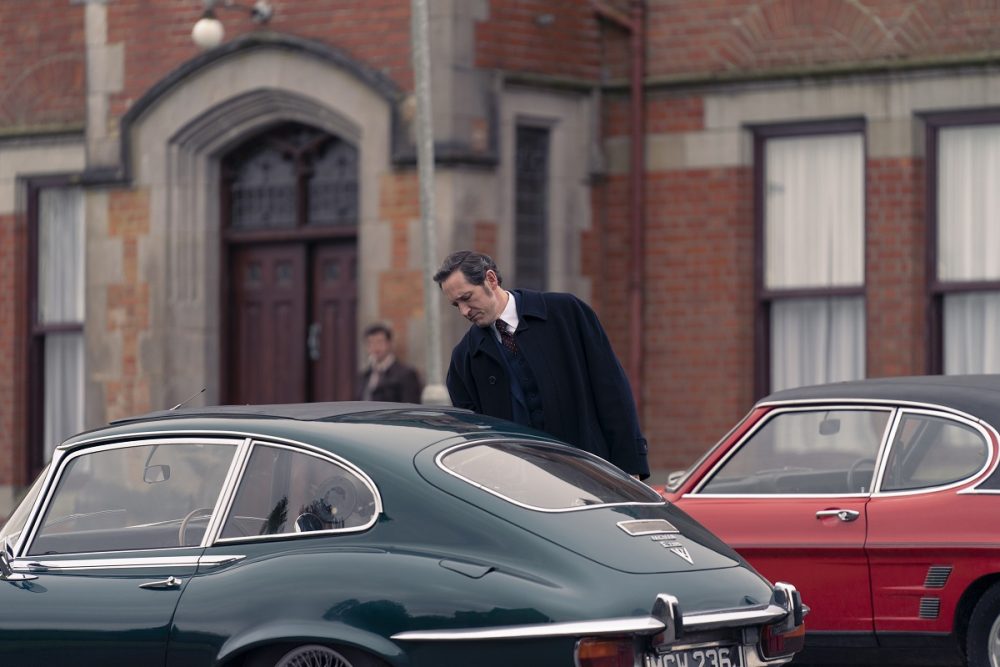
There’s a particular kind of pleasure in watching devoted enthusiasts argue about whether a fictional detective’s car actually suits him. When Channel 5’s Dalgliesh put Bertie Carvel behind the wheel of a British Racing Green Jaguar E-Type, one PistonHeads forum thread erupted almost immediately: “V12 E type is far too louche for the ascetic poet/philosopher who also happens to be a policeman,” argued the original poster, suggesting a Jensen or Bristol would have suited the character better. It’s a lovely, slightly niche row—and it exists because the TV production made a deliberate choice to give Adam Dalgliesh a car he never drove in P.D. James’s original novels.
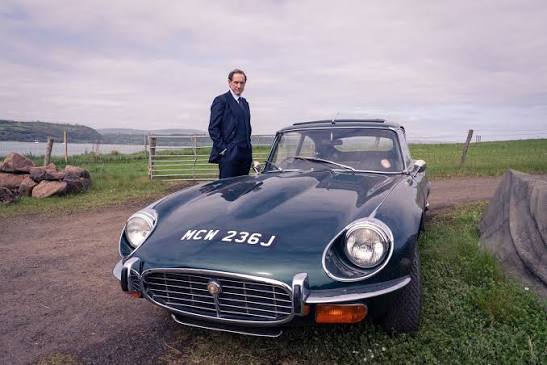
The Car: Jaguar E-Type Series III
Make/Model: Jaguar E-Type, Series III, 2+2
Screen Example: 1971 model, dark green (British Racing Green)
Registration: MCW 236J
Engine: 5.3-litre V12
Confirmed via: IMCDb.org, identified from Episode 1.01
Carvel’s Dalgliesh drives what enthusiast forums have described as a “concours resto”—a genuinely well-preserved, early manual example fitted with a Webasto sunroof, clearly sourced with some care by the production rather than simply hired as generic period dressing.
The Show: Dalgliesh
Network: Channel 5 (UK) / Acorn TV (US)
Created by: Helen Edmundson
Based on: The Adam Dalgliesh novels by P.D. James
Star: Bertie Carvel as Detective Chief Inspector (later Commander) Adam Dalgliesh
Premiered: 1 November 2021 (US), 4 November 2021 (UK)
Run: Three series, 18 episodes, adapting three novels per series
Setting: Mid-1970s England
Adam Dalgliesh is one of British crime fiction’s most distinctive detectives: a published poet and recent widower serving as a Metropolitan Police detective at New Scotland Yard, who solves crimes as much through empathy and psychological insight as through conventional procedure. Bertie Carvel’s performance leans fully into the character’s contradictions—an “enigmatic detective-poet,” austere and self-contained, carrying private grief beneath a controlled, watchful exterior. The series has adapted nine of James’s novels across three seasons, moving through cases including A Taste for Death, A Certain Justice, and The Murder Room.
Why the E-Type Doesn’t (Quite) Work—And Why That’s Interesting
This is a rare entry in the collection where the car’s fit is genuinely, openly contested by the people who watch closely:
A Deliberate Departure From the Books: In P.D. James’s original novels, Dalgliesh’s car changes over time—a Cooper Bristol in the earliest books, later a Jensen Healey, and eventually a Jaguar XJS. He never drives an E-Type in print. The TV production’s choice to give him one instead is a genuine adaptation decision, not a simple visual translation of the source material.
“Byronic Romanticism” vs. Ascetic Restraint: Multiple write-ups on the E-Type’s casting note that it “adds to his air of Byronic romanticism”—glamorous, dashing, faintly dangerous. But that’s arguably in tension with the character P.D. James actually wrote: a controlled, watchful, somewhat austere poet-policeman, more interested in the psychology of murder than in projecting charisma. The PistonHeads debate captures this tension precisely—an E-Type feels like exactly the kind of car a more flamboyant character would drive, not necessarily this one.
The In-Universe Justification: As one forum contributor pointed out, an honest 1970s Metropolitan Police detective’s salary alone wouldn’t stretch to an E-Type—but Dalgliesh is also a successful published poet, giving the production a plausible (if generous) explanation for how his character could actually afford one.
A Production Choice for Recognisability: One forum poster suggested a simpler explanation than character psychology: the producers likely wanted a car that the vast majority of viewers would instantly recognise as a period British icon, and few 1970s British cars carry that same instant, glamorous recognition value on screen the way an E-Type does—practical storytelling ahead of strict textual fidelity.
A Genuinely Well-Chosen Specific Car: Whatever the character debate, the production found and used an excellent example—a manual, sunroof-equipped, beautifully preserved Series III that enthusiast forums have specifically praised as looking like a proper concours restoration rather than a tired rental prop.
The Jaguar E-Type: Britain’s Most Celebrated Sports Car
Origins and the Sayer Legacy
Designed by aerodynamicist Malcolm Sayer and launched in March 1961, the Jaguar E-Type (marketed in North America as the XK-E) became an instant sensation, combining genuinely advanced engineering with sleek, sculptural styling derived from Jaguar’s own D-Type racing programme. Enzo Ferrari himself is famously said to have called it “the most beautiful car ever made”—a compliment from precisely the rival whose own cars the E-Type was priced to undercut. At launch, the E-Type cost around £2,250, a genuinely startling price for performance and looks that comfortably matched far more expensive continental exotica. Jaguar Cars were built at Browns Lane, Coventry, West Midlands – see historic images of Coventry on GhostViewer.
Three Series, One Icon
The E-Type evolved across three distinct series between 1961 and 1974:
- Series 1 (1961-1968): The original, with covered headlamps and the classic 3.8-litre (later 4.2-litre) straight-six
- Series 2 (1968-1971): Revised for emerging safety and emissions regulations—uncovered headlamps, larger air intake, repositioned bumpers
- Series 3 (1971-1974): The final and most significantly revised version, and the one Dalgliesh drives
The Series III: A New Engine, A New Character
Launched in 1971, the Series III introduced the first entirely new Jaguar engine since the original XK unit of 1948—a 5.3-litre, all-aluminium V12 with a single overhead camshaft per bank, fed by four Zenith-Stromberg carburettors. It was, at the time, the only V12 engine in mass production anywhere in the world, and Jaguar marketed the resulting car as the “Ultimate Cat,” emphasising its smoothness and near-silent running over outright aggression.
Accommodating the new engine required genuine structural changes: wider front and rear subframes, a wider track (borrowed partly from Jaguar’s saloon range), flared wheel arches, larger brakes, and a distinctive new slatted front grille that instantly identifies a Series III at a glance. The two-seater coupé body style was dropped entirely, leaving only the longer-wheelbase 2+2 coupé (Dalgliesh’s configuration) and the open roadster, both now sharing the same extended floorpan.
Performance was genuinely potent for the era: 314bhp at 6,200rpm, a top speed around 135-146mph depending on specification, and the option (unique among open E-Types) of a Borg-Warner automatic transmission—though Dalgliesh’s screen car, notably, is an early manual example.
Production and Legacy
A total of 15,287 Series III E-Types were built between 1971 and 1974, all at Jaguar’s Browns Lane works in Coventry, split between roadster and 2+2 coupé body styles. Production of the E-Type ended in 1974 with 50 specially commemorated final examples, each carrying a numbered dashboard plaque bearing founder Sir William Lyons’s own signature—closing out a model that had, by that point, spent thirteen years defining what a British sports car could be.
The Fan Debate, In Full
The PistonHeads thread that sparked much of this post’s framing is worth dwelling on a moment longer, because it captures something genuinely valuable about how devoted audiences engage with period detective drama. One contributor, having checked Wikipedia’s own account of the novels, noted with evident satisfaction that Dalgliesh drove “a Cooper Bristol and Jensen Healey” in the earlier books—vindicating the original poster’s instinct that something more restrained and specifically British would have suited the character better than a V12 showstopper. Another pushed back, suggesting the production likely wasn’t attempting deep characterisation through vehicle choice at all, simply reaching for whatever period car 90% of viewers would immediately recognise and admire.
Both readings are probably right, in their own way. The E-Type is, undeniably, a slightly glamorous swerve away from James’s more understated original conception of the character—and it’s also, undeniably, a magnificent thing to watch drive through 1970s England on a Sunday evening.
Why the E-Type (Still) Suits Dalgliesh, Sort Of
Even granting the fan critique real weight, there’s a case to be made that the E-Type isn’t quite as poor a fit as the PistonHeads thread suggests. Dalgliesh is a published poet as well as a policeman—a man whose interior life runs on aesthetic and emotional registers his colleagues don’t share. A car engineered as much for beauty as for outright competitive pace, driven by a man who processes grief and violence through verse, isn’t an entirely illogical pairing. It may not be the car P.D. James actually gave him, but it isn’t a wholly arbitrary one either.
Whether restrained ascetic or closet romantic, Dalgliesh gets to drive one of the most beautiful cars Britain ever built—and evidently, quite a few Jaguar enthusiasts wish the production had made a different choice regardless.
Technical Specifications: Jaguar E-Type Series III (2+2)
Manufacturer: Jaguar Cars Ltd
Designer: Malcolm Sayer
Production: 1971-1974 (Series III)
Series III Units Built: 15,287 (roadster and 2+2 combined)
Assembly: Browns Lane, Coventry, England
Body Style: 2-door 2+2 coupé (also offered as 2-door roadster)
Layout: Front-engine, rear-wheel drive
Construction: Unitary steel monocoque with front subframe
Engine: 5,343cc SOHC V12
Power: 314 bhp @ 6,200 rpm (as tested; later emissions-affected figures ranged 242-295 bhp)
Torque: 349 lb-ft @ 3,800 rpm
Fuel System: 4x Zenith-Stromberg 175 CD2SE carburettors
Transmission: 4-speed manual (screen car); Borg-Warner automatic optional
Top Speed: Approx. 135-146 mph
Suspension: Independent, all round
Brakes: Servo-assisted discs, all round
Screen Car: 1971 model, dark green, registration MCW 236J, manual with sunroof
See Also: Detective Cars on Screen
- Atticus Pünd’s Standard Ten & Susan Ryeland’s MGB – Magpie Murders’ dual-timeline pairing of a 1950s saloon and a 1960s roadster
- Will Davenport’s BSA A7 – Grantchester’s leather-jacketed vicar on two wheels
- Roy Grace’s Alfa Romeo 159 – The scruffy black Alfa of Brighton’s most troubled detective
- Phryne Fisher’s Hispano-Suiza – Miss Fisher’s glamorous red 1920s French luxury tourer
- “Hercules” – Father Brown’s Morris Minor Traveller – Mrs Devine’s beloved wood-framed workhorse from Kembleford
- Van der Valk’s Jeep Cherokee XJ – A battered American workhorse loose on Amsterdam’s canals
- Columbo’s Peugeot 403 Cabriolet – The rumpled LA detective’s deceptively rare French convertible
- Mack’s Mini Moke – Return to Paradise’s reluctantly inherited, hammer-started beach runabout
- Ben Cooper’s Volvo XC90 – Cooper & Fry’s understated Peak District family SUV
- Lily Petal’s Triumph Spitfire 1500 – The Hairdresser Mysteries’ yellow 1970s roadster
- Harry Wild’s BMW 3 Series E30 – Jane Seymour’s red 1980s BMW from Dublin’s literary detective drama
- Inspector Lynley’s Jensen Interceptor – The aristocratic detective’s British-American grand tourer
- Inspector Morse & Endeavour Jaguars – The burgundy Mk2 and later XJ6/XJ40 synonymous with Oxford’s finest detective
- Gene Hunt’s Ford Cortina – The Sweeney-style Ford from Life on Mars
- Rosemary & Thyme’s Land Rover Series III – The gardening detectives’ practical British 4×4
- Vera’s Land Rover Defender – The battered blue workhorse of Northumberland
- Bergerac’s Triumph Roadsters – Two different Triumph Roadsters both wearing Jersey registration J 1610
- Jonathan Creek’s Citroën 2CV – The windmill-dwelling magician’s green French minimalist runabout
- Whitstable Pearl’s 2CV Fourgonnette – The van variant of the 2CV used by Pearl’s seaside restaurant detective
- Queens of Mystery Morris Traveller – Matilda’s mother’s 1960s woodie, driven in every investigation
- The Coroner’s Land Rover – Jane Kennedy’s blue Series III soft top
- Lord Peter Wimsey’s Daimler Double-Six – “Mrs Merdle,” the aristocratic sleuth’s stately 12-cylinder saloon
- Foyle’s Humber Super Snipe – The elegant wartime saloon of Hastings
- More Detective Cars – Explore the complete collection
Further Reading
- WhatClassicCar.co.uk – Classic car reviews, buying guides, and market analysis
- Jaguar Enthusiasts’ Club (JEC) – Model history and technical resources for the E-Type
- IMCDb.org – Internet Movie Cars Database, the source for the screen car’s confirmed registration and identification
Dalgliesh airs on Channel 5 in the UK and Acorn TV in the US, based on P.D. James’s novels, with Bertie Carvel in the title role. The Jaguar E-Type Series III was produced from 1971-1974 at Jaguar’s Browns Lane works in Coventry, with 15,287 examples built. Whether or not it’s the car Adam Dalgliesh would actually have chosen for himself remains a genuinely lively point of disagreement among the show’s more detail-focused fans.