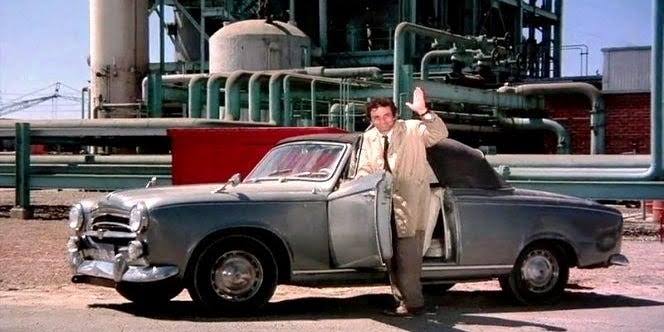
Los Angeles, 1971. Peter Falk, about to play a detective unlike any seen on American television before, wanders the Universal Studios back lot looking for a car. In a corner, abandoned and forlorn—faded paint, a hole in the hood, an engine that coughed rather than started—sits a beige Peugeot 403 Cabriolet. For anyone else, it’s scrap. For Falk, it’s instant recognition: this battered, unglamorous French convertible is exactly what Lieutenant Columbo would drive. Nearly every episode across more than three decades, that same beat-up Peugeot rattled onto the scene—and every time, it lulled a killer into a fatal mistake: underestimating the man behind the wheel.
The Car: Peugeot 403 Cabriolet
Make/Model: Peugeot 403 Cabriolet
Screen Years: 1959 model (Seasons 1-3), later joined/replaced by a 1960 model
Colour: Beige/faded tan
Registration: 044-APD (1959 car), later 448-DBZ (1960 car)
Designer: Pininfarina
Chosen by: Peter Falk himself, after spotting one abandoned in the Universal Studios parking lot
It became, in the words of one fan site, “battered and unbeautiful, eccentric and woeful looking, but still a classic”—a description that could just as easily apply to Columbo himself.
The Show: Columbo
Network: NBC (1968, 1971-1978), later ABC (1989-2003)
Star: Peter Falk as Lieutenant Columbo (first name never definitively confirmed)
Format: The “inverted detective story”—viewers see the murder committed in the opening minutes, then watch Columbo painstakingly piece together the case
Run: Officially 1968-2003, with the classic NBC run spanning 1971-1978
Signature elements: Rumpled beige raincoat, ever-present cigar, disarming “just one more thing” catchphrase, and a chronically neglected Basset Hound named Dog
Columbo’s genius lay in subversion. Rather than a slick, hard-charging investigator, Falk played a shambling, seemingly disorganised LAPD homicide detective who appeared to stumble his way through cases, forever misplacing notes and interrupting himself mid-sentence. His suspects—almost always wealthy, sophisticated, and supremely confident they’d committed the perfect murder—consistently mistook his scruffiness for incompetence. It was, of course, the entire strategy. Columbo’s dishevelled exterior, right down to the car he drove, was camouflage for one of television’s sharpest detective minds.
Why the Peugeot Works for Columbo
The choice of car wasn’t incidental set dressing—it was character work of the highest order:
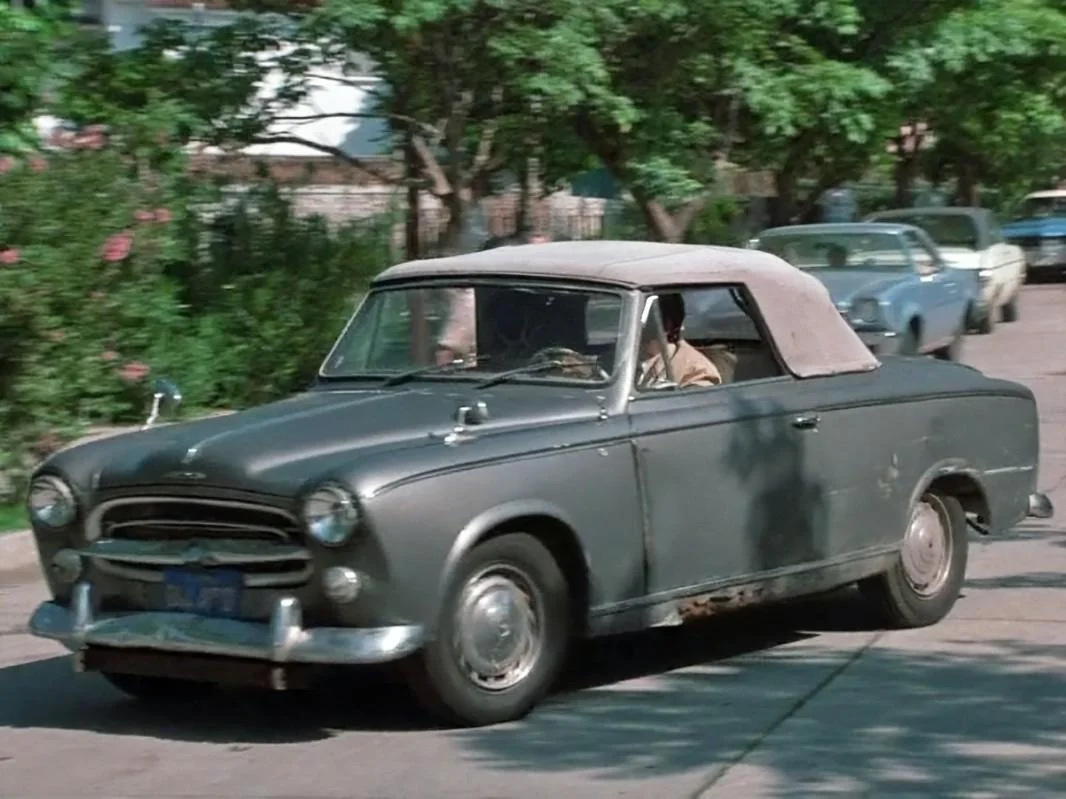
Part of the Disguise: Just as the rumpled raincoat and unlit cigar made Columbo look harmless, his tatty, coughing, faded convertible reinforced the same impression. No suspect worried about a detective who couldn’t get his own car to start reliably. That was precisely the point—it made wealthy killers drop their guard, certain this shabby little man posed no real threat.
Deliberately Unglamorous: This was the era of Rockford’s sleek Pontiac Firebird and Starsky and Hutch’s muscle-bound Gran Torino. Columbo, by contrast, drove something that looked like it belonged to a man who couldn’t afford anything better—an image entirely at odds with the sharp, well-resourced network detectives audiences were used to.
A Character in Its Own Right: The Peugeot developed its own on-screen personality—an engine that refused to start at dramatically inconvenient moments, a leaking soft-top, creaking doors. It became as recognisable and beloved a part of the show as Columbo’s coat or his cigar, a running gag and a comfort blanket in equal measure.
Continental, But Not Flashy: A French convertible was unusual enough on American streets in the early 1970s to feel distinctive without ever feeling expensive or aspirational—much like Columbo’s own understated brilliance, which nobody in the room ever quite expected.
Chosen With Instinct, Not Committee: The story of Falk personally spotting the car abandoned on the studio lot and immediately knowing it was right mirrors Columbo’s own investigative method—trusting a gut instinct that everyone around him dismisses, right up until it solves the case.
The Peugeot 403: A French Workhorse Turned Hollywood Icon
Pininfarina Styling and a Rejected Fiat
Unveiled on 20 April 1955 at the Trocadéro in Paris, the Peugeot 403 marked a genuine turning point for the company—it was Peugeot’s first model designed for large-scale export, and the beginning of a partnership with Italian coachbuilder Pininfarina that would shape Peugeot design for more than fifty years. The 403 featured clean, contemporary “ponton” three-box styling, a departure from the more rounded, old-fashioned lines of its predecessor, the 203.
There were persistent, never fully confirmed rumours in period that the 403’s overall shape had originally been developed by Pininfarina for a proposed Fiat 1900 replacement, only for Fiat to shelve those plans and defer replacing the 1900 for several more years—leaving Pininfarina’s design available, and Peugeot happy to take it.
From Family Saloon to Sales Milestone
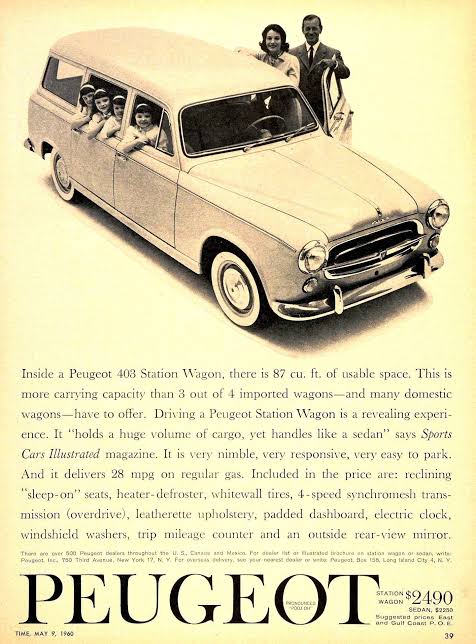
The 403 was built as a genuine family workhorse first and foremost: a 4-door sedan, a 5-door estate (“Familiale,” which included fully reclinable front seats and a manual column shift), a 2-door pickup, and a 3-door van, in addition to the cabriolet that would later find fame on American television. It became the first Peugeot to sell over one million units, and by the time production ended in October 1966, a remarkable 1,214,121 examples had been built across Peugeot’s plant in Sochaux, France, along with additional assembly in Australia, Argentina, New Zealand, and Uruguay.
The 403 also holds a genuinely important place in French automotive history: it was the first mass-produced French car available with a diesel engine, a significant step for the industry.
The Cabriolet: A Rare and Expensive Outlier
Where the 403 sedan and estate were built by the hundreds of thousands, the cabriolet was an altogether different proposition. Debuting in August 1956, it was built primarily by Pininfarina in Italy, with the first ten pre-series examples handled by French coachbuilder Marcel Portout. Production ran only until the spring of 1961, when it was superseded by a drop-top version of the newer Peugeot 404—and across that entire run, only around 2,030 to 2,050 examples were built, depending on the source consulted.
The cabriolet was a genuine luxury proposition within the 403 range. In 1958, it cost a full 80% more than the entry-level “berline grand luxe” sedan, and came with a distinctly upmarket specification to match—high-quality leather upholstery, more finished trim, and the kind of styling flourish the humble family saloon never aspired to. It’s precisely this rarity and relative extravagance that makes the sight of Columbo, in his crumpled raincoat, driving one so deliciously incongruous: a scruffy detective in what was, when new, one of the more expensive things Peugeot made.
Engineering Underneath the Elegance
Beneath the Pininfarina bodywork, the 403 was engineered with genuine sophistication for its era. The primary engine was a 1,468cc inline-four of advanced design for the mid-1950s—over-square dimensions, overhead valves, and hemispherical combustion chambers, producing around 65hp at roughly 5,000rpm and 75 lb-ft of torque at 2,500rpm. It ran on wet cylinder liners, and even featured a thermostatically controlled engine fan—an unusual refinement for the period, cutting out below 75°C and re-engaging at 84°C, which Peugeot claimed improved fuel economy by 5-10% while also cutting fan noise.
A smaller 1,290cc engine was offered on some markets and derivatives, and from the early 1960s a 1,816cc diesel became available—directly tied to the model’s status as France’s diesel pioneer. All 403s used a 4-speed manual gearbox.
The car rode on a 2,660mm wheelbase (2,900mm for the estate) and measured 4,470mm long in saloon form. It was solidly, conservatively engineered—reliability and durability were the 403’s watchwords far more than outright performance, and by most contemporary accounts it delivered handsomely on both counts. One period detail that speaks to changing safety attitudes: the 403 originally carried a distinctive, forward-leaning chrome lion hood ornament on its nose, echoing Peugeot’s badge—removed after 1958 amid growing concern over pedestrian safety, with the lion motif relocated to a shield-shaped grille emblem instead.
Not Built for Speed—And That Suited Columbo Fine
By the standards of American television in the early 1970s, the Peugeot 403 Cabriolet was decidedly leisurely. Contemporary road tests suggested a top speed around 80mph and a 0-60mph time north of 20 seconds—figures that would have looked positively arthritic next to the muscle cars other TV detectives drove. But outright pace was never remotely the point. Columbo wasn’t chasing anyone down at speed; he was quietly, patiently closing in on people who thought they’d gotten away with murder. A car that wheezed rather than roared suited that rhythm perfectly.
Two Cars, Two Number Plates
Eagle-eyed fans have long noted that Columbo’s Peugeot wasn’t a single, unchanging vehicle across the show’s run. The series began with a 1959-model 403, identifiable by its black soft-top and door mirrors mounted up on the front fenders, carrying registration 044-APD. Fairly early in the run, production shifted to a 1960 model, distinguishable by its lighter-coloured top and door-mounted mirrors in the more conventional position, now wearing plate 448-DBZ. Notably, Columbo was still seen driving the original 1959 car as late as Season 3’s “Any Old Port in a Storm,” suggesting both vehicles remained in rotating use for some time rather than one being definitively retired.
Universal Studios owned the primary car, reportedly transporting it to location shoots carefully by trailer rather than risking it under its own power—itself a nice irony, given how unreliable the car was written to be on screen. At least two or three additional examples are believed to have been leased from Peugeot directly to serve as backups and stunt doubles, meaning the “one battered Peugeot” of popular memory was, behind the scenes, likely several cars sharing a single identity.
Whatever Happened to Columbo’s Peugeot?
The fate of the original 1959 screen car remains genuinely uncertain, and something of an enduring mystery among fans of the show. Some sources claim it was sold at auction in 1990 for $7,000. Others insist it was never sold at all, and instead languished in Universal’s possession, reportedly spotted slowly deteriorating in a storage lot in Ensenada, Mexico. Enthusiasts have periodically attempted to track down and restore the genuine article, without confirmed success. A 1960 example, believed to be one of the show’s cars, is known to be in private ownership in Florida—though given how many Peugeots were used across the show’s run, it’s entirely possible more than one surviving “Columbo car” exists in private hands today.
Peter Falk and the Character Who Defined Him
Peter Falk played Lieutenant Columbo across an extraordinary span of American television—from the character’s earliest appearances in the late 1960s through television movies stretching into the early 2000s. The role earned Falk multiple Emmy Awards and cemented Columbo as one of the most beloved and instantly recognisable detectives in television history, precisely because he inverted every expectation of what a TV detective should look and sound like.
The Peugeot was, by Falk’s own account and by the enduring affection of fans, a genuine piece of that characterisation rather than a prop chosen by a studio transport department. He picked it out himself, on instinct, the same way his character solved every case.
The 403 Cabriolet Today: A Genuine Rarity
With only around 2,030-2,050 cabriolets built across the model’s entire production run, surviving examples are scarce and highly sought after by collectors of both classic French automobiles and television memorabilia. Auction houses handling 403 Cabriolets have specifically noted the model’s popularisation through Columbo as a meaningful factor in collector interest and, by extension, value—a rare case of a supporting TV prop measurably boosting a classic car’s desirability decades after the fact. Well-preserved, original examples with documented history routinely draw serious international bidding whenever they come to market.
Why the Peugeot 403 Cabriolet Suits Columbo
The genius of Columbo’s Peugeot lies in the gap between what it appears to be and what it actually is—precisely Columbo’s own genius, applied to a car instead of a man. On paper, the 403 Cabriolet was never a cheap or humble machine; when new, it was one of the more expensive, more elegantly styled things in Peugeot’s entire range, hand-finished by an Italian design house with a client list that would eventually include some of the most beautiful cars ever built. But dressed down, faded, and left to wheeze and splutter on camera, it read as exactly the kind of car nobody would ever suspect belonged to the sharpest detective in the room.
That’s the trick, every single time. Underestimate the coat. Underestimate the cigar. Underestimate the car. And by the time you’ve finished doing all three, Columbo already has his man. See the cast of all episodes.
Technical Specifications: Peugeot 403 Cabriolet
Manufacturer: Peugeot SA
Body Design: Pininfarina (production largely handled by Pininfarina in Italy; first 10 pre-series units by Marcel Portout, France)
Cabriolet Production: August 1956 – Spring 1961
Cabriolet Units Built: Approximately 2,030-2,050
Total 403 Production (all body styles): 1,214,121 units (1955-1966)
Assembly: Sochaux, France (main plant); Pininfarina, Turin (cabriolet body)
Body Style: 2-door convertible
Layout: Front-engine, rear-wheel drive
Dimensions (saloon reference):
- Wheelbase: 2,660 mm (104.7 in)
- Length: 4,470 mm (176.0 in)
- Width: 1,670 mm (65.7 in)
- Height: 1,510 mm (59.4 in)
Engine: 1,468cc inline-four (TN3/XB2), OHV, hemispherical combustion chambers, wet cylinder liners
Power: Approx. 60-65 hp at ~5,000 rpm
Torque: Approx. 75 lb-ft at 2,500 rpm
Transmission: 4-speed manual (column shift)
Top Speed: Approx. 80 mph
0-60 mph: 20+ seconds
Screen Registrations: 044-APD (1959 car), 448-DBZ (1960 car)
See Also: Detective Cars on Screen
- Mack’s Mini Moke – Return to Paradise’s reluctantly inherited, hammer-started beach runabout
- Ben Cooper’s Volvo XC90 – Cooper & Fry’s understated Peak District family SUV
- Lily Petal’s Triumph Spitfire 1500 – The Hairdresser Mysteries’ yellow 1970s roadster
- Harry Wild’s BMW 3 Series E30 – Jane Seymour’s red 1980s BMW from Dublin’s literary detective drama
- Inspector Lynley’s Jensen Interceptor – The aristocratic detective’s British-American grand tourer
- Inspector Morse & Endeavour Jaguars – The burgundy Mk2 and later XJ6/XJ40 synonymous with Oxford’s finest detective
- Gene Hunt’s Ford Cortina – The Sweeney-style Ford from Life on Mars
- Rosemary & Thyme’s Land Rover Series III – The gardening detectives’ practical British 4×4
- Bergerac’s Triumph Roadsters – Two different Triumph Roadsters both wearing Jersey registration J 1610
- Jonathan Creek’s Citroën 2CV – The windmill-dwelling magician’s green French minimalist runabout
- Whitstable Pearl’s 2CV Fourgonnette – The van variant of the 2CV used by Pearl’s seaside restaurant detective
- Queens of Mystery Morris Traveller – Matilda’s mother’s 1960s woodie driven in every investigation
- Vera’s Land Rover Defender – The battered blue workhorse of Northumberland
- The Coroner’s Land Rover – Jane Kennedy’s blue Series III soft top
- Lord Peter Wimsey’s Daimler Double-Six – “Mrs Merdle,” the aristocratic sleuth’s stately 12-cylinder saloon
- Foyle’s Humber Super Snipe – The elegant wartime saloon of Hastings
- More Detective Cars – Explore the complete collection
Further Reading
- WhatClassicCar.co.uk – Classic car reviews, buying guides, and market analysis
- Pininfarina Heritage – Design house archive covering the 403 and the wider Peugeot partnership
- Peugeot Heritage – Official Peugeot history resources
Columbo aired on NBC from 1968-1978 and later on ABC from 1989-2003, starring Peter Falk in his defining role. The Peugeot 403 Cabriolet was produced in just over 2,000 examples between 1956 and 1961, making it one of the rarer models Peugeot ever built—a fitting piece of trivia for a car that spent its screen life pretending to be worthless. If you’re fortunate enough to find a genuine 403 Cabriolet today, expect serious collector interest; unlike its screen persona, the real thing was never anything less than desirable.
This article is part of the Detective Cars collection on CozycrimeIndex.com.