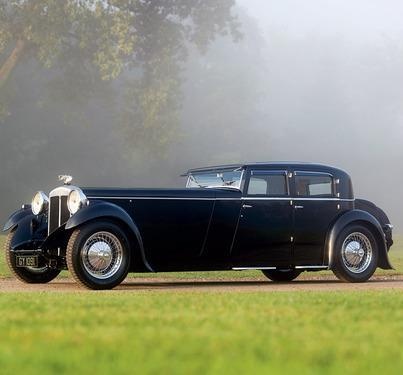
In Dorothy L. Sayers’s beloved detective novels adapted for television by the BBC between 1972 and 1975, aristocratic amateur sleuth Lord Peter Wimsey drove one of the most impressive motorcars of the interwar period—a 1927 Daimler Double-Six that he affectionately named “Mrs Merdle” after a character in Charles Dickens’s Little Dorrit who had an “aversion to row.” The name perfectly suited Lord Peter’s preference for a silent car that never made a fuss, reflecting both his appreciation for mechanical sophistication and his whimsical sense of humour.
The Daimler Double-Six was Britain’s first V12 engine designed purely for automotive use, announced in October 1926 as The Daimler Company Limited’s masterpiece confirming its position at the top of the British motor industry. The car caused a sensation—it was in a class of its own, competing directly with Rolls-Royce’s New Phantom whilst offering something distinctively different: the innovative sleeve-valve technology that gave Daimler engines their legendary smoothness and near-silent operation.
Lord Peter’s 1927 model featured a 7.1-litre sleeve-valve V12 engine—an extraordinary piece of engineering created by chief engineer Laurence Pomeroy, who essentially took two existing Daimler six-cylinder engines and mounted them on a common crankcase. Unlike conventional engines with poppet valves that required regular maintenance and created mechanical noise, the sleeve-valve design used sliding sleeves with cutouts that aligned with inlet and exhaust ports, operated by eccentrically-driven rods. This ingenious system produced what motoring journalists of the era described as an “astonishing degree of smoothness and quietness,” allowing Daimler owners to “leisurely survey the moving surface of the earth through the windows of their Daimler Double-Sixes as they pass onward in silent dignity.”
The Double-Six was upholstered in what Dorothy L. Sayers herself described as “a style of sober magnificence”—befitting a car driven by the second son of a Duke. These were bespoke vehicles built in extremely limited numbers (approximately 500 chassis across all variants between 1926 and 1938), appealing to royalty, aristocrats, and industrial magnates during the economic boom of the 1920s. Initial models were priced around £2,800—an astronomical sum representing several years’ wages for ordinary workers—and fewer than ten of the very first examples were produced.
Performance was remarkable for such a large luxury car. Contemporary road tests reported that the big Double-Sixes needed no other gears once rolling, even when climbing hills, and could achieve “2 to 82 mph in top gear in the highest degree of smoothness and quietness.” Petrol consumption was surprisingly economical for a V12 at around 10 miles per gallon—not savage by 1920s standards for a car of this size and power. The bonnet was famously enormous—reported to be up to ten feet long—creating what one modern commentator described as “the car of a man who is over-compensating,” though in Lord Peter’s case it perfectly matched his theatrical personality and genuine appreciation for engineering excellence.
Lord Peter liked driving fast, and the powerful Daimler suited both his aristocratic status and his love of modern technology. The car represented the perfect marriage of traditional British craftsmanship with cutting-edge innovation—much like Wimsey himself, who combined old-world manners with thoroughly modern detective methods. The Double-Six could be driven sedately with impeccable dignity befitting a peer of the realm, or pushed to surprising speeds when Lord Peter’s investigations required haste.
Distinguishing features included duplicated components for reliability and balance—two seven-jet carburettors, two water pumps, two magnetos, and separate exhaust systems, with each bank of cylinders having its own components. From 1929 onwards, Double-Sixes were distinguishable from Daimler’s six-cylinder cars by a chromium bar down the centre of the radiator grille—a visual signature of V12 ownership that announced the driver’s membership in Britain’s most exclusive motoring club.
Dorothy L. Sayers wrote about creating the car for her detective with characteristic wit: “When I had no money to pay my bus fare I presented him with a Daimler double-six, upholstered in a style of sober magnificence, and when I felt dull I let him drive it. I can heartily recommend this inexpensive way of furnishing to all who are discontented with their incomes. It relieves the mind and does no harm to anybody.” By the time of Busman’s Honeymoon, readers learned that Lord Peter had owned nine successive Daimlers, all christened “Mrs Merdle,” demonstrating his loyalty both to the marque and to the name that so perfectly captured his automotive philosophy.
The Daimler Company had enjoyed royal patronage since King Edward VII awarded them the royal warrant in 1902, making Daimler the British monarch’s preferred marque throughout the early twentieth century. Lord Peter’s choice of a Daimler rather than a Rolls-Royce or Bentley reflected both his establishment credentials and his discerning taste—Daimlers were driven by those with nothing to prove, whose status was secure enough that they valued engineering excellence and refined silence over showy ostentation.
In the BBC television adaptations, the Daimler became as much a part of Lord Peter’s character as his monocle or his loyal valet Bunter. The car represented freedom, modernity, and the ability to pursue investigations across England with independence and speed. Whether rushing to Yorkshire to save his brother from a murder charge or racing through the Fenlands to solve a churchyard mystery, Lord Peter and “Mrs Merdle” made an unforgettable partnership—the ultimate British gentleman detective in the ultimate British luxury motorcar, both representing the finest achievements of their respective crafts in that extraordinary period between the wars when style, engineering, and character combined to create legends that endure nearly a century later.
