When Jane Seymour roars through the streets of Dublin in Harry Wild, she’s behind the wheel of one of the most iconic BMWs ever built: a vintage red BMW 3 Series E30. For a retired literature professor turned foul-mouthed private investigator, it’s the perfect companion—stylish enough for a woman who knows quality, practical enough for stakeouts and car chases, and with just enough character to match Harry’s own unconventional approach to detective work.
The Car: Red BMW 3 Series (E30)
Make/Model: BMW 3 Series E30 (Second Generation, “Mark II”)
Production Years: 1982-1994
Harry’s Car: Red, 1980s model (specific year unconfirmed)
Body Style: Various available (2-door, 4-door sedan, convertible from 1985, Touring wagon from 1987)
Designer: Claus Luthe
First Spotted: May 2021 during filming in Dublin, Ireland
The E30 is widely regarded as one of BMW’s greatest achievements. Where the E21 introduced the 3 Series name, the E30 cemented the car’s reputation as the benchmark compact executive sport sedan. It’s the car that made BMW synonymous with “the ultimate driving machine.”
The Show: Harry Wild
Network: Acorn TV Original
Premiered: 4 April 2022
Current Status: Five seasons confirmed (Season 5 filming 2025, due 2026)
Star: Jane Seymour (age 73) as Harriet “Harry” Wild
Character: Retired literature professor with a knack for solving mysteries
Sidekick: Fergus Reid (Rohan Nedd) – the teenager who originally mugged her
Setting: Dublin, Ireland and County Kildare
Character Notes: Whiskey-drinking, foul-mouthed, “not your typical grandmother”
The show follows Harry Wild, a recently retired English literature professor who discovers an unexpected talent for detective work after being mugged. While recovering at her police detective son Charlie’s house, she gleans clues from his current murder case—and when he dismisses her insights, she decides to solve it herself. Instead of turning in her mugger, young Fergus Reid, she recruits him as her partner. Together, this mismatched pair solve literary-themed murders across Dublin, with Harry using her knowledge of Shakespeare, Dostoevsky, and classic literature to crack cases that baffle the Garda.
Jane Seymour fractured her kneecap during filming but kept working—much like Harry herself would have done.
Why the BMW E30 Works for Harry Wild
The BMW E30 is perfect for Harry Wild’s character. It’s:
Sophisticated Without Being Stuffy: The E30 was always the thinking person’s sports sedan. In the 1980s and 1990s, it was what doctors, architects, and yes, university professors drove. It signals taste and intelligence—but not the kind of stuffiness Harry rejects in her retirement.
Practical Yet Spirited: With rear seats for Fergus and enough boot space for stakeout supplies, it’s utterly functional. But with BMW’s legendary straight-six engines available (and even the four-cylinder models being peppy), it can move when Harry needs to chase down a suspect or flee from danger.
A Car With Stories: The E30 isn’t a generic modern crossover. It’s a car with history, character, and personality—qualities Harry embodies herself. An older car suggests someone who values substance over fashion, who’s comfortable with herself and doesn’t need the latest shiny thing.
Dublin-Appropriate: In Ireland’s capital, where narrow Georgian streets and tight parking are daily realities, the E30’s compact dimensions make sense. It’s small enough to navigate Dublin’s medieval core yet substantial enough to feel safe and capable.
Still Going Strong: That a 1980s BMW is still on the road in the 2020s tells you everything about its build quality. Harry, at 70+, is also still going strong—and proving that age doesn’t diminish capability or style.
The red colour adds a flash of personality and defiance. This isn’t a detective trying to blend in. This is a woman who drinks whiskey at the pub, swears like a sailor, and doesn’t care what anyone thinks.
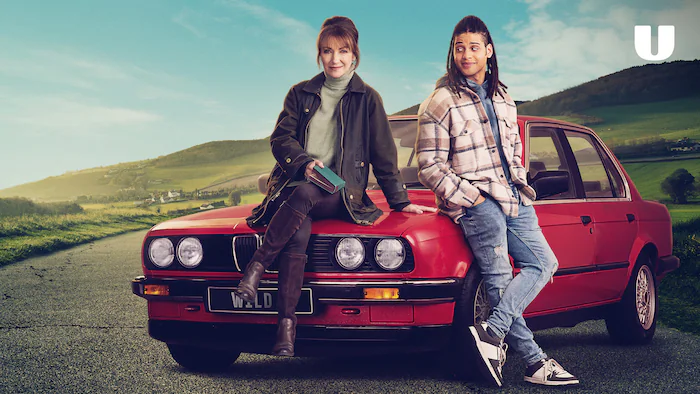
The BMW E30: Engineering Excellence Meets ’80s Style
Design Philosophy
The E30 was designed by Claus Luthe, one of post-war Europe’s most influential car stylists. Before joining BMW, he’d worked for NSU and Volkswagen, bringing a fresh perspective to Bavarian conservatism.
The E30 softened the “sharknose” aggression of earlier BMWs, replacing it with a bluffer, more upright front end. But it retained BMW’s signature kidney grille, twin headlights (on most models), and that distinctive Hofmeister kink on the C-pillar—the little forward kick in the rear side window that’s been a BMW trademark since the 1960s.
The design was clean, purposeful, and remarkably free of unnecessary decoration. In an era of angular wedge shapes and digital dashboards, the E30 was refreshingly straightforward. It looked expensive without being ostentatious—perfect for professionals who wanted quality without flash.
Body Styles: Something for Everyone
The E30 evolved throughout its production run:
1982: Launch as 2-door sedan
1983: 4-door sedan added
1985: Factory convertible introduced (replacing Baur conversions)
1987: Touring (wagon) added with “Series 2” facelift
1986: The legendary M3 variant unveiled
By the end of production, you could buy an E30 as a two-door or four-door sedan, a convertible with a manual or electric hood, or a practical Touring wagon—the first factory BMW estate car, which started life as an engineer’s garage project.
The Heart of the Matter: E30 Engines
This is where the E30 truly shines—and why the user noted “lots of different engine sizes available.” BMW offered an extraordinary range of powerplants:
Four-Cylinder Engines
M10 Series (1982-1987)
The M10 was a venerable carryover from the E21, with roots stretching back to the 1960s. By the 1980s, it was ancient but reliable:
- 316: 1.8L (1766cc), carburettor, 90 PS (66 kW) – The budget entry model
- 318i: 1.8L (1766cc), Bosch L-Jetronic fuel injection, 105 PS (77 kW)
These engines were never thrilling. Carbureted 316s felt particularly wheezy. But they were economical, durable, and kept E30 ownership affordable for younger buyers.
M40 Series (1987-1991, “Series 2” cars)
BMW replaced the M10 with the more modern M40 SOHC engine:
- 316i: 1.6L (1596cc), 102 PS (75 kW)
- 318i: 1.8L (1796cc), 116 PS (85 kW) – Incorporated Motronic fuel injection
The M40 was lighter, more efficient, and smoother than the M10. The 318i with the M40 engine became one of the most popular E30 variants—quick enough to be entertaining, economical enough to run daily, and with that characteristic BMW eagerness to rev.
M42 Series (1989-1991)
An advanced DOHC four-cylinder offering better performance and refinement.
S14 Series (M3 and 320iS)
The legendary M3 engine deserves special mention:
- M3 (1986-1989): 2.3L (2302cc), 195 PS (143 kW) – The original legend
- M3 Evolution (1988): 2.3L, 220 PS (162 kW)
- M3 Sport Evolution (1990): 2.5L (2467cc), 238 PS (175 kW) – The ultimate E30
The S14 was a high-revving, motorsport-derived four-cylinder that could spin to 7,000+ rpm. It made the M3 the most successful touring car racer of its era and a street-legal legend.
A detuned version was used in the 320iS (Portugal and Italy only, to avoid high-displacement taxes): 2.0L, 192 PS—essentially an M3 in budget-friendly packaging.
Six-Cylinder Engines
The straight-six E30s were where BMW truly showed its colours. The inline-six was smooth, torquey, and had that glorious BMW growl:
M20 Series (1982-1991)
BMW’s workhorse straight-six came in multiple displacements:
- 320i: 2.0L (1990cc), various outputs depending on market and year (around 125-129 PS)
- 323i: 2.3L (2316cc), 139-150 PS (102-110 kW)
- 325i: 2.5L (2494cc), 170-171 PS (125-126 kW)
- 325e (“eta”): 2.7L (2693cc), 122 PS but massive torque for economy
The six-cylinder E30s transformed the car. They were smooth, refined, and genuinely quick. The 325i could hit 100 km/h (62 mph) in around 7.5 seconds—rapid for the 1980s. More importantly, they had that intoxicating straight-six soundtrack and the smoothness that only an inline-six can provide.
The 325e was BMW’s attempt at efficiency. The “eta” engine prioritized torque and economy over outright power, making it perfect for long-distance cruising. It wasn’t fast, but it was thrifty and unstressed.
Diesel Engines
324d: 2.4L straight-six diesel, 86 PS
324td: 2.4L turbodiesel, 115 PS
The E30 was the first 3 Series to offer diesel power. While never quick, the diesels were economical and practical—popular in Europe but rare elsewhere.
All-Wheel Drive
325iX (1985-1991): BMW’s first AWD 3 Series, using a viscous coupling system and the 325i engine (171 PS). It added weight but provided all-weather capability—revolutionary for BMW at the time.
Transmission Options
BMW offered flexibility:
- 5-speed manual: Standard across the range (even the base 316)
- 4-speed automatic: Available on most models
- 3-speed automatic: Early cars only
The manual was the enthusiast’s choice—precise, with a lovely mechanical feel. BMW even placed first gear at bottom-left, racing-style, in the M3.
Living With an E30: The Good and the Bad
The Good
Driving Dynamics: Even the base-model E30s handled beautifully. The steering was direct and communicative, the chassis balanced and adjustable. On twisty roads, E30s rewarded skilled drivers with poise and precision.
Build Quality: BMWs of the 1980s were robustly built. Panel gaps were tight, doors closed with a satisfying thunk, and the interior felt solid. BMW used quality materials—proper carpet, thick plastics, and durable switchgear.
Character: The E30 has personality. From the tilted-towards-driver dashboard to the precise gearshift to the way the straight-six pulls smoothly from 2,000 rpm, it feels special in ways modern cars often don’t.
Versatility: With four body styles and a vast engine range, there was an E30 for everyone—from the budget 316 student car to the M3 homologation special to the practical 325i Touring family wagon.
Tunability: The E30 has a massive aftermarket. Upgrading suspension, brakes, wheels, or even engine swaps (M50, S50, or even S54 conversions) is well-documented. Many E30s have been transformed from mild-mannered commuters into track weapons.
Collectability: The E30—especially the M3, but increasingly even clean six-cylinder models—is now a modern classic. Values have been rising steadily. A well-maintained E30 is an appreciating asset.
The Bad
Rust: This is the E30’s Achilles heel. Early cars (1982-1986) had poor rust protection. Common rust spots include:
- Sills (rocker panels)
- Wheel arches (especially rear)
- Battery tray
- Suspension turrets in the engine bay
- Boot floor
- A-pillars
- Sunroof surround (if fitted)
The 1987 “Series 2” facelift improved galvanization, but rust remains a serious concern. Any E30 purchase should involve thorough inspection underneath.
Dated Four-Cylinders: The M10 four-cylinder engines feel ancient by modern standards. They’re noisy, slow, and thirsty relative to their modest power output. Even the M40 is fairly basic. If you want a truly enjoyable E30, get a straight-six.
Parts Availability: While the E30 community is strong and many parts are available, some trim pieces, interior fabrics, and body panels are getting harder to find. Original paint colors can be expensive to match.
Crashworthiness: 1980s safety standards were primitive compared to today. E30s have no airbags, minimal crumple zones, and old-fashioned seatbelts. They’re wonderful to drive but not crash-compatible with modern vehicles.
Overheating Issues: E30s with automatic transmissions can suffer cooling system failures—especially in hot climates. The plastic cooling system components (expansion tank, radiator necks) become brittle with age.
Interior Quirks: Dashboard cracks are common if exposed to sun. Cigarette burns in upholstery (it was the 1980s—everyone smoked) are widespread. Some interior fabrics are impossible to source.
Electrical Gremlins: Like many 1980s cars, E30s can develop electrical issues—failing window regulators, dodgy central locking, temperamental instrument clusters.
The 1987 “Series 2” Facelift
In September 1987 at the Frankfurt Motor Show, BMW updated the E30 significantly:
Styling Changes:
- New front bumper design
- Redesigned rear lights (larger, more modern)
- Revised rear apron
- Chrome window trim deleted
- Updated headlight reflectors
Mechanical Updates:
- M10 four-cylinder replaced by M40
- Improved rust protection (better galvanization)
- Introduction of the Touring (wagon) body style
- Removal of the 325e from the lineup
North American Market received additional changes:
- 1987: Shortened “diving board” aluminum bumpers
- 1989: Aluminum bumpers replaced entirely by shorter body-colored plastic units
The Series 2 cars are generally more desirable—better engines, improved rust resistance, and more modern styling. However, early cars have their own charm and are increasingly collectible.
The E30 M3: A Legend Deserving Special Mention
Though Harry Wild drives a standard E30, the M3 variant deserves recognition as one of the greatest performance cars ever built.
Development: BMW Motorsport needed a homologation special for Group A touring car racing. They took a two-door E30, widened the bodywork, fitted massive box flares, added an aggressive rear spoiler, and dropped in the race-bred S14 engine.
Engine: The S14 four-cylinder was based on the M10 block but completely reworked—DOHC, four valves per cylinder, individual throttle bodies, 7,000+ rpm redline. It produced 195 PS in standard form, with Evolution and Sport Evolution models pushing to 238 PS.
Suspension: Completely redesigned with five-lug hubs, wider track, stiffer springs, and revised geometry. The M3 suspension shares almost nothing with regular E30s.
Racing Success: The E30 M3 dominated touring car racing from 1987-1992, winning championships in DTM, British Touring Car, European Touring Car, and countless national series worldwide. It remains the most successful touring car ever built.
Road Car: Despite its racing pedigree, the M3 was a brilliant road car—usable daily, surprisingly comfortable, yet thrilling when pushed. The S14 engine was a jewel—eager to rev, sonorous, and incredibly responsive.
Collectibility: E30 M3s are now six-figure cars in good condition. Sport Evolution models command even more. They’re investments as much as cars.
Special Editions: BMW produced numerous M3 special editions—Cecotto, Europameister, Ravaglia, and more—each commemorating racing victories. These are even rarer and more valuable.
The M3 proved that a four-cylinder could be as exciting as a six-cylinder, that a homologation special could be a great road car, and that BMW Motorsport understood driving pleasure at the deepest level.
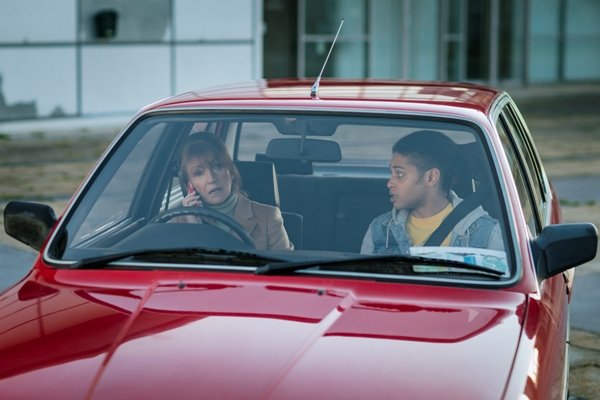
Filming Locations: Harry Wild’s Dublin
The E30 is filmed primarily in Dublin and surrounding areas:
Primary Location: Dublin, Ireland
County Kildare: Various locations used throughout the series
Brennan’s Kilteel Inn: Main Street, Kilteel, County Kildare—rebranded as “The Hairy Goose” pub for filming (a regular hangout for Harry)
Harbour Bar: Howth, County Dublin (coastal suburb north of city centre)
Harry Wild is filmed entirely in Dublin and its surroundings, giving the BMW E30 authentic Irish city streets as its backdrop—narrow Georgian terraces, cobbled laneways, waterfront drives along the Liffey and Dublin Bay, and the green countryside of Kildare. The E30’s compact dimensions make it perfect for Dublin’s tight medieval core and crowded residential areas.
Jane Seymour: From Bond Girl to Detective in a BMW
Jane Seymour, now 73, brings gravitas and wit to Harry Wild. She’s best known for:
- Solitaire in Live and Let Die (1973) opposite Roger Moore
- Dr. Quinn, Medicine Woman (1993-1998)—her most iconic role
- *Somewhere in Time (1980) with Christopher Reeve
- Recent work in The Kominsky Method alongside Michael Douglas
Seymour is also an executive producer on Harry Wild, giving her creative control over the character. She’s stated this is her most exciting role since Dr. Quinn—and you can see why. Harry Wild is sexually active, intellectually sharp, physically capable, and completely uninterested in conforming to anyone’s expectations of how a 70-year-old woman should behave.
The show has been a massive success for Acorn TV, ranking among the platform’s top 10 most-watched seasons of all time. Season 5 is currently filming in Dublin and will debut in 2026.
The E30 Today: Classic Status Achieved
The BMW E30 3 Series has firmly entered modern classic territory. Prices have risen dramatically:
Market Values (approximate, varies by condition/model):
- 316/318i (four-cylinder): £5,000-£15,000 for decent examples
- 320i/323i (six-cylinder): £8,000-£20,000
- 325i/325e (large six-cylinder): £10,000-£25,000+
- 325i Touring: £12,000-£30,000+ (rarest and most practical)
- Convertibles: £10,000-£35,000+ depending on condition
- M3 (standard): £50,000-£100,000+
- M3 Sport Evolution: £150,000-£250,000+
Rust-free, original examples command premiums. Modified cars are worth less unless tastefully upgraded.
Racing Heritage and Motorsport Success
Beyond the M3’s dominance, E30s excelled in grassroots motorsport:
Club Racing: E30s are hugely popular in club racing and track days. Their balance, parts availability, and tunability make them ideal track cars.
Spec E30: In the USA, the National Auto Sport Association runs a Spec E30 racing series using 325i/325is models with specific modifications. It’s affordable, competitive, and produces incredible racing.
Drifting: The E30’s rear-wheel drive, balanced chassis, and abundance of engine swap options make it a drift car favorite. E30s with LS V8 swaps or turbocharged M50/S50 engines are common in the drift scene.
Rally: E30s competed in rallying with modest success. The 325iX (AWD) was occasionally rallied, and privateer teams ran various E30 models in national championships.
Why the E30 Endures
The E30’s appeal transcends nostalgia. It represents a specific era of BMW—before electronics dominated, before complexity overwhelmed simplicity, before cars became isolated pods.
Driving Purity: The E30 connects driver to machine. You feel the road, you sense weight transfer, you shift gears mechanically. It’s visceral in ways modern cars aren’t.
Simplicity: No traction control, no stability control, no adaptive dampers, no drive modes. Just a steering wheel, three pedals (or two), and you. This simplicity is liberating.
Community: The E30 community is global and passionate. Forums like R3vlimited, E30Zone, and countless Facebook groups offer knowledge, parts, and camaraderie. Restoring or modifying an E30 is a shared journey.
Versatility: The E30 can be a daily driver, a track car, a show car, or a practical family wagon. Its versatility keeps it relevant across different enthusiast niches.
Character: The E30 has soul. From the mechanical clack of the door locks to the whir of the fuel pump priming to the howl of a straight-six at 6,000 rpm, it rewards attentiveness. It’s a car you listen to, feel, and connect with.
Harry Wild and the E30: A Perfect Match
The BMW E30 is the ideal car for Harriet Wild:
Timeless Style: Like Harry herself, the E30 doesn’t chase trends. It’s elegant, purposeful, and confident in its own skin.
Practical Intelligence: It’s not a flashy supercar or an impractical sports car. It’s a smart choice—capable, reliable, and versatile.
Hidden Depth: Beneath the understated exterior lies real capability. The E30 can hustle when needed, just as Harry can switch from literature professor to streetwise investigator in seconds.
Irish Suitability: The E30 fits Dublin’s character—European sophistication mixed with practical realism, heritage paired with functionality.
Age and Dignity: The E30 has aged beautifully. It’s still handsome, still capable, and still desirable—much like Harry herself at 70+.
When Jane Seymour pilots that red BMW through Dublin’s streets, she’s not just driving a car. She’s driving a statement: that age doesn’t mean obsolescence, that quality endures, and that style never goes out of fashion.
The E30 and Harry Wild both prove the same point: what’s truly excellent doesn’t need to be new. It just needs to be real.
Technical Specifications: BMW E30 3 Series (Summary)
Production: 1982-1994 (various body styles)
Designer: Claus Luthe
Body Styles: 2-door sedan, 4-door sedan, convertible, Touring (wagon)
Platform: BMW E30
Layout: Front-engine, rear-wheel drive (325iX: all-wheel drive)
Dimensions:
- Length: 4,325 mm (170.3 in)
- Width: 1,645 mm (64.8 in)
- Height: 1,380 mm (54.3 in)
- Wheelbase: 2,570 mm (101.2 in)
- Curb Weight: 990-1,370 kg (2,183-3,020 lb) depending on model
Engine Range:
- Four-Cylinder: 1.6L-2.5L, 90-238 PS (66-175 kW)
- Six-Cylinder: 2.0L-2.7L, 122-171 PS (90-126 kW)
- Diesel: 2.4L, 86-115 PS (63-85 kW)
Transmission:
- 5-speed manual (standard)
- 3-speed automatic (early cars)
- 4-speed automatic (most models)
Top Speed: 165-245 km/h (103-152 mph) depending on model
0-100 km/h: 7.3-13+ seconds depending on model
Notable Variants:
- M3: The legend—2.3L-2.5L S14 engine, 195-238 PS, widebody, rear spoiler
- 325iX: First AWD BMW 3 Series
- 320iS: Italy/Portugal-only M3 lite with 192 PS
- 325i Touring: Practical wagon variant (1987-1994)
- Convertible: Factory soft-top (1985+) or Baur conversion (earlier)
See Also: Detective Cars on Screen
Matilda Stone’s Morris Traveller: The Car That Connects Queens of Mystery to a Missing Mother
Her three crime-writing aunts — Beth, Cat, and Jane — lovingly restored the Traveller and gave it to Matilda when she became a detective.
The Secret of J 1610: Bergerac’s Two Triumph Roadsters
Every fan of Bergerac knows the car. That maroon Triumph Roadster — curvaceous, open-topped, and utterly distinctive against the blue waters and green lanes […]
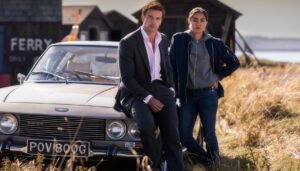
The Jensen Interceptor: Inspector Lynley’s Distinguished Detective Car
More about Inspector Lynley’s POV800G – Jensen Interceptor. A British Icon with Italian Styling
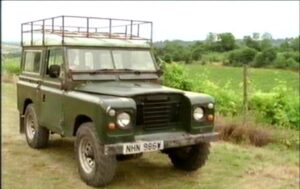
The Wagon: Rosemary & Thyme’s Faithful Land Rover Series III
In the gentle world of British cozy mysteries, few vehicles have been as perfectly cast as “The Wagon”—the battered, green 1980 Land […]
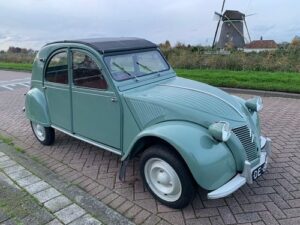
Jonathan Creek’s Citroën 2CV: The Perfect Car for a Magician’s Consultant
Some detective cars announce their arrival — the roar of Morse’s Jaguar, the rumble of Gene Hunt’s Cortina. Jonathan Creek’s car arrived […]
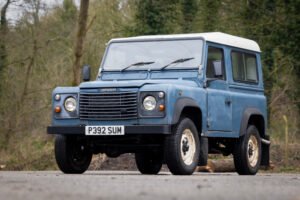
Vera’s Land Rover Defender: The Battered Blue Workhorse of Northumberland
When Detective Chief Inspector Vera Stanhope rumbles onto a crime scene in her blue Land Rover Defender, you know someone in Northumberland […]
Further Reading
- WhatClassicCar.co.uk – Classic car reviews, buying guides, and market analysis
- BMW Classic Centre – Official BMW heritage division
- R3vlimited.com – Premier E30 community and technical resource
- E30Zone.net – Global E30 enthusiast forum
- BMW CCA – BMW Car Club of America (E30 resources)
Harry Wild streams on Acorn TV. Season 5 is filming in Dublin in 2025 and will premiere in 2026. The BMW 3 Series E30 was produced from 1982-1994 across multiple body styles and engine variants. Values have risen significantly as the E30 achieves modern classic status. If you’re considering an E30, inspect thoroughly for rust—it’s the biggest issue with these otherwise brilliant cars.
This article is part of the Detective Cars collection on CozycrimeIndex.com.