
Within seconds of The Hairdresser Mysteries opening credits, viewers get their first taste of Lily Petal’s personality—not through dialogue, but through a blaring car radio and a flash of yellow paintwork. As T. Rex’s “20th Century Boy” blasts across Alcester High Street, Sally Phillips’ character arrives in Blossom Vale exactly as she means to go on: loud, stylish, utterly unbothered by what the locals think. The car doing the announcing is a 1976 Triumph Spitfire 1500—open-topped, sunshine-yellow, and about as far from village conformity as a car can get.
The Car: Triumph Spitfire 1500
Make/Model: Triumph Spitfire 1500
Year: 1976
Colour: Yellow (Triumph offered this generation in Inca Yellow or Mimosa Yellow)
Engine: 1,493cc inline-four
Body Style: 2-seat drophead convertible
It’s the final and most powerful evolution of the Spitfire line, and it makes an entrance to match Lily’s own: a big-city hairdresser blowing into a “sleepy northern market town” with more attitude than the neighbours were prepared for.
The Show: The Hairdresser Mysteries
Network: BBC One
Creator: Jim Cartwright (playwright behind Road and The Rise and Fall of Little Voice)
Star: Sally Phillips (Miranda, Bridget Jones’s Diary) as Lily Petal
Setting: The fictional village of Blossom Vale, West Midlands, 1970s
Premiered: July 2026
Season 1: 6 episodes
Production: Mill Bay Media, in association with Night Train Media
Lily Petal is a high-end London hair stylist who abandons the cutthroat city salon scene to buy a small shop at the top of a quiet, cobbled village street. She’s obsessed with all things 1970s—fashion, music, attitude—and brings her big-city sensibilities to a community that doesn’t quite know what to make of her.
What she discovers is that a hairdresser’s chair is a uniquely powerful vantage point. Clients relax under the dryer and let their guard down, sharing confidences and gossip they’d never reveal anywhere else. When a priceless antique is stolen in the very first episode—and the case turns darker when the thief turns up dead—Lily’s people-reading instincts, honed over years behind the chair, prove sharper than anyone expected. She teams up with her salon assistant Clary Coombs (Charlotte Jordan, Coronation Street) to investigate, much to the exasperation of PC Adam Watson (Ben Castle-Gibb), the young village copper who’s smitten with Clary and perpetually trying to keep proper police procedure intact while Lily and half the village turn up at his crime scenes with theories and gossip.
The supporting cast includes Sunetra Sarker as Wincey “Newsflash” Evans, the village’s resident gossip, alongside Charlotte Hope, Elisabeth Dermot Walsh, and Adrian Hood as Stan.
Why the Spitfire Works for Lily Petal
The Triumph Spitfire is exactly the right car for a character built on contrast—city glamour dropped into rural England:
A Statement, Not Transport: Lily didn’t need a practical car; she needed an entrance. The open top, the colour, the noise—everything about the Spitfire announces her before she’s said a word.
1970s to the Core: The show is soaked in period detail, and the Spitfire 1500 (launched 1974, still in production when the show is set) is as period-correct as the soundtrack. It’s not a vintage curiosity to 1976 eyes—it’s a current, desirable little sports car.
Compact and Nippy for Village Life: Blossom Vale’s cobbled streets and tight high street suit a small two-seater far better than anything larger. The Spitfire’s diminutive dimensions—under 3.7 metres long—make it perfectly at home weaving through a market town.
Open-Top Confidence: A convertible in a small English village is its own kind of social statement. Lily driving with the top down, radio blaring, is a woman entirely comfortable being looked at—which is, after all, half the job of running a salon.
Affordable Glamour: The Spitfire was always marketed as the affordable sports car—glamorous looks without supercar money. That fits a hairdresser who’s ambitious and stylish, but not from money. She’s built her look, just as she’s built her career, from talent and flair rather than inherited wealth.
The Triumph Spitfire: A British Roadster Icon
Origins and Design
The Spitfire was the work of Italian stylist Giovanni Michelotti, who had already designed the Triumph Herald saloon on which the Spitfire’s chassis was based. Michelotti’s original “Bomb” prototype sketch dates back to 1957, but the car’s launch was delayed by Standard-Triumph’s financial troubles. When Leyland Motors took over the company, officials reportedly found Michelotti’s prototype gathering dust under a sheet in a factory corner—and quickly greenlit it for production.
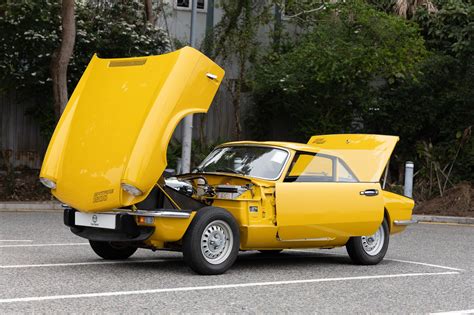
Launched in 1962, the Spitfire was designed to rival the Austin-Healey Sprite and MG Midget, but with genuine advantages: a larger engine, independent front suspension, front disc brakes, wind-up windows (rather than the side-screens fitted to its rivals), a lockable boot, and a forward-tilting bonnet for easy engine access. Named after the legendary Supermarine Spitfire fighter plane of the Second World War, it traded on British aviation heritage from day one.
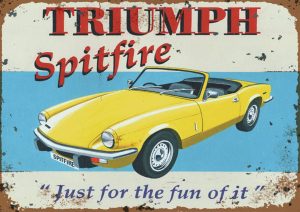
Metal Vintage Tin Sign – just for you
Five Generations, Nearly Two Decades
The Spitfire evolved across five distinct versions between 1962 and 1980, with over 314,000 units built in total:
Mark I (1962-1964): The original—1,147cc engine, 63 bhp, 45,753 built.
Mark II (1965-1967): Mechanically similar to the Mark I but with minor trim and engine refinements, still on the 1,147cc unit producing up to 67 bhp.
Mark III (1967-1970): A significant step up—engine grew to 1,296cc, producing around 75 bhp with improved brakes. The interior gained a wood-veneer dashboard and better seats, and the folding soft-top became permanently attached rather than needing to be stowed in the boot. Production reached 65,320 units, continuing even after the Mark IV’s introduction.
Mark IV (1970-1974): Michelotti was brought back to restyle the car, squaring off the tail, removing the awkward raised front bumper and bonnet seams, and giving the interior a full-width dashboard. Mechanically, this was the biggest change in the car’s history—a completely redesigned rear suspension using a “swing spring” that dramatically reduced the oversteer for which swing-axle Spitfires (and Triumph Heralds) had become notorious. The gearbox gained full synchromesh. Engine displacement stayed at 1,296cc, though US-market emissions rules gradually strangled output.
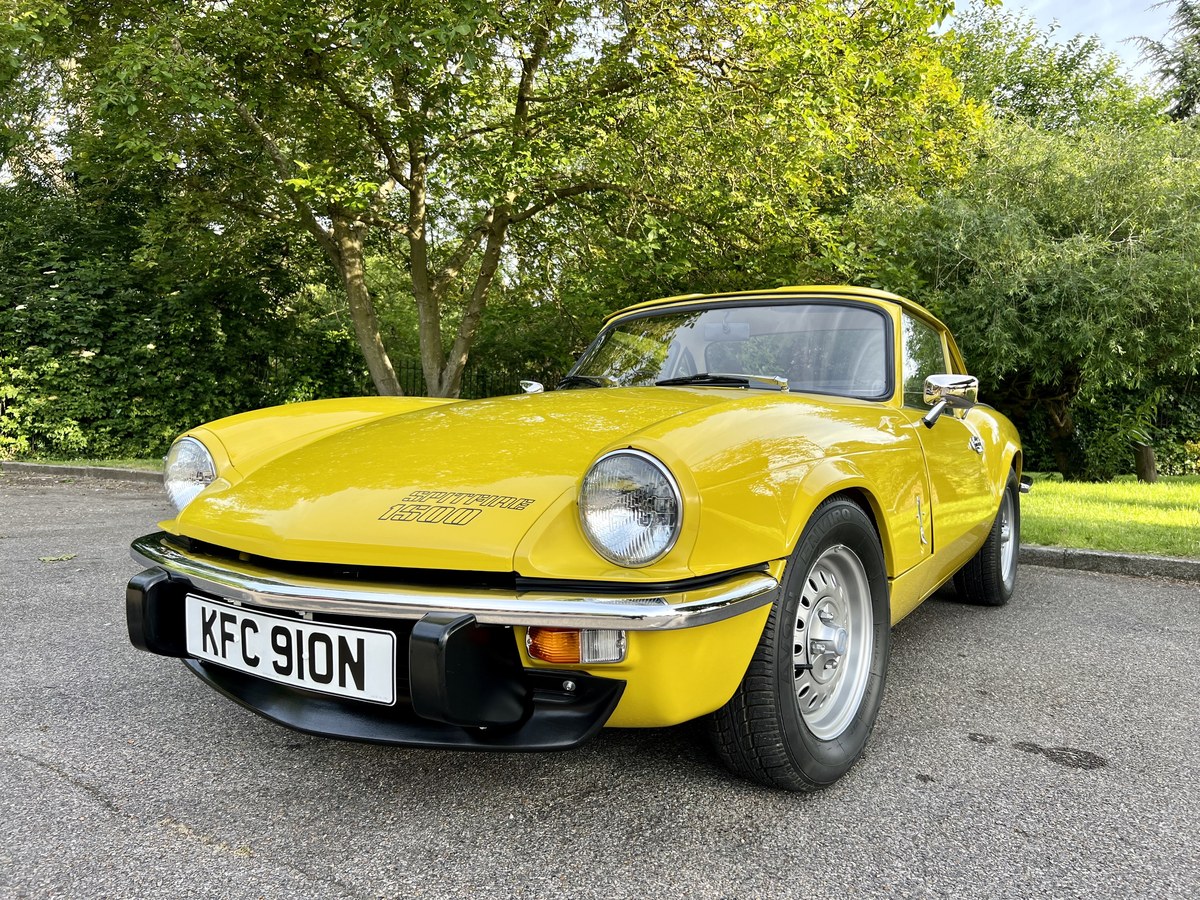
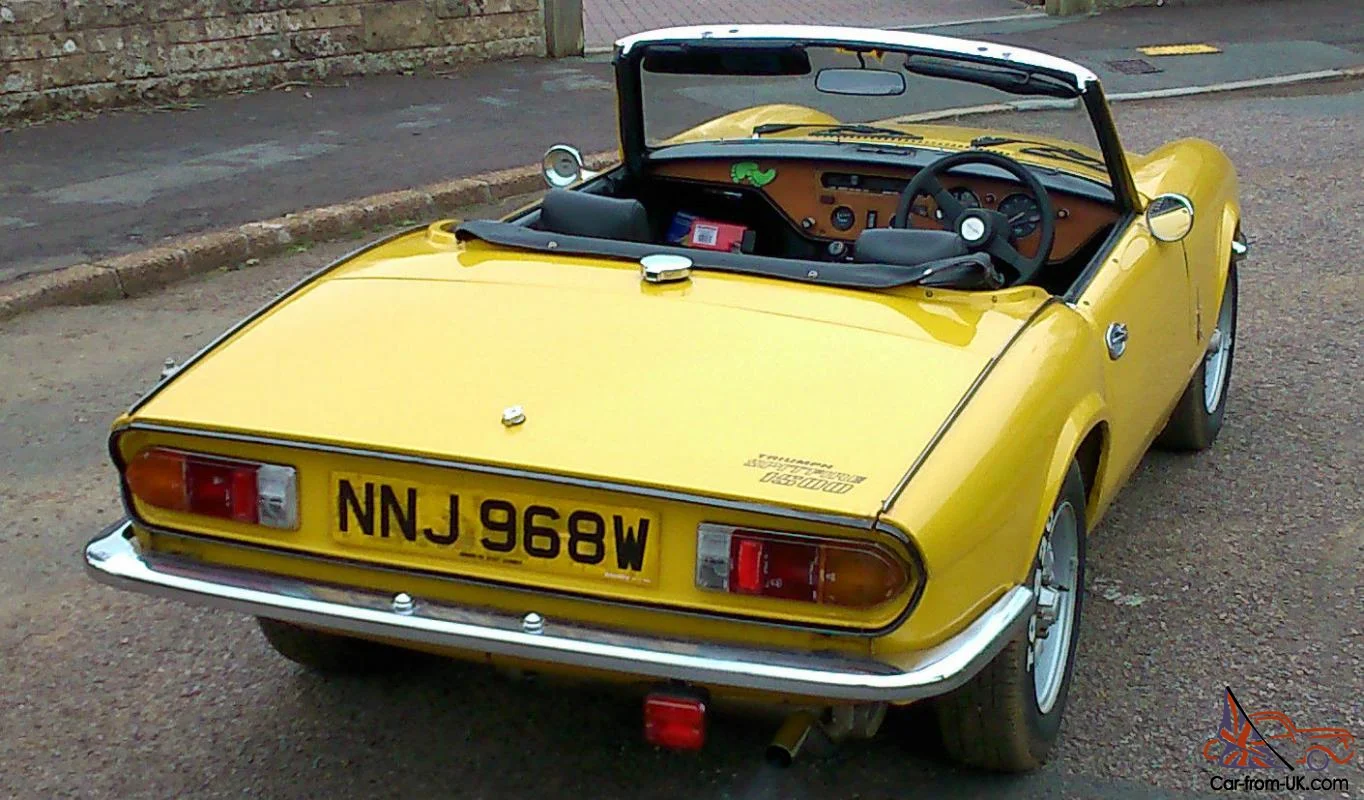
Spitfire 1500 (1974-1980): The final and best-selling evolution, and the model Lily drives. Engine capacity grew to 1,493cc to counteract the power losses emissions regulations had inflicted on the Mark IV. UK-spec cars with 9:1 compression and twin SU HS4 carburettors produced 71 bhp at 5,500 rpm and 82 lb-ft of torque at 3,000 rpm—enough for a 101 mph top speed and 0-60 mph in around 11.3 seconds, genuinely brisk for a budget British roadster of the era. A stiffer front anti-roll bar and wider track (with longer axles) sharpened the handling further. Nearly 96,000 units were built at Triumph’s Canley factory in Coventry, making the 1500 the most numerous Spitfire variant of all.
The American Market’s Different Story
Because North America accounted for roughly half of all Spitfire sales, US-spec 1500s tell a different story. Stricter emissions rules meant a single Zenith-Stromberg carburettor and a compression ratio slashed to 7.5:1 (briefly raised to 9.1:1 for 1976 only, then dropped back). With a catalytic converter and exhaust gas recirculation fitted, American cars produced just 53 bhp and needed a leisurely 16.3 seconds to reach 60 mph. US cars are also visually distinct, with chunky plastic over-riders and wing-mounted reflectors, and—on 1979-1980 models—black rubber bumpers replacing the chrome items used elsewhere.
Triumph discontinued the Spitfire in August 1980, largely because it could no longer meet California’s increasingly strict emissions standards—a market that represented roughly half of all US Spitfire sales, and therefore a quarter of the model’s entire global business.
Living With a Spitfire: The Good and the Bad
The Good
Genuinely Fun to Drive: Light, simple, and direct, the Spitfire rewards enthusiastic driving on a B-road far more than its modest power output suggests. This was always the point—minimal weight and feel over outright pace.
Simple Mechanicals: Built from parts-bin components shared with the Triumph Herald and Vitesse, the Spitfire is straightforward to maintain and work on at home—a big part of its enduring popularity with classic car owners.
Strong Parts and Club Support: With over 300,000 built and a devoted owners’ community, parts availability is excellent by classic car standards, and specialists are plentiful across the UK.
Genuine Open-Top Character: There’s nothing quite like a proper drophead roadster with the top down on a sunny day—exactly the image the show trades on in its opening moments.
Affordable Classic Ownership: Compared to contemporaries like the MGB or Triumph TR6, Spitfires remain one of the more accessible ways into classic British sports car ownership.
The Bad
Swing-Axle Handling (Pre-Mark IV): Earlier Spitfires, sharing the Herald’s swing-axle rear suspension, could exhibit alarming oversteer and wheel “tuck-under” if pushed hard into a corner—a trait not fully addressed until the Mark IV’s 1970 “swing spring” redesign.
Emissions-Strangled Late Cars: US-market 1500s in particular suffered badly under emissions equipment, with power dropping well below UK-spec figures.
Rust: Like most British cars of the era, Spitfires are prone to corrosion—sills, floors, and the chassis outriggers are common problem areas that any prospective buyer should inspect carefully.
Modest Practicality: A strict two-seater with limited boot space, the Spitfire was never meant for anything beyond weekend fun and short trips—though for a hairdresser popping around a compact village, that’s no great hardship.
Filming Locations: Blossom Vale Revealed
The Hairdresser Mysteries is entirely fictional in its setting—Blossom Vale doesn’t exist—but the production leaned heavily into a real West Midlands location as part of a wider BBC push to commission more drama outside London, following shows like This City Is Ours, Unforgivable, and Virdee.
Primary Location: Alcester, a historic Roman market town in Warwickshire, eight miles west of Stratford-upon-Avon. Known for timber-framed Tudor buildings and a bustling high street, Alcester sits at the junction of the River Arrow and River Alne, with origins dating to a Roman settlement founded in AD 47. Lily’s opening drive down Alcester High Street, Spitfire radio blaring, is the viewer’s introduction to Blossom Vale.
Church House, Butter Street: A genuine 15th-century building in Alcester, normally the administrative hub for St Nicholas Church and Alcester Minster, transformed into Lily’s 1970s-style salon.
Oversley Green: A small Warwickshire village used for further filming, including Bridge House as a key location—also previously used by Shakespeare & Hathaway.
The Chateau Impney Hotel & Exhibition Centre: A Grade II listed 19th-century house built in the style of an elaborate French château, located in Droitwich Spa, Worcestershire, and a hotel since 1925.
Ragley Hall: A grand 17th-century Palladian stately home in Warwickshire, featured when Lily arrives there in episode three.
Other locations: Stratford-upon-Avon, Wellesbourne, Redditch (Batchley Road Fish Bar), Perdiswell Leisure Centre in Worcester, Evesham, and Aston Cantlow all appear across the series.
Filming took place across September 2025, with the series airing from July 2026.
Sally Phillips: From Comedy to Cosy Crime
Sally Phillips is best known for her comedy work—Miranda, Bridget Jones’s Diary, and Smack the Pony—making The Hairdresser Mysteries a shift into the cosy crime genre, albeit one that retains a strong streak of comic warmth in the Lily-Clary-Adam dynamic. The show’s creator, Jim Cartwright, is better known as an acclaimed British playwright, with credits including Road (1986) and The Rise and Fall of Little Voice (later adapted into the 1998 film starring Jane Horrocks, Michael Caine, and Brenda Blethyn). His trademark ear for authentic, vivid working-class communities transfers naturally to Blossom Vale and to Lily’s journey from London competition to village life.
The Spitfire Today: Classic Market Values
Spitfires remain one of the more accessible entry points into classic British sports car ownership:
- Project/restoration cars: Can be found from a few thousand pounds
- Good usable examples: Typically £6,000-£15,000 depending on condition and specification
- Concours/exceptional examples: Can command a premium above this range
The 1976 example Lily drives on screen reportedly sold for around £2,000 back in 2010—a reminder of just how much classic Spitfire values have climbed over the past 15 years as the model has achieved firm modern-classic status.
Why the Spitfire Suits The Hairdresser Mysteries
The Triumph Spitfire and Lily Petal share the same trick: making an entrance that’s all colour, confidence, and a refusal to blend in, while underneath it there’s genuine substance—a well-engineered small sports car in the Spitfire’s case, real intuition and insight in Lily’s. Both are frequently underestimated because of their packaging. Both prove, episode after episode, that there’s more going on than the surface suggests.
A yellow, open-top British roadster blasting T. Rex through a quiet Warwickshire market town isn’t subtle. It isn’t meant to be. It’s the sound of a woman announcing she’s arrived—and daring the village to keep up.
Technical Specifications: Triumph Spitfire 1500 (1974-1980)
Manufacturer: Standard-Triumph / British Leyland
Production: December 1974 – August 1980
Units Built: 95,829 (most numerous Spitfire variant)
Assembly: Canley, Coventry, England
Designer: Giovanni Michelotti
Body Style: 2-seat drophead convertible
Layout: Front-engine, rear-wheel drive
Dimensions:
- Length: 145 in (3,683 mm)
- Width: 57 in (1,448 mm)
- Height: 48 in (1,219 mm), hood up
- Wheelbase: 83 in (2,108 mm)
- Kerb weight: approx. 1,568-1,759 lb (711-798 kg)
Engine: 1,493cc inline-four (Standard SC engine family)
Power (UK spec): 71 bhp (DIN) at 5,500 rpm
Torque (UK spec): 82 lb-ft at 3,000 rpm
Power (US spec): 53 bhp (emissions-restricted)
Transmission: 4-speed manual, optional overdrive
Top Speed: Approx. 101 mph (UK spec)
0-60 mph: Approx. 11.3 seconds (UK spec); 16.3 seconds (US spec)
Total Spitfire Production (all variants, 1962-1980): 314,332 units
See Also: Detective Cars on Screen
- Inspector Lynley’s Jensen Interceptor – Lynley’s British Icon with Italian Styling
- Harry Wild’s BMW 3 Series E30 – Jane Seymour’s red 1980s BMW from Dublin’s literary detective drama
- Inspector Morse & Endeavour Jaguars – The burgundy Mk2 and later XJ6/XJ40 synonymous with Oxford’s finest detective
- Gene Hunt’s Ford Cortina – The Sweeney-style Ford from Life on Mars
- Rosemary & Thyme’s Land Rover Series III – The gardening detectives’ practical British 4×4
- Bergerac’s Triumph Roadsters – Two different Triumph Roadsters both wearing Jersey registration J 1610
- Jonathan Creek’s Citroën 2CV – The windmill-dwelling magician’s green French minimalist runabout
- Whitstable Pearl’s 2CV Fourgonnette – The van variant of the 2CV used by Pearl’s seaside restaurant detective
- Queens of Mystery Morris Traveller – Matilda’s mother’s 1960s woodie driven in every investigation
- More Detective Cars – Explore the complete collection
Further Reading
- WhatClassicCar.co.uk – Classic car reviews, buying guides, and market analysis, plus other Triumph Cars
- Triumph Sports Six Club – UK owners’ club and technical resource for Spitfire and related models
- Club Triumph – Wider Triumph marque owners’ club
The Hairdresser Mysteries premiered on BBC One in July 2026 and is available on BBC iPlayer. The Triumph Spitfire was produced from 1962-1980 across five main variants, with the 1500 being the final and most numerous version. If you’re considering a Spitfire of your own, inspect thoroughly for rust in the sills, floors, and chassis outriggers—it’s the most common issue with these otherwise charming and accessible classic roadsters.

This article is part of the Detective Cars collection on CozycrimeIndex.com – The Cars That Cozy Crime Detectives Love to Drive