Bristol, 2026. A body lies where it shouldn’t, the scene is taped off, and the murder squad is waiting. Then a small, low-slung British coupé noses through the cordon — not a pool car, not a modern SUV, but an MGB GT, a car designed in the early 1960s and built at Abingdon until 1980. Out climbs Dr Ethan Winter, Richard Armitage‘s rule-bending forensic pathologist, and before he has said a word you already know something about him. He is not like the people around him. He chooses things for their character, not their convenience. And he is perfectly happy to drive something that needs a choke on a cold morning.
ITV’s Winter is darker than most of the shows we cover here — we’ve flagged it as gritty rather than cosy — but its choice of car puts it squarely in the great British tradition of detectives whose vehicles say as much as their dialogue. Morse had his Jaguar, Bergerac had his Triumph Roadster, Lynley had his Jensen. Ethan Winter has the MGB GT: the most popular British sports car ever built, in its most grown-up form.
The Car: MGB GT
Make/Model: MG MGB GT
Body: Two-door, 2+2 fixed-head coupé with opening rear tailgate
Production: 1965–1980, Abingdon-on-Thames, Oxfordshire
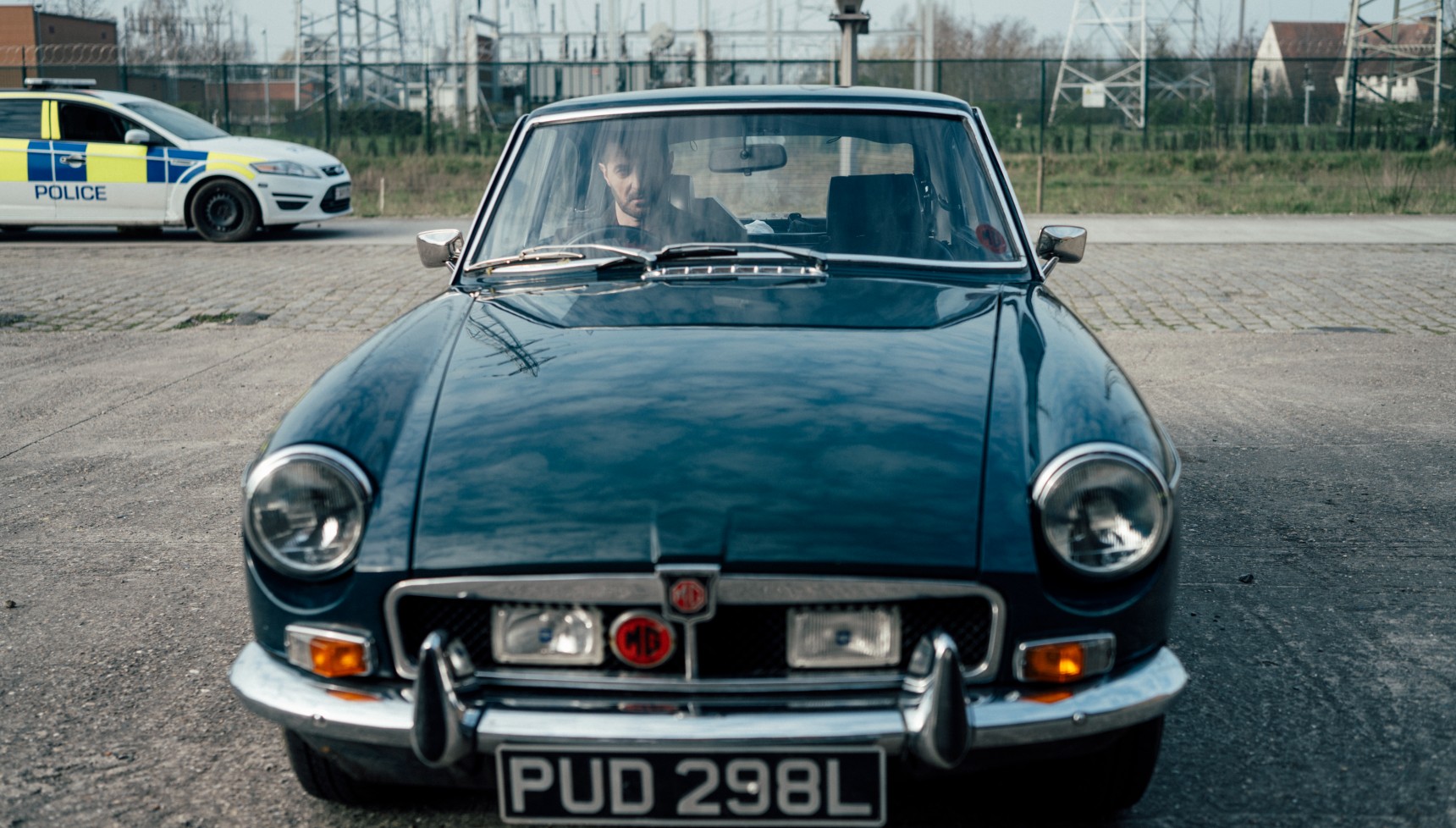
Registration: PUD 298L
Year: 1973 (bought new in April 1973)
Colour: Mallard Green
Engine: 1,798cc B-series, now enlarged to 1,840cc with Stage 2 modifications
Mileage: Approx. 70,000
Bumpers: Chrome
Wheels: Rostyle
Driven by: Dr Ethan Winter (Richard Armitage)
Show: Winter (ITV / PBS Masterpiece, 2026)
The MGB GT is not a rare car. That’s part of its charm. More than 125,000 were built, many survive, and almost every British adult of a certain age has a memory of one — a teacher’s car, an uncle’s car, the one parked on the drive three doors down. That familiarity is exactly why it works on screen. It reads instantly as classic, British, and slightly eccentric, without the flash of an E-Type or the price tag of an Aston Martin.
The Show: Winter
Network: ITV and STV (UK), streaming on ITVX and STV Player; PBS Masterpiece (US)
Star: Richard Armitage as Dr Ethan Winter
Co-star: Annabel Scholey as DI Lauren Bell
Setting: Bristol
Filming: Bristol and Belgium
Format: Six episodes, each a self-contained case, with a personal story arc running underneath
Adapted by: David Allison (The Couple Next Door) and Mark Greig (Ashes to Ashes)
Directed by: Dries Vos and Kaat Beels
Production: Eagle Eye Drama, co-produced with Masterpiece, in association with ITV Studios and Happy Duck Films
Based on: The French series Balthazar, created by Clothilde Jamin and Clélia Constantine
Ethan Winter is one of the most gifted pathologists of his generation — brilliant, intuitive, and willing to bend the rules when it suits him. He’s paired with DI Lauren Bell, a meticulous, no-nonsense detective, and together they work Bristol’s most complex murders. But Winter carries a secret: the unsolved murder of someone close to him, which he is quietly investigating on his own.
The production team will be familiar to fans of Professor T — Eagle Eye Drama also made the British version of that show, and Winter shares several of its key people, including both directors and producer Matt Baker. If you enjoyed the stylish, slightly off-kilter look of Professor T, expect something similar here, with a heavier emotional undercurrent.
Richard Armitage described his character as someone walking the line between diligent professional and reckless maverick — and that is exactly the line an MGB GT walks too.
Reading the Clues: Dating PUD 298L
Ethan Winter would approve: the car can be dated from the evidence on its body, just as he reads a victim.
The registration suffix. British number plates of this era ended in a year letter. The “L” suffix was issued from 1 August 1972 to 31 July 1973, so PUD 298L was first registered in that twelve-month window.
The area code. The “UD” in PUD was an Oxford registration mark. That’s a pleasing detail, because every MGB was built at Abingdon, a few miles south of Oxford. Whether this particular car was sold new locally or simply picked up an Oxford number, it fits the car’s home turf.
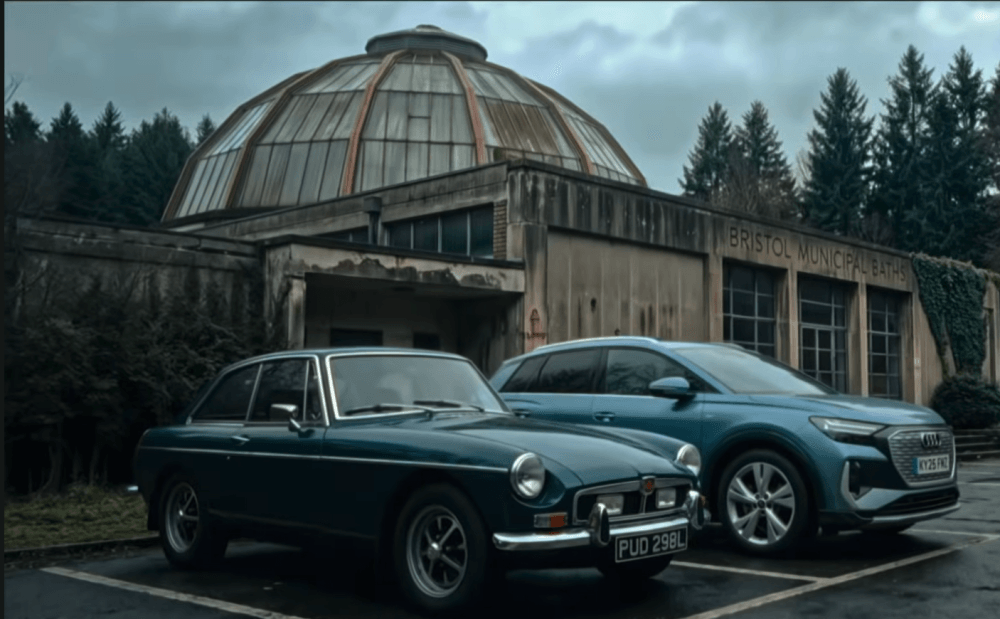
The grille. In the trailer the car wears a black mesh grille inside a chrome surround. MG introduced this style for the 1973 model year, replacing the recessed black grille of 1970–72 that buyers had disliked. It’s one of the quickest ways to tell a 1973-on chrome-bumper car from an earlier one.
The overriders. The chrome bumper overriders carry rubber facings, another 1973 model-year change.
The wheels. The car runs on Rostyle wheels: pressed-steel wheels styled to look like alloys, fitted as standard to MGBs from 1969 until 1973. Wire wheels were the traditional option.
The bumpers. Chrome, so this is a pre-1974 car, built before the big black polyurethane bumpers arrived.
Put together, PUD 298L is a 1973 model-year MGB GT, and its history confirms it: the car was bought new in April 1973. That’s the final chrome-bumper period, which many enthusiasts consider the sweet spot of the range. It has the improved grille and interior of the later cars, the all-synchromesh gearbox, and the original low ride height and handling, without the weight and raised suspension of the rubber-bumper cars that followed.
Fifty Years With One Owner
The real story of PUD 298L is its history, as reported by TV Guide. The car’s first owner bought it in April 1973 and kept it for half a century, finally selling it in Norfolk in 2023. In all that time it covered only around 70,000 miles.
It has been well looked after. In 2004 the engine was reconditioned by Oselli, the respected Oxfordshire engine specialists, at a cost of £2,589. It now runs at 1,840cc with Stage 2 modifications, a little more than the standard 1,798cc. In 2019 it received a new distributor, electronic ignition, an uprated rotor arm and a new starter motor. Inside, the cabin has wood trim throughout.
Finished in Mallard Green, one of the classic British Leyland colours of the period, the car changed hands again in 2026, selling in Lymington after its starring role in Winter.
“Like a Toy Car”
The MGB GT is a compact car, and Richard Armitage is nearly 6ft 3in. Speaking to TV Guide, he admitted he’d been nervous about driving it, and only realised how small it was when he watched early cuts of the first episode. Getting in with his knees “round my ears” was a challenge, there’s no power steering to help on tight corners, and he couldn’t climb in while wearing Ethan’s long coat.
He clearly loved it anyway. He called it a beautiful car, the kind he’d have drawn as a child, said growing up driving a Mini had prepared him for small British cars, and remembered polishing the chrome on his dad’s Triumph. Any MGB owner will recognise every one of those feelings.
Old Meets New
In the trailer, Winter’s GT is parked beside a modern Audi Q4 e-tron outside a domed building signed “Bristol Municipal Baths”. It’s a neat bit of visual storytelling: a fifty-year-old British coupé next to a 2025 electric SUV. One car belongs to the present; the other belongs to a man who can’t quite let go of the past.
Why an MGB GT Suits Ethan Winter
A Car That Says “I Don’t Follow the Crowd”
Modern TV detectives mostly drive whatever the production’s sponsor supplies — a grey German saloon, a sensible SUV. A 1960s or 1970s British coupé is a deliberate choice. It tells you that Winter values things that have a history, that he’s prepared to put up with a little inconvenience for something he likes, and that he doesn’t much care how he looks to colleagues.
Practical Enough for a Working Professional
This is where the GT, rather than the open roadster, is the clever pick. A pathologist is called out at all hours and in all weathers. The GT has a proper steel roof, wind-up windows, a heater worth having, and — crucially — a hatchback tailgate with a useful luggage area behind the seats. You can throw a bag of kit in the back. You can drive it through a wet Bristol February (which is when filming began) without a soft-top leaking on your knees. It’s a sports car that’s been made sensible — which suits a character who is brilliant but erratic.
A Hint of the Past
Winter is a man shaped by something unresolved in his history. Driving a car built decades ago — maintained, kept going, refusing to be replaced — is a quiet visual echo of a man who can’t let go. Whether the writers intended that or not, it’s there on screen.
Distinctly British — in a British Remake
Balthazar was unmistakably Parisian. Re-locating the story to Bristol needed visual markers that say England without resorting to cliché. Few cars do that better than an MG. The octagon badge, the chrome (or rubber) bumpers, the low roofline — it’s as British as the Clifton Suspension Bridge.
The MGB Story: How Britain’s Favourite Sports Car Was Born
From MGA to MGB
By the end of the 1950s, MG’s sports car was the MGA — pretty, popular, and built on a separate chassis in the traditional way. For its replacement, MG’s designers at Abingdon took a more modern approach: a monocoque (unitary) body, where the body shell itself carries the loads. This made the new car roomier inside, stiffer, and more comfortable, while keeping overall size compact.
The MGB roadster was launched in 1962. It used the BMC B-series four-cylinder engine, enlarged to 1,798cc, producing around 95 bhp — modest numbers today, but enough for a genuine 100+ mph in a light, well-balanced car. Wind-up windows (a novelty for an MG) and a decent boot made it a sports car you could actually live with, and it was an immediate success in Britain and especially in America.
Enter the GT (1965)
In October 1965, MG added the car Ethan Winter now drives: the MGB GT. The open car’s windscreen was raised and a fastback steel roof added, with input from the Italian styling house Pininfarina. The result was neat, elegant, and — thanks to its large lift-up rear tailgate — surprisingly practical.
The GT is often described as one of the first affordable hatchbacks. Behind the two front seats was a small rear bench, nominally for two, though really best suited to children, dogs, or shopping. Fold it down and you had a flat load floor that made the car a genuine all-rounder: commuter on weekdays, touring car at weekends.
The GT was heavier than the roadster, so it wasn’t quite as quick, but it was quieter, more refined, and better in bad weather. It also gained a stronger rear axle, which later spread across the range.
“The Poor Man’s Aston Martin”
The GT’s fastback shape drew comparisons with far more expensive grand tourers of the period, and enthusiasts have long called it a poor man’s Aston Martin. That’s a bit generous to the MG’s performance, but not to its looks. Viewed side-on, the long bonnet, short tail and glassy cabin have aged extremely well — arguably better than the roadster’s.
Generations and Changes: Chrome or Rubber?
The MGB GT was built for fifteen years, and it changed along the way. If you’re watching Winter and want to date Ethan’s car, these are the things to look for.
Mark I (1965–1967)
The earliest GTs. Chrome bumpers, chrome grille, a simple dashboard and a four-speed gearbox without synchromesh on first gear. Overdrive was a popular option. By the time the GT arrived, the engine had already been upgraded from three main bearings to a stronger five-bearing crankshaft (late 1964), so all GTs benefit from that.
Mark II (1967–1969)
A significant mechanical update: an all-synchromesh gearbox, an alternator in place of the dynamo, and a switch to negative-earth electrics. An automatic gearbox became available as an option, though it was never common. The transmission tunnel was reshaped to make room for the new gearbox.
The Leyland Years (1969–1974)
After BMC merged into British Leyland, the MGB received cosmetic updates: a recessed black grille for a time (unpopular, and later replaced), Rostyle-style wheels, revised interiors, and reclining seats. Mechanically it remained much the same honest B-series car.
Rubber Bumpers (1974–1980)
The most visible change. From late 1974, new US safety rules demanded bumpers that could absorb low-speed impacts. MG’s answer was large black polyurethane bumpers front and rear, and an increase in ride height to bring bumper height in line with American regulations. The raised car didn’t handle as crisply as the earlier models, though later revisions (including anti-roll bars) helped.
Purists have long preferred the chrome-bumper cars, and they generally command higher prices. But rubber-bumper GTs have their own following — they’re often cheaper to buy, many are well sorted, and the later cars came with more comfortable interiors.
End of the Line (1980)
The last MGBs were built at Abingdon in October 1980, and the factory closed soon afterwards. It was a hugely emotional moment in British motoring — the end of MG sports car production at its spiritual home. In total, just over half a million MGBs were built, with the GT accounting for roughly a quarter of them.
Under the Bonnet: Engine Options in the MGB GT Family
The Standard Car: 1.8-Litre B-Series
The vast majority of MGB GTs use the 1,798cc B-series four-cylinder: overhead valves, twin SU carburettors, around 95 bhp in British trim and plenty of low-down torque. It’s not a high-revving engine — it’s a lazy, torquey unit that suits relaxed cross-country driving, and it’s famously durable and easy to work on. Parts are cheap and almost universally available.
With overdrive fitted, a GT cruises happily at modern motorway speeds, which is why so many owners still use them for touring.
The MGC GT (1967–1969): The Six-Cylinder Cousin
For a short period MG offered the MGC — an MGB-shaped car with a 2.9-litre straight-six engine, available as a roadster and as a GT. It was faster in a straight line but heavier at the front, and the motoring press of the day criticised its handling. Only around 9,000 were built in total, roughly half of them GTs. Today, MGC GTs have a devoted following and are valued above the four-cylinder cars. Look for the bulge in the bonnet and larger wheels.
The MGB GT V8 (1973–1976): The Real Grand Tourer
The most desirable of the family. MG fitted the light, aluminium 3.5-litre Rover V8 — the same engine family later used in Range Rovers and countless kit cars — into the GT body. Power rose to around 137 bhp and, more importantly, torque nearly doubled, transforming the car into a genuinely fast, effortless tourer.
The V8 was only offered as a GT (never as a roadster) and was never officially sold in the US. Only around 2,600 were made. Today, original factory V8s are the most sought-after MGBs of all, and many standard GTs have since been converted to V8 power by enthusiasts.
Diesel and Other Myths
There was never a factory diesel MGB, and no factory fuel-injected version in period. Modern owners, however, have fitted everything from fuel injection to five-speed gearboxes and even electric conversions — a reflection of how adaptable the car is.
Why the MGB GT Survives in Such Numbers
Production Volume
With more than 125,000 GTs built, the MGB GT was never a rarity, and a large proportion survive, especially in the UK.
Parts Availability
This is the MGB’s superpower. Almost every mechanical and trim part is available new. Even complete new body shells have been produced by British Motor Heritage, using original tooling, so a rusted-out car can be rebuilt on a brand-new shell. Very few classic cars can claim that.
Simplicity
The MGB was designed to be maintained with basic tools. Most jobs are within reach of a home mechanic, and specialists are found across the UK — including plenty in the Bristol area and the wider South West.
Clubs and Community
The MG Owners’ Club and the MG Car Club are among the largest one-make car clubs in the world. Owners’ events, technical advice and social runs are easy to find, which keeps cars on the road and knowledge alive.
Buying an MGB GT Today
If watching Winter has you browsing classifieds, the good news is that the MGB GT remains one of the most accessible ways into classic car ownership.
Prices (Approximate, UK, 2026)
- Project cars: from around £2,000–£4,000. Even running GTs occasionally sell for very little at auction — one 1974 GT went for around £2,200 at a Brightwells sale in September 2026.
- Usable rubber-bumper GTs: roughly £4,000–£8,000
- Good chrome-bumper GTs: roughly £7,000–£15,000
- Exceptional or restored-on-Heritage-shell cars: £15,000–£25,000+
- MGC GT: typically more than an equivalent four-cylinder car
- Factory GT V8: the top of the tree, with the best examples well above standard GT prices
In the US, Hagerty puts a good-condition 1967 MGB GT at around $9,400, though the best cars sell for more. In Germany, current listings mostly range between about €15,000 and €45,000, reflecting how strong European demand for well-restored British cars has become.
As always, condition matters far more than year or specification. A well-restored rubber-bumper car will be a better buy than a rusty chrome-bumper one.
What to Check
Rust — the big one. As a monocoque car, the MGB’s strength comes from its body structure, so rust isn’t just cosmetic.
- Sills: the inner and outer sills are structural. Check carefully, including where they meet the front and rear wings.
- Castle rails: the box sections under the floor alongside the sills
- Floor pans and footwells
- Front and rear wheel arches and wing bottoms
- Door bottoms
- The tailgate bottom edge (GT-specific)
- Battery boxes under the rear seat area — the twin six-volt batteries in many cars live here, and acid and water do damage
Be wary of shiny paint over poorly repaired sills. A Heritage-shell rebuild with paperwork can be worth paying extra for.
Engine and gearbox
- Low oil pressure, excessive smoke, or knocking from the bottom end
- Crankshaft end-float (thrust washer wear is a known B-series issue)
- Head gasket health and cooling — check for overheating in traffic
- Overdrive: make sure it engages and disengages cleanly in third and fourth
Suspension and steering
- Front kingpins and bushes — they need regular greasing; worn ones make the steering vague
- Lever-arm dampers can leak and lose effectiveness
- Rubber-bumper cars: check whether they’ve been lowered back to chrome-bumper ride height (a common, and often beneficial, modification)
Electrics
- Lucas electrics are simple but old; check everything works, including the overdrive switch and heater fan.
Living With One
An MGB GT is an easy classic to own. Insurance on classic policies is affordable, fuel economy is reasonable for the era, and road tax exemption applies to cars over 40 years old in the UK (subject to the usual historic vehicle rules). It’s a car you can genuinely use — exactly as Ethan Winter does.
Spotting Bristol on Screen
Winter was filmed in Bristol and Belgium, and part of the pleasure of a detective series is watching for recognisable places as the car winds through them. Bristol offers a wonderful backdrop for an MGB: steep Georgian terraces in Clifton, the harbourside and its warehouses, the Avon Gorge and the famous suspension bridge, and narrow streets where a compact 1960s coupé looks at home. Keep an eye on where Winter parks. In the first episode he drives through Clifton, and his glass-walled apartment looks out over the Clifton Suspension Bridge. You can see how Bristol’s streets have changed over time on GhostViewer’s Bristol then and now page.
The MGB GT in Film and Television
The MGB has been a supporting actor in British television for decades, often used to place a character in a period or to suggest someone a little romantic, a little rebellious. Its role in Winter is a bit different: this is a contemporary drama, and the car isn’t there to set the date — it’s there to define the man. That puts it in the same family as Lynley’s Jensen and Morse’s Jaguar: a classic in a modern setting, chosen to reveal character.
Technical Specifications: MGB GT (1.8, Chrome Bumper, 1973 Model Year)
Engine: BMC B-series 1,798cc OHV inline four-cylinder
Fuel System: Twin SU carburettors
Power: Approx. 95 bhp
Transmission: Four-speed manual (all-synchromesh from Mk II), optional overdrive; optional automatic on some later cars
Drive: Rear-wheel drive
Suspension: Independent front with coil springs and lever-arm dampers; live rear axle on leaf springs
Brakes: Front discs, rear drums
Body: Steel monocoque, 2+2 fastback coupé with lift-up tailgate
Top Speed: Approx. 100–105 mph
0–60 mph: Approx. 13 seconds
Production (GT): Around 125,000 (1965–1980), plus around 2,600 GT V8s
Built at: Abingdon-on-Thames, Oxfordshire – see Abingdon on GhostViewer.
See Also: Detective Cars on Screen
- Inspector Lynley’s Jensen Interceptor – The aristocratic detective’s British-American grand tourer
- Inspector Morse & Endeavour Jaguars – The burgundy Mk2 synonymous with Oxford’s finest detective
- Bergerac’s Triumph Roadsters – Two Triumph Roadsters wearing Jersey registration J 1610
- Foyle’s War Humber Super Snipe – Sam’s wartime staff car in Hastings
- Lily Petal’s Triumph Spitfire 1500 – Another British sports car, from The Hairdresser Mysteries
- Harry Wild’s BMW 3 Series E30 – Jane Seymour’s red 1980s BMW in Dublin
- Columbo’s Peugeot 403 Cabriolet – The rumpled lieutenant’s battered French convertible
- Gene Hunt’s Ford Cortina – The 1970s Ford from Life on Mars (Winter co-adapter Mark Greig wrote for its sequel, Ashes to Ashes)
- More Detective Cars – Explore the complete collection
Further Reading
- Winter on Cozy Crime Index – Cast, character tracker and viewing details
- WhatClassicCar.co.uk – Classic car reviews, buying guides, and market analysis
- MG Car Clubs – Technical help, events, and owners’ communities
- British Motor Heritage – New MGB body shells built on original tooling
- British Motor Museum – Warwickshire.
Winter airs on ITV and STV in the UK, streaming on ITVX and STV Player, and on PBS Masterpiece in the US. Heads up: unlike most shows on Cozy Crime Index, Winter is dark and gritty rather than cosy.
