
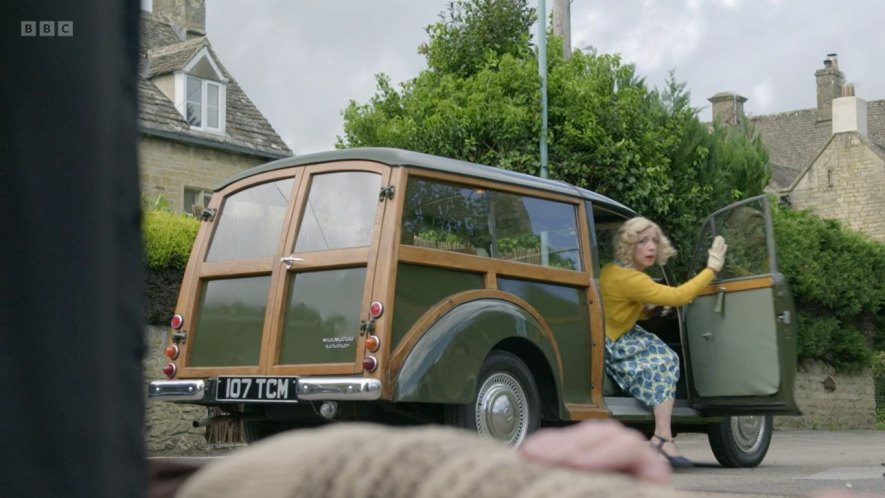
Every long-running cozy crime series eventually acquires a car with a proper name, and in Father Brown, that honour belongs to a wood-framed Morris Minor Traveller called Hercules—the pride and joy of Mrs Devine, the parish secretary who’s driven Father Brown around the fictional Cotswold village of Kembleford since Series 10. Given her enthusiastic, ambulance-honed driving style, the name may be less a tribute to the car’s strength than to the nerve required of anyone riding in the passenger seat.
The Car: Morris Minor 1000 Traveller
Make/Model: Morris Minor 1000 Traveller
Year: 1965
Nickname: “Hercules”
Registration: 107 TCM (widely believed to be a fictional plate created for the series)
Body Style: 4-door estate, with distinctive external ash-wood rear frame
Hercules has been Mrs Devine’s principal form of transport since Series 10, appearing regularly in the show’s title sequence and serving as the go-to vehicle whenever Father Brown himself needs to travel further afield than his bicycle can comfortably manage.
The Show: Father Brown
Network: BBC One / BBC iPlayer
Based on: The Father Brown short stories by G. K. Chesterton
Star: Mark Williams as Father Brown
Setting: The fictional Cotswold village of Kembleford, mid-1950s
Premiered: 14 January 2013
Run: Thirteen series and counting (140+ episodes), with two further seasons already commissioned
Father Brown follows the mild-mannered but formidably perceptive Roman Catholic priest of St Mary’s Church as he solves murder after murder among the parishioners, gentry, and passing visitors of Kembleford, drawing on the insights of the confessional box and an unshakeable understanding of human nature. Described by the BBC as the UK’s number one daytime drama for several years running and sold to more than 200 territories worldwide, it’s become one of British television’s most durable cozy crime institutions, mixing light comedy and warm community spirit with genuinely dark and twisty mysteries.
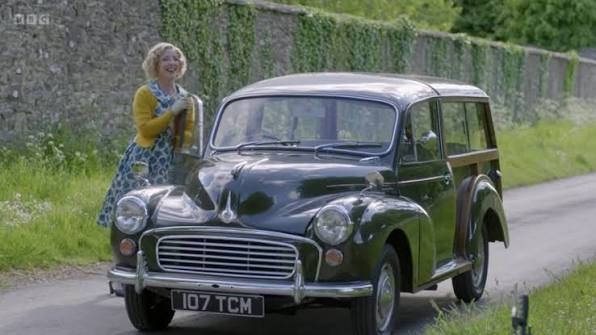
Mrs Devine, played by Claudie Blakley, joined the cast as parish secretary from Series 10, succeeding the formidable Mrs McCarthy (Sorcha Cusack). She later marries Chief Inspector Walter Sullivan, becoming Mrs Sullivan—though Hercules, and her enthusiastic driving of him, remain a constant regardless of her surname.
Why Hercules Works for Father Brown
A wood-framed Morris Minor estate, driven with more enthusiasm than caution, fits the show’s world with real precision:
A Character Built From War Service: Mrs Devine drove ambulances during the Second World War, and the show makes clear this shaped her driving style permanently—”rather enthusiastic,” in the show’s own understated words. That she now drives a small family estate car the same way she once drove an ambulance under fire is exactly the kind of gently comic, character-revealing detail cozy crime does best.
Practical Parish Transport: Kembleford is a working village, not a glamorous city beat, and Hercules is entirely fit for purpose—running errands, ferrying Father Brown to crime scenes and christenings alike, and generally serving as the practical, dependable backbone of parish life, much as Mrs Devine herself does in her role as secretary.
A Name That Suggests Devotion: Owners naming a beloved car is itself a small but telling character note—Mrs Devine’s evident pride in Hercules, described explicitly as her “pride and joy,” speaks to a woman who takes real satisfaction in the ordinary, practical things she’s good at, a nice complement to a character who initially took the job specifically seeking a little excitement in her life.
A Recurring, Reliable Presence: Hercules’s appearance in the show’s own title sequence signals just how thoroughly the car has become part of the series’ visual identity—a rare distinction most detective cars in this collection, however beloved, never quite achieve.
Gentle Fallibility: True to any well-loved older car, Hercules isn’t infallible—the Traveller breaks down at least once on screen, in the episode “The Deserving Poor,” a small but honest touch that keeps the character-car relationship grounded rather than idealised.
The Morris Minor: Britain’s People’s Car
Origins and Design
The Morris Minor was the creation of Alec Issigonis—the same Greek-born engineer who would later design the Mini—working under Nuffield Group managing director Miles Thomas during the Second World War, when Thomas gave Issigonis a free hand to develop a new small car for the postwar period. Originally codenamed “Mosquito,” the design combined maximum interior space with minimum overall size, alongside reliability and affordability, at a time when the British motor industry was desperate to launch fresh postwar models.
Famously, when the prototype was nearly complete, Issigonis felt the proportions weren’t quite right—so he had it physically cut in half lengthways and the two halves moved four inches further apart until the shape looked correct. The production Minor was built four inches wider than originally planned as a direct result, a decision that not only improved the car’s looks but also its interior space and handling. Company founder Lord Nuffield, informed of the plan, reportedly dismissed the finished prototype as looking like “a poached egg” and struggled even to remember Issigonis’s name—but the Minor went on to become one of the defining shapes of postwar Britain regardless.
Launch and Reception
The Morris Minor debuted at the Earls Court Motor Show in London on 20 September 1948, priced at £358 as a two-door saloon, alongside an open tourer variant. It was, by contemporary accounts, an immediate sensation—The Motormagazine reported the Morris stand was thronged with the public and said the Minor “stole the show,” a genuinely remarkable achievement given it was competing for attention against exhibits including Jaguar’s brand-new XK120 sports car.
A four-door saloon followed in 1950, broadening the Minor’s family appeal considerably, before the model range reached its most charming and enduring form in 1952-1953: the wood-framed Traveller estate.
The Traveller: A Distinctly British Estate
The Traveller’s most distinctive feature—and the one that makes Hercules instantly recognisable on screen—was its external structural ash-wood frame across the rear bodywork, varnished rather than painted, with two side-hinged rear doors. Unlike some contemporaries’ decorative wood trim, the Traveller’s timber frame was genuinely structural, forming an integral part of the car’s rear body strength.
Travellers were built alongside the saloon at Morris’s Cowley plant, minus their rear bodywork, before the half-completed cars were shipped to the MG factory at Abingdon, where the wooden-framed rear bodies—themselves built in Coventry—were mated to the chassis and final assembly completed. It’s a wonderfully convoluted, thoroughly British manufacturing process for a car that would go on to represent a very particular, comfortable idea of Englishness for generations of owners and enthusiasts.
Three Series, Over 1.6 Million Cars
The Morris Minor was built across three distinct series during its 23-year production run:
- Series MM (1948-1953): The original cars, powered by a carried-over 918cc side-valve engine derived from the older Morris Eight
- Series II (1952-1956): Adopted BMC’s new A-Series overhead-valve engine, initially at 803cc, improving performance and refinement
- Minor 1000 (1956-1971): The definitive, longest-running version—the designation “1000” referring to the enlarged 948cc engine (later increased again to 1,098cc from 1962), the version fitted to Hercules’s own 1965 example
By the time production ended, well over 1.6 million Morris Minors of all body styles had been built—the first British car ever to pass the one-million sales mark, and a genuine fixture of British roads for a quarter of a century. More than 180,000 of those were Travellers, produced from 1952 until the very last example rolled off the line in April 1971.
Living With a Morris Minor Traveller
The Good
Simple, Approachable Mechanicals: Built to be affordable, reliable, and easy to maintain for ordinary postwar families, the Minor remains one of the most beginner-friendly classic cars to own and work on today, with strong parts availability and an enormous, dedicated owners’ community.
Genuine Charm: Few cars evoke a particular, comfortable vision of mid-century Englishness as effectively as a wood-framed Traveller—an image the Father Brown production has clearly leaned into deliberately, choosing a car that instantly signals its 1950s Cotswold setting.
Improving Performance Across Its Life: The evolution from the original 918cc side-valve engine’s leisurely 52.5-second 0-60mph time to the later 1,098cc engine’s considerably more usable 26.5 seconds meant later Minors, including Hercules’s own 1965 example, are genuinely more pleasant and practical to drive than the earliest cars.
A Design That Aged Gracefully: Issigonis’s widened, carefully proportioned shape changed remarkably little across the model’s 23-year production run—a testament to just how right he got the fundamentals from the very start.
The Bad
Rust: As with most unitary-construction British cars of the era, corrosion is the Morris Minor’s most persistent enemy, and the Traveller’s structural timber frame brings an additional maintenance consideration all its own—the ash wood requires regular inspection and occasional replacement to keep the rear bodywork sound.
Leisurely Performance (Early Cars Especially): The original 918cc side-valve engine, in particular, is genuinely slow by any modern standard, and even the later 1,098cc engine offers only modest performance next to contemporary traffic.
Basic Safety by Modern Standards: Like any car of its era, the Minor predates seatbelts as standard equipment, crumple-zone engineering, and any form of modern occupant protection—worth bearing in mind, perhaps, given Mrs Devine’s self-described “enthusiastic” driving style.
Filming in the Cotswolds
Father Brown is filmed largely on location around the genuine Cotswold villages and countryside that inspired Kembleford’s fictional setting, giving Hercules’s every appearance a real, lived-in backdrop of honey-coloured stone cottages, village greens, and the gently rolling English countryside the show has become so closely associated with. That authentic setting is a significant part of the show’s enduring international appeal—described by fans as offering “the pastoral beauty of the English countryside” combined with classic whodunit plotting, a combination that has carried the series successfully across more than 200 territories worldwide.
Claudie Blakley and the Changing Face of the Presbytery
Claudie Blakley took on the role of Mrs Isabel Devine from Series 10, succeeding Sorcha Cusack’s long-running Mrs McCarthy as Father Brown’s parish secretary. Where Mrs McCarthy was devoutly proper and instinctively protective of Father Brown’s reputation, Mrs Devine was written as a character actively seeking a little excitement in her life—her interest in Father Brown’s investigations was, by her own account, part of what drew her to apply for the secretarial position in the first place. Her wartime ambulance-driving service and enthusiastic approach behind Hercules’s wheel fit neatly into that same character thread: a woman who has seen genuine danger before, and isn’t especially inclined to drive cautiously now that the war is over.
Why the Morris Minor Suits Father Brown
Hercules and Father Brown share the same essential warmth: neither is remotely interested in glamour, speed, or intimidation, and both are entirely, comfortably at home among Kembleford’s quiet lanes and honey-stone cottages. A wood-framed, gently ageing family estate, driven with more enthusiasm than the speed limit strictly allows, mirrors the show’s own tone precisely—cozy, dependable, unmistakably British, and quietly more capable than its unassuming exterior lets on.
Where Phryne Fisher’s Hispano-Suiza announces wealth and independence, and Roy Grace’s battered Alfa carries private grief, Hercules carries something gentler: a woman who found her excitement in solving crimes alongside a priest, driving the same beloved car through it all, one enthusiastic gear-change at a time.
Technical Specifications: Morris Minor 1000 Traveller
Manufacturer: Morris Motors (1948-1952); British Motor Corporation (1952-1968); British Leyland (1968-1971)
Designer: Sir Alec Issigonis
Production: 1948-1971 (all variants); Traveller specifically 1952-1971
Total Production: 1,619,857-1,619,958 units (all body styles)
Traveller Production: Over 180,000 units
Assembly: Cowley, Oxfordshire (main production); Abingdon (Traveller wood-body assembly, bodies built in Coventry)
Body Style: 4-door estate, with external structural ash-wood rear frame
Layout: Front-engine, rear-wheel drive
Dimensions:
- Wheelbase: 86 in (2,184 mm)
- Length: 148 in (3,759 mm)
- Width: 60 in (1,524 mm)
- Height: 60 in (1,524 mm)
Engine Range (across production life):
- 918cc side-valve I4 (Series MM)
- 803cc A-Series OHV I4 (Series II, early)
- 948cc A-Series OHV I4 (Minor 1000, from 1956)
- 1,098cc A-Series OHV I4 (Minor 1000, from 1962) — fitted to Hercules
Top Speed: Approx. 62-77 mph, depending on engine
0-60 mph: 52.5 seconds (918cc) improving to 26.5 seconds (1,098cc)
See Also: Detective Cars on Screen
- Roy Grace’s Alfa Romeo 159 – The scruffy black Alfa of Brighton’s most troubled detective
- Phryne Fisher’s Hispano-Suiza – Miss Fisher’s glamorous red 1920s French luxury tourer
- Van der Valk’s Jeep Cherokee XJ – A battered American workhorse loose on Amsterdam’s canals
- Columbo’s Peugeot 403 Cabriolet – The rumpled LA detective’s deceptively rare French convertible
- Mack’s Mini Moke – Return to Paradise’s reluctantly inherited, hammer-started beach runabout
- Ben Cooper’s Volvo XC90 – Cooper & Fry’s understated Peak District family SUV
- Lily Petal’s Triumph Spitfire 1500 – The Hairdresser Mysteries’ yellow 1970s roadster
- Harry Wild’s BMW 3 Series E30 – Jane Seymour’s red 1980s BMW from Dublin’s literary detective drama
- Inspector Lynley’s Jensen Interceptor – The aristocratic detective’s British-American grand tourer
- Inspector Morse & Endeavour Jaguars – The burgundy Mk2 and later XJ6/XJ40 synonymous with Oxford’s finest detective
- Gene Hunt’s Ford Cortina – The Sweeney-style Ford from Life on Mars
- Rosemary & Thyme’s Land Rover Series III – The gardening detectives’ practical British 4×4
- Vera’s Land Rover Defender – The battered blue workhorse of Northumberland
- Bergerac’s Triumph Roadsters – Two different Triumph Roadsters both wearing Jersey registration J 1610
- Jonathan Creek’s Citroën 2CV – The windmill-dwelling magician’s green French minimalist runabout
- Whitstable Pearl’s 2CV Fourgonnette – The van variant of the 2CV used by Pearl’s seaside restaurant detective
- Queens of Mystery Morris Traveller – Matilda’s mother’s other 1960s woodie, driven in every investigation
- The Coroner’s Land Rover – Jane Kennedy’s blue Series III soft top
- Lord Peter Wimsey’s Daimler Double-Six – “Mrs Merdle,” the aristocratic sleuth’s stately 12-cylinder saloon
- Foyle’s Humber Super Snipe – The elegant wartime saloon of Hastings
- More Detective Cars – Explore the complete collection
Further Reading
- WhatClassicCar.co.uk – Classic car reviews, buying guides, and market analysis
- Morris Minor Owners Club – Dedicated owners’ resource and technical archive
Father Brown airs on BBC One and BBC iPlayer, with Series 14 and 15 already commissioned to follow the show’s thirteenth series. The Morris Minor was produced from 1948-1971, selling over 1.6 million examples and becoming the first British car to pass the one-million sales mark—a genuinely fitting car for a show so thoroughly devoted to gentle, dependable, quintessentially British charm.
This article is part of the Detective Cars collection on CozycrimeIndex.com.
