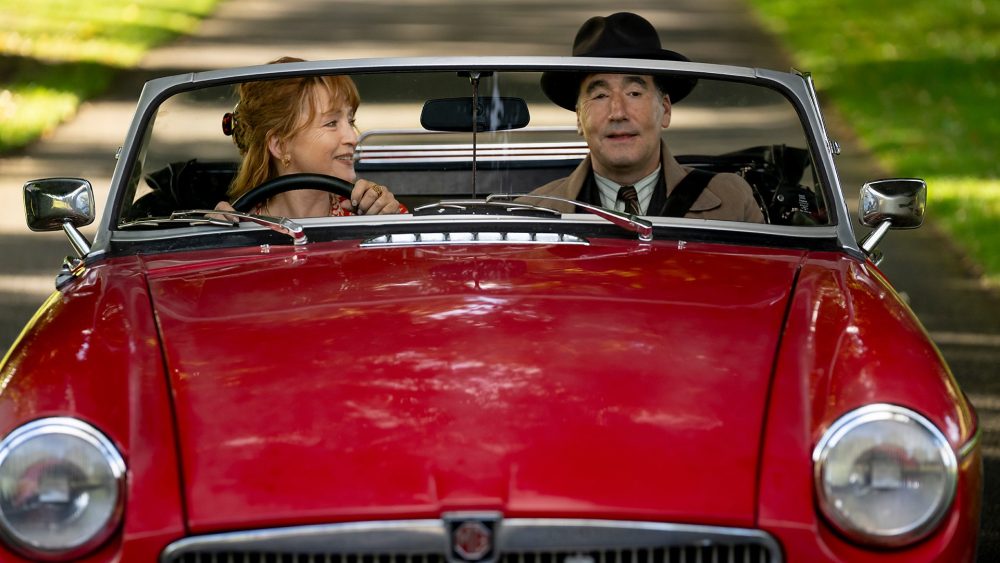
Most detectives in this collection get one car. Atticus Pünd and Susan Ryeland, the dual protagonists of Magpie Murders and its sequel Moonflower Murders, get one each—and the contrast between them is the whole point. One belongs to a fictional 1950s detective inside a novel; the other belongs to the very real present-day editor reading that novel, trying to work out who really killed its author. Fittingly, their cars are a generation apart too: a sedate 1955 Standard Ten for Pünd, and a red 1967 MG roadster for Ryeland.
The Cars: Standard Ten & MG MGB
Atticus Pünd’s car: Standard Ten, registration KSK 813, built 1955
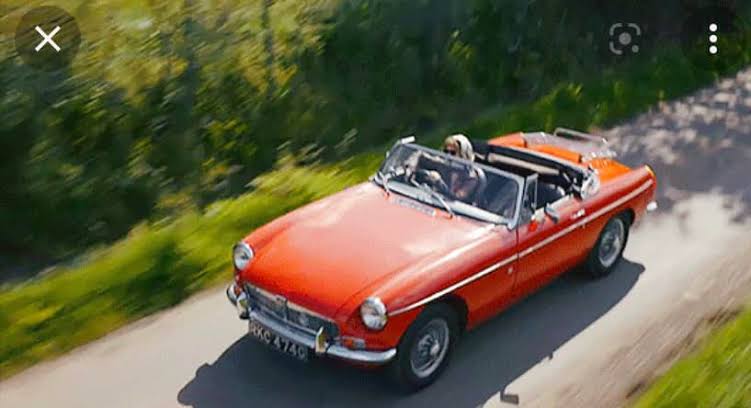
Susan Ryeland’s car: MG MGB roadster, registration RKC 474G, built 1967, red
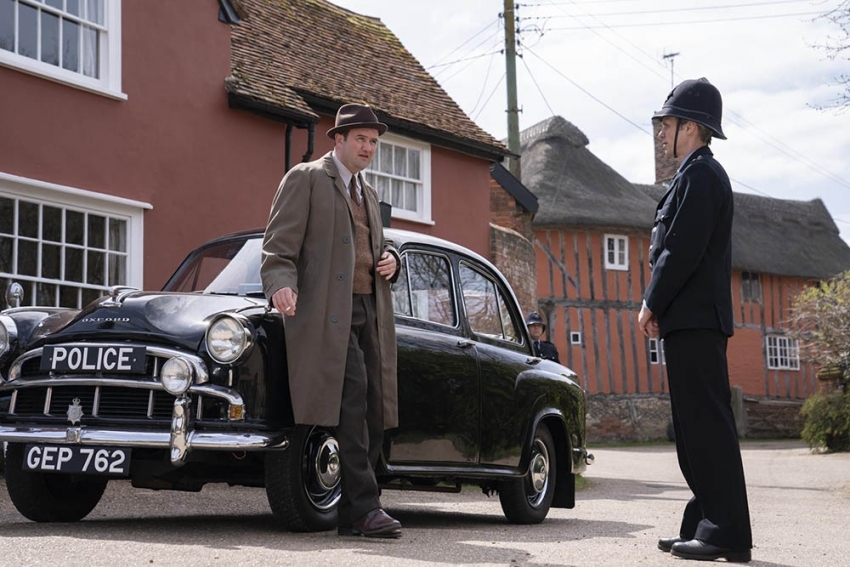
Bonus vehicle: Detective Inspector Chubb (1950s timeline) drives a 1957 Morris Oxford Series III
Two cars, twelve years and a fictional universe apart, both instantly placing their driver in a specific time and temperament the moment they appear on screen.
The Show: Magpie Murders / Moonflower Murders
Network: BritBox (UK) / PBS Masterpiece (US)
Based on: Anthony Horowitz’s novels of the same names
Stars: Lesley Manville as Susan Ryeland, Tim McMullan as Atticus Pünd
Premiered: Magpie Murders, 2022; Moonflower Murders, 2024
Format: A story within a story—present-day scenes of book editor Susan Ryeland investigating a real murder are interwoven with dramatised scenes from the Atticus Pünd detective novel she’s editing, with the two timelines visually and narratively colliding throughout
Magpie Murders opens with Susan, editor at Cloverleaf Books, preparing to read the final manuscript in bestselling author Alan Conway’s Atticus Pünd detective series—only to discover the last chapter is missing, and that Conway himself has just died in an apparent suicide. As Susan investigates Conway’s death, she becomes increasingly convinced that his real-life acquaintances were the models for characters in his fiction, and that the solution to both the real murder and the missing fictional one are entangled with each other. The show dramatises Pünd’s 1950s investigation into a death at Pye Hall in the village of Saxby-on-Avon in parallel with Susan’s present-day inquiry, with Horowitz’s script allowing the two timelines to intersect in genuinely inventive ways—including, memorably, a moment where Susan’s car and Pünd’s cross paths at a junction, one woman briefly glimpsing a fictional detective who shouldn’t exist outside the pages of a manuscript.
The sequel series, Moonflower Murders, continues Susan’s story two years later, now running a hotel in Crete with her partner Andreas, drawn back into another case with the same dual-timeline structure.
Why the Two Cars Work
The choice of vehicle for each half of the story does real narrative work:
A Fictional Detective Needs a Fictional-Feeling Car: Pünd exists only within Alan Conway’s manuscript, and his world is deliberately period-precise, gently theatrical 1950s English village crime fiction. A Standard Ten—modest, unhurried, entirely unglamorous—suits a detective whose power lies in quiet, patient observation rather than physical presence. It’s a car built for a man who solves crimes by listening, not by moving fast.
A Contemporary Editor Needs a Character of Her Own: Susan Ryeland is sharp, impatient, and increasingly obsessive as her investigation deepens—TV Tropes’ own description of the show flags her MG roadster explicitly as a “Hero’s Classic Car,” the kind of vehicle that signals a character with personality and independence rather than one blending into the background. A red, open-top MGB does exactly that.
Two Very Different Speeds for Two Very Different Investigations: The Standard Ten was tested by The Motor in 1954 at a leisurely 38.3 seconds 0-60mph—a car that physically cannot rush anywhere, matching Pünd’s own unhurried, methodical style. Susan’s MGB, by contrast, could hit 60mph in around 11-12 seconds—a car built for a woman driving with real urgency toward answers, occasionally furious ones.
Crossing Paths, Literally: The show’s own visual device—Susan’s car passing Pünd’s at a road junction—only works because the two vehicles are so visibly, instantly distinguishable from one another. A viewer registers the difference in silhouette alone, in the blink of an eye, exactly as the scene demands.
A Nice Detail for the Detail-Oriented: Enthusiast forums (notably the MG Experience community) have pored over the show frame by frame trying to nail down exact registrations and build years for both Pünd’s Standard Ten and DI Chubb’s 1957 Morris Oxford—a level of scrutiny that speaks to just how carefully the production dressed its 1950s timeline with period-correct, unglamorous British saloons.
The Standard Ten: Britain’s Unpretentious Family Saloon
Origins
The Standard Ten name had a long and slightly complicated history at the Standard Motor Company, first used as far back as 1906 and revived several times across subsequent decades for whatever modestly-sized family car the company happened to be building. The version that matters here—the one Atticus Pünd drives—was introduced in March 1954 under the leadership of Standard’s energetic and famously dictatorial chairman, Sir John Black, as a larger-engined, less basic companion to the existing Standard Eight.
Specification
Pünd’s 1955 Standard Ten used a 948cc overhead-valve four-cylinder engine (sourced, in a small irony given Pünd’s Britishness, from BMC), producing a modest 35bhp at 4,500rpm. Standard trim included Vynide-covered seats, two sun visors, two windscreen wipers, hubcaps, and a chrome radiator grille—a car built to be respectable and affordable rather than exciting. A five-door estate version, the Companion, followed in October 1955, and an up-market variant, the tail-finned Standard Pennant, arrived in 1957.
Contemporary road tests bear out just how unhurried the Ten was: The Motor‘s own 1954 test recorded a top speed of 69.0mph, a 0-60mph time of 38.3 seconds, and fuel consumption of 34.4mpg—entirely adequate for the school run or the vicarage, and entirely unsuited to any kind of car chase, which suits a detective whose method has never involved anything resembling a car chase in the first place.
Legacy
Standard built 172,500 examples of this generation of the Ten between 1954 and 1956, and the model, alongside the Pennant, was eventually replaced by the Triumph Herald in 1961—by which point the Standard name itself was being phased out in favour of the more commercially valuable Triumph badge, a branding shift already underway in the industry as Pünd’s own fictional cases were being written. See Through Time – Canley in Coventry, the home of Standard-Triumph.
The MG MGB: Britain’s Best-Selling Sports Car
Origins
Development of the MGB began at Abingdon under project codename EX205 as early as 1958, with chief engineer Syd Enever leading a team determined to replace the ageing MGA with something genuinely modern. The most significant technical leap was structural: where the MGA (and MG’s sports cars before it) used traditional body-on-frame construction, the MGB adopted a unitary monocoque body—a lighter, stronger, more space-efficient design that gave passengers more legroom and luggage space despite the car actually being three inches shorter overall than its predecessor.
Launched in May 1962, the MGB used a 1,798cc B-Series four-cylinder engine, producing around 95bhp in UK specification, mated to a four-speed manual gearbox with optional Laycock de Normanville overdrive. A five-bearing crankshaft, introduced in late 1964, further improved refinement.
Susan’s Car: A 1967 Mark II
Susan’s specific example, built in 1967, would have arrived just as the MGB transitioned to Mark II specification—introduced in late 1967 with synchromesh on all four gears, revised gear ratios, an optional Borg-Warner automatic transmission (outside the US market), a new rear axle, and an alternator replacing the earlier dynamo. It represented the MGB at its most refined and usable, well before the American-market rubber bumpers and raised ride height of the mid-1970s began compromising the car’s original, cleanly proportioned looks.
A Genuine Sales Phenomenon
The MGB went on to become one of the best-selling sports cars in history, with 399,070 roadsters built across an 18-year production run at Abingdon, Oxfordshire (plus additional assembly in Australia), before the factory finally closed in October 1980. It remained fundamentally the same shape and structure throughout, a rare example of a design getting things so right on the first attempt that it barely needed reinventing across nearly two decades of production—a car that, fittingly, has proven just as enduring as the classic British detective fiction Susan Ryeland spends her career editing.
Anthony Horowitz’s Meta-Fiction, on Wheels
Magpie Murders and Moonflower Murders are, at their core, about the relationship between fiction and reality—about an author who despised the genre that made him famous, and an editor forced to treat his invented detective as a genuine investigative resource in solving a real murder. The two cars are a small but perfectly judged piece of that same meta-fictional game: one, a period-correct 1950s saloon that could only exist within the pages of a manuscript; the other, a genuinely collectible, real-world classic sports car driven by the woman trying to close the gap between fiction and fact.
That the two vehicles briefly cross paths at a junction—one glimpsing the other, however impossibly—is as neat a visual shorthand for the entire show’s premise as Horowitz could have devised.
Technical Specifications
Standard Ten (1954-1956, Pünd’s car built 1955)
Manufacturer: Standard Motor Company
Production: 1954-1956 (this generation); 172,500 units
Assembly: Coventry, England
Body Style: 4-door saloon
Engine: 948cc OHV I4
Power: 35 bhp @ 4,500 rpm
Top Speed: 69.0 mph
0-60 mph: 38.3 seconds
MG MGB Roadster (1962-1980, Ryeland’s car built 1967)
Manufacturer: British Motor Corporation (1962-1968); British Leyland (1968-1980)
Production: 1962-1980; 399,070 roadsters built (all years)
Assembly: Abingdon, Oxfordshire, England
Designer: Syd Enever / Don Hayter
Body Style: 2-door roadster, unitary monocoque construction
Engine: 1,798cc B-Series I4
Power: Approx. 95 bhp (UK spec)
0-60 mph: Approx. 11-12 seconds
Top Speed: Approx. 103-105 mph
See Also: Detective Cars on Screen
- Will Davenport’s BSA A7 – Grantchester’s leather-jacketed vicar on two wheels
- Roy Grace’s Alfa Romeo 159 – The scruffy black Alfa of Brighton’s most troubled detective
- Phryne Fisher’s Hispano-Suiza – Miss Fisher’s glamorous red 1920s French luxury tourer
- “Hercules” – Father Brown’s Morris Minor Traveller – Mrs Devine’s beloved wood-framed workhorse from Kembleford
- Van der Valk’s Jeep Cherokee XJ – A battered American workhorse loose on Amsterdam’s canals
- Columbo’s Peugeot 403 Cabriolet – The rumpled LA detective’s deceptively rare French convertible
- Mack’s Mini Moke – Return to Paradise’s reluctantly inherited, hammer-started beach runabout
- Ben Cooper’s Volvo XC90 – Cooper & Fry’s understated Peak District family SUV
- Lily Petal’s Triumph Spitfire 1500 – The Hairdresser Mysteries’ yellow 1970s roadster
- Harry Wild’s BMW 3 Series E30 – Jane Seymour’s red 1980s BMW from Dublin’s literary detective drama
- Inspector Lynley’s Jensen Interceptor – The aristocratic detective’s British-American grand tourer
- Inspector Morse & Endeavour Jaguars – The burgundy Mk2 and later XJ6/XJ40 synonymous with Oxford’s finest detective
- Gene Hunt’s Ford Cortina – The Sweeney-style Ford from Life on Mars
- Rosemary & Thyme’s Land Rover Series III – The gardening detectives’ practical British 4×4
- Vera’s Land Rover Defender – The battered blue workhorse of Northumberland
- Bergerac’s Triumph Roadsters – Two different Triumph Roadsters both wearing Jersey registration J 1610
- Jonathan Creek’s Citroën 2CV – The windmill-dwelling magician’s green French minimalist runabout
- Whitstable Pearl’s 2CV Fourgonnette – The van variant of the 2CV used by Pearl’s seaside restaurant detective
- Queens of Mystery Morris Traveller – Matilda’s mother’s 1960s woodie, driven in every investigation
- The Coroner’s Land Rover – Jane Kennedy’s blue Series III soft top
- Lord Peter Wimsey’s Daimler Double-Six – “Mrs Merdle,” the aristocratic sleuth’s stately 12-cylinder saloon
- Foyle’s Humber Super Snipe – The elegant wartime saloon of Hastings
- More Detective Cars – Explore the complete collection
Further Reading
- WhatClassicCar.co.uk – Classic car reviews, buying guides, and market analysis
- MG Owners Club – Model history and technical resources for the MGB
- Standard Motor Club – Dedicated resource for Standard Motor Company models, including the Ten
Magpie Murders and Moonflower Murders air on BritBox in the UK and PBS Masterpiece in the US, based on Anthony Horowitz’s novels. A third instalment, Marble Hall Murders, is set to premiere in 2026. The Standard Ten was produced from 1954-1956 as a modest, affordable British family saloon; the MG MGB, built from 1962-1980 at Abingdon, became one of the best-selling sports cars in history. Together, they make one of the more thoughtfully mismatched detective-car pairings in the whole collection—which, fittingly, is rather the point.
This article is part of the Detective Cars collection on CozycrimeIndex.com.