
Alfa Romeo Forum members clocked it almost as soon as Grace premiered on ITV: a black Alfa Romeo 159, visibly the worse for wear, chrome trim peeling, grille blacked out, registration WT07BHE—and, in one memorable early episode, thoroughly written off in a crash, only to reappear unharmed a few weeks later, in the time-honoured tradition of television continuity nobody quite bothers to explain. For Detective Superintendent Roy Grace, a man permanently haunted by his wife’s unsolved disappearance, an unloved, slightly battered Italian saloon is exactly the right kind of company.
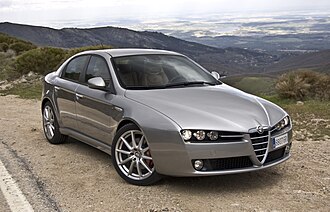
The Car: Alfa Romeo 159
Make/Model: Alfa Romeo 159 1.9 JTDm 16V Lusso
Year: 2009
Colour: Black
Registration: WT07BHE
Engine: 1.9-litre JTDm turbodiesel
Enthusiast forum-goers have tracked the car’s condition across the show’s run with genuine, slightly wounded affection—noting peeling aerosol paint on the grille and trim, and grumbling good-naturedly that ITV ought to look after it better. It’s a level of scrutiny most detective cars in this collection never quite attract, and testament to how recognisable, and how beloved, the battered 159 has become among the show’s Alfa-owning fanbase.
The Show: Grace
Network: ITV
Based on: The Roy Grace novels by Peter James
Star: John Simm as Detective Superintendent Roy Grace
Setting: Brighton and Hove, England
Premiered: 14 March 2021
Run: Six series (2021-present), 20 episodes
Writer: Russell Lewis (also the screenwriter behind Endeavour)
Roy Grace is a dogged, unorthodox Brighton detective whose life has been defined by tragedy: his wife Sandy vanished without explanation years before the series begins, and Grace has never stopped searching for answers, even as he tries—not always successfully—to build a new life with his partner Cleo. Bestselling crime novelist Peter James created the character after his own home was burgled; conversations with the responding officers sparked a fascination with real policing methods that fed directly into the character’s meticulous, procedurally grounded cases. Alongside DS Glenn Branson and DS Bella Moy, Grace investigates murders across Brighton and Hove, using unconventional methods—including, controversially within the show, occasional recourse to a psychic medium—that put him repeatedly at odds with his superiors even as his results keep proving him right.
Why the Alfa Romeo 159 Works for Roy Grace
The choice of a battered Alfa says a great deal about the character, deliberately or not:
Beauty With a Wound: The Alfa Romeo 159 was, when new, widely regarded as one of the most beautifully styled saloons of its era—a genuinely striking design in a segment usually dominated by conservative German rivals. Seeing that same handsome shape scuffed, faded, and patched up on screen mirrors Grace himself: a man whose sharp instincts and evident capability sit alongside visible, unhealed damage.
Understated, Not Flashy: Grace is described as a “hard-working police officer who has given his life to the job”—not a man interested in status symbols. A diesel-engined, mid-range Lusso trim Alfa (rather than one of the range’s sportier, more image-conscious variants) fits a detective whose focus is entirely on the work, with little energy left over for anything else, including car maintenance.
A Continental Choice on an English South Coast Beat: An Italian saloon patrolling Brighton and Hove has a slightly displaced, melancholic quality that suits Grace’s own unsettled inner life—a man permanently a little out of step with everyone and everything around him, going through the motions of an ordinary life while carrying an extraordinary, unresolved grief.
Damaged But Still Running: The much-discussed continuity gag—crashed in one episode, mysteriously restored a few weeks later—accidentally becomes rather fitting thematic shorthand. Grace, too, keeps absorbing blows (personal and professional) and keeps turning up for the next case regardless.
A Cop’s Car, Not a Hero’s Car: Where some fictional detectives drive cars chosen to flatter the actor or the production values, Grace’s 159 leans into something more mundane and recognisable—the kind of slightly-too-old, slightly-neglected car a genuinely overworked detective superintendent, more focused on solving murders than washing his motor, would actually drive.
The Alfa Romeo 159: A Design Triumph With a Troubled Reputation
Origins and Design
Unveiled in 2005 and launched for the 2006 model year, the Alfa Romeo 159 was developed on the GM/Fiat “Premium” platform, shared in modified form with the Alfa Romeo Brera coupé and the Vauxhall/Opel Vectra-based models of the same era. Styled in-house at Alfa Romeo’s Centro Stile under the direction of Wolfgang Egger, the 159 was widely praised on launch for its dramatic, muscular proportions and distinctive front end, dominated by Alfa’s traditional shield-shaped grille flanked by twin, deeply recessed headlamp clusters.
The 159 was intended as a direct rival to the BMW 3 Series, Audi A4, and Mercedes-Benz C-Class, competing in the fiercely contested European executive saloon segment. While it never matched its German rivals for sales volume, it earned a genuinely devoted following among enthusiasts who valued its striking design and distinctively Italian driving character over the more clinical, appliance-like feel of its competitors.
Engine Range
The 159 was offered with a broad spread of petrol and diesel engines across its production life:
Petrol
- 1.8 MPI: 1.8-litre four-cylinder, entry-level petrol option
- 1.9 JTS: 1.9-litre direct-injection four-cylinder petrol
- 2.2 JTS: 2.2-litre direct-injection four-cylinder petrol
- 3.2 V6: 3.2-litre naturally aspirated V6, the range-topping performance option, available with Alfa’s Q4 all-wheel-drive system
Diesel (the JTDm family, widely regarded as some of the best diesel engines of their era)
- 1.9 JTDm 8v: 1.9-litre, lower-output diesel
- 1.9 JTDm 16v: 1.9-litre, higher-output 16-valve diesel—the engine fitted to Grace’s own screen car
- 2.4 JTDm: 2.4-litre five-cylinder diesel, offering stronger performance
The 1.9 JTDm 16V, as driven on screen, produced a useful, torque-rich output well suited to everyday driving, and the JTDm engine family more broadly earned Alfa Romeo genuine respect during a period when diesel refinement and efficiency were becoming increasingly important to European buyers.
Trim Levels
The 159 range spanned several trim levels through its production life, with Lusso (“Luxury”)—the specification of Grace’s own car—sitting as a well-equipped mid-to-upper trim, offering a more comfort-focused specification than the sportier Ti (Turismo) models further up the range.
Living With an Alfa Romeo 159: The Good and the Bad
The Good
Striking, Enduring Design: Even close to two decades after launch, the 159’s styling remains widely admired—a rare example of a mainstream executive saloon that genuinely turned heads when new and continues to do so as a used buy today.
Excellent Diesel Engines: The JTDm engines earned Alfa Romeo a strong reputation for diesel refinement and efficiency during the mid-to-late 2000s, at a time when diesel technology across the industry was advancing rapidly.
Genuine Driving Character: Alfa Romeo’s traditional strengths—sharp, communicative steering and an eager, involving driving experience—were retained in the 159 despite its shared underpinnings with more mainstream GM/Fiat platform-mates.
Strong Value on the Used Market: As a used buy, the 159 offers a genuinely distinctive, well-equipped executive saloon at a price point well below its German rivals of similar age and specification.
The Bad
Reliability Reputation: The 159, like many Alfa Romeos of its era, developed a reputation among owners for a range of electrical and mechanical niggles—an image the show’s own scruffy, occasionally crash-damaged screen car does little to dispel.
Poor Rear Visibility: A commonly cited criticism of the 159’s otherwise striking design is its small rear window and thick pillars, which noticeably compromise rear visibility—a real-world drawback of prioritising dramatic styling over outright practicality.
Weight: The 159 was a comparatively heavy car for its class, which somewhat blunted the outright performance and efficiency of its smaller engine variants compared to lighter, more conservatively engineered rivals.
Cabin Space: Rear passenger space was noted by contemporary reviewers as tighter than key rivals, a consequence of the dramatic, coupé-influenced roofline that gave the 159 much of its visual drama.
John Simm and a Franchise Built on Grief
John Simm—previously best known for Life on Mars and his portrayal of the Master in Doctor Who—took on the role of Roy Grace for the 2021 series, adapting Peter James’s hugely popular novel series (now spanning sixteen books at the time of the show’s production) for the screen. Simm has spoken about devouring the first three novels within days of being offered the role, quickly understanding the character’s defining tension: a “brilliant but troubled cop” whose personal devastation and professional brilliance are permanently, inextricably intertwined. Screenwriter Russell Lewis—whose credits include Morse, Lewis, and Endeavour—brought a similarly meticulous, character-driven sensibility to adapting James’s Brighton-set procedurals for television.
The show is filmed largely on location in and around Brighton and Hove, giving Grace’s battered black Alfa a genuinely lived-in backdrop of seafront promenades, Regency architecture, and the city’s distinctive mix of faded grandeur and everyday grit—tonally, not a bad match for the car itself.
Why the Alfa Suits Roy Grace
Roy Grace and his Alfa Romeo 159 share a quiet, unresolved tension between what they once were and what they’ve become. The 159 was, when new, one of the most striking executive saloons on the road—and Grace, before Sandy’s disappearance, was presumably a man whose life had a shape and a direction it visibly no longer has. Both car and character now carry their history openly: a scuffed grille, a story that doesn’t quite add up, a capability that’s never entirely left them despite everything.
It’s a detective car built on damage rather than concealment—not glamorous like Phryne Fisher’s Hispano-Suiza, not disguising anything like Columbo’s Peugeot, but simply, visibly, still doing the job, dents and all.
Technical Specifications: Alfa Romeo 159
Manufacturer: Alfa Romeo (Fiat Group)
Design: Centro Stile Alfa Romeo, under Wolfgang Egger
Production: 2005-2011
Platform: GM/Fiat “Premium” (shared with Alfa Romeo Brera, Vauxhall/Opel Vectra-derived models)
Assembly: Pomigliano d’Arco, Italy
Body Style: 4-door saloon, 5-door Sportwagon estate
Layout: Front-engine, front-wheel drive (V6 available with Q4 all-wheel drive)
Engine Range:
- Petrol: 1.8L-3.2L, four-cylinder and V6
- Diesel (JTDm): 1.9L-2.4L, four- and five-cylinder
Screen Car: 2009 1.9 JTDm 16V Lusso, black, registration WT07BHE
See Also: Detective Cars on Screen
- Phryne Fisher’s Hispano-Suiza – Miss Fisher’s glamorous red 1920s French luxury tourer
- “Hercules” – Father Brown’s Morris Minor Traveller – Mrs Devine’s beloved wood-framed workhorse from Kembleford
- Van der Valk’s Jeep Cherokee XJ – A battered American workhorse loose on Amsterdam’s canals
- Columbo’s Peugeot 403 Cabriolet – The rumpled LA detective’s deceptively rare French convertible
- Mack’s Mini Moke – Return to Paradise’s reluctantly inherited, hammer-started beach runabout
- Ben Cooper’s Volvo XC90 – Cooper & Fry’s understated Peak District family SUV
- Lily Petal’s Triumph Spitfire 1500 – The Hairdresser Mysteries’ yellow 1970s roadster
- Harry Wild’s BMW 3 Series E30 – Jane Seymour’s red 1980s BMW from Dublin’s literary detective drama
- Inspector Lynley’s Jensen Interceptor – The aristocratic detective’s British-American grand tourer
- Inspector Morse & Endeavour Jaguars – The burgundy Mk2 and later XJ6/XJ40 synonymous with Oxford’s finest detective
- Gene Hunt’s Ford Cortina – The Sweeney-style Ford from Life on Mars
- Rosemary & Thyme’s Land Rover Series III – The gardening detectives’ practical British 4×4
- Vera’s Land Rover Defender – The battered blue workhorse of Northumberland
- Bergerac’s Triumph Roadsters – Two different Triumph Roadsters both wearing Jersey registration J 1610
- Jonathan Creek’s Citroën 2CV – The windmill-dwelling magician’s green French minimalist runabout
- Whitstable Pearl’s 2CV Fourgonnette – The van variant of the 2CV used by Pearl’s seaside restaurant detective
- Queens of Mystery Morris Traveller – Matilda’s mother’s 1960s woodie driven in every investigation
- The Coroner’s Land Rover – Jane Kennedy’s blue Series III soft top
- Lord Peter Wimsey’s Daimler Double-Six – “Mrs Merdle,” the aristocratic sleuth’s stately 12-cylinder saloon
- Foyle’s Humber Super Snipe – The elegant wartime saloon of Hastings
- More Detective Cars – Explore the complete collection
Further Reading
- WhatClassicCar.co.uk – Classic car reviews, buying guides, and market analysis
- Alfa Romeo Owners Club (UK) – Model history and technical resources
Grace airs on ITV, based on the bestselling novels by Peter James, with John Simm in the title role. The Alfa Romeo 159 was produced from 2005-2011 and remains a striking, if occasionally troubled, used buy in the executive saloon class—not unlike the detective who drives one, dents and all, through Brighton’s seafront streets.
This article is part of the Detective Cars collection on CozycrimeIndex.com.
