Cambridge stands as one of Britain’s most atmospheric settings for detective fiction, its colleges, bicycle-filled streets, and willow-fringed Backs providing a backdrop every bit as photogenic as its famous rival across the fens. Where Oxford built a whole detective dynasty around Morse, Cambridge offers something different: not one franchise stretched across decades, but a cluster of crime dramas that use the same city—and its surrounding Cambridgeshire landscape—in very different ways. Scholarly tradition, town-and-gown tension, and the quiet menace of meadows and river paths have made the place irresistible to writers who want intellect, beauty, and murder in the same frame.
The city is perhaps most closely associated on modern television with Professor T (2021–), ITV’s adaptation of the Belgian crime drama starring Ben Miller as Professor Jasper Tempest—a brilliant University of Cambridge criminologist whose obsessive–compulsive disorder, overbearing mother, and razor-sharp mind make him an unlikely but invaluable adviser to the police. Campus assaults, college politics, and cases that turn on psychology as much as forensics keep Tempest circling the university world that both defines and confines him. The series trades on Cambridge’s academic glamour—Jesus College features prominently on screen—whilst much of the production was filmed in Belgium with additional Cambridge location work. For viewers, the story-world is unmistakably Cambridge; for visitors, that distinction between setting and shooting location is worth keeping in mind.
Ludwig (2024–) takes a warmer, quirkier route through the same city. David Mitchell’s John “Ludwig” Taylor—a reclusive puzzle designer who steps into his missing twin brother’s detective life—turns Cambridge into a playground of impossible crimes, lateral thinking, and gentle comedy. Where Professor T leans into the tortured academic genius, Ludwig leans into the puzzle: locked rooms, clever misdirection, and a police station that feels like a workplace rather than a Gothic stage set. Together the two shows prove that Cambridge can host both cerebral campus mystery and contemporary cozy-adjacent crime without needing a single shared detective.
Beyond the city centre, Cambridgeshire’s detective tradition runs through the village of Grantchester. Grantchester (2014–), adapted from James Runcie’s novels, follows a succession of crime-solving vicars—Sidney Chambers, Will Davenport, and Alphy Kottaram—working alongside Detective Inspector Geordie Keating in a 1950s and 1960s world of parish secrets, jazz, warm beer, and meadows along the Cam. The village church, pubs, and riverside walks are the series’ heart, but Cambridge itself regularly appears: King’s Parade, Trinity Lane, Senate House Passage, and other streets that need little dressing to feel mid-century. Grantchester is not “Cambridge college crime” in the Professor T sense—it is the pastoral orbit of the university city, where town, gown, and village meet with sometimes fatal consequences.
What makes Cambridge such a compelling setting for crime drama is the contrast it embodies. The city represents learning, enlightenment, and some of civilisation’s highest achievements, yet within its courts and along its riverbanks occur jealousies, betrayals, and murders as dark as any found elsewhere. The juxtaposition of beauty and violence, intellect and passion, tradition and modernity elevates Cambridge-set mysteries beyond simple whodunits into stories about class, belonging, and the cost of brilliance. Add the geography—the Backs where a body might wash up, college gardens for clandestine meetings, libraries and laboratories that hide secrets in plain sight, and pubs where students, dons, and townspeople collide—and every location carries layers of history waiting to be disturbed.
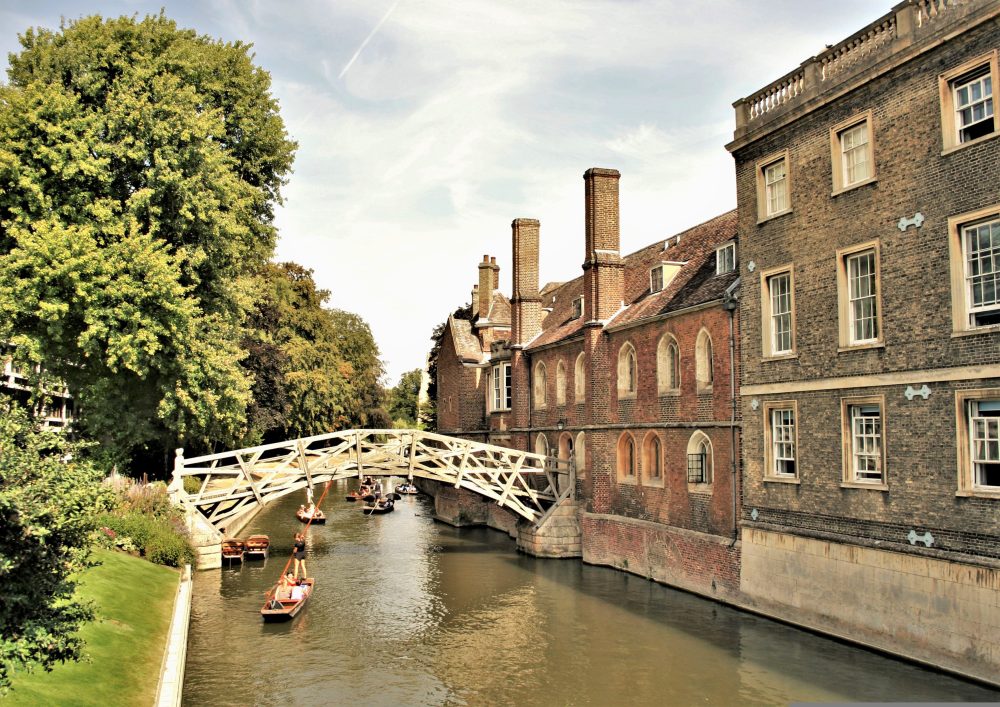
For visitors inspired by these dramas, Cambridge rewards exploration. King’s College Chapel and King’s Parade remain instantly recognisable from Grantchester’s establishing shots; the Mathematical Bridge and the Backs offer the riverside calm that television loves to undercut with crime; Market Square and the lanes around the colleges evoke the everyday city Ludwig’s characters inhabit; and a short walk or punt brings you to Grantchester Meadows and the Church of St Andrew and St Mary, the spiritual home of Runcie’s sleuthing clergy. Professor T’s Cambridge is more impressionistic on screen, but the real colleges still convey the academic pressure-cooker that makes Tempest’s world feel plausible.
Whether you arrive for a criminologist who cannot leave a crooked picture alone, a puzzle-solver impersonating a detective, or a vicar with a gift for asking the right questions, Cambridge and its Cambridgeshire hinterland remain ready for the next generation of television detectives—proof that the other university city has a detective fiction identity entirely its own.
See Cambridge’s Then and Now
Discover how Cambridge has changed over the decades through historic photographs compared with modern views on GhostViewer. These then-and-now comparisons reveal the city’s architectural evolution whilst showing how much of its essential character—the colleges, the Backs, the timeless streets—remains beautifully preserved, ready to welcome the next generation of television detectives pursuing justice through one of Britain’s most photogenic cities. Read more about the history of Cambridge and view the changes, add memories and more.
