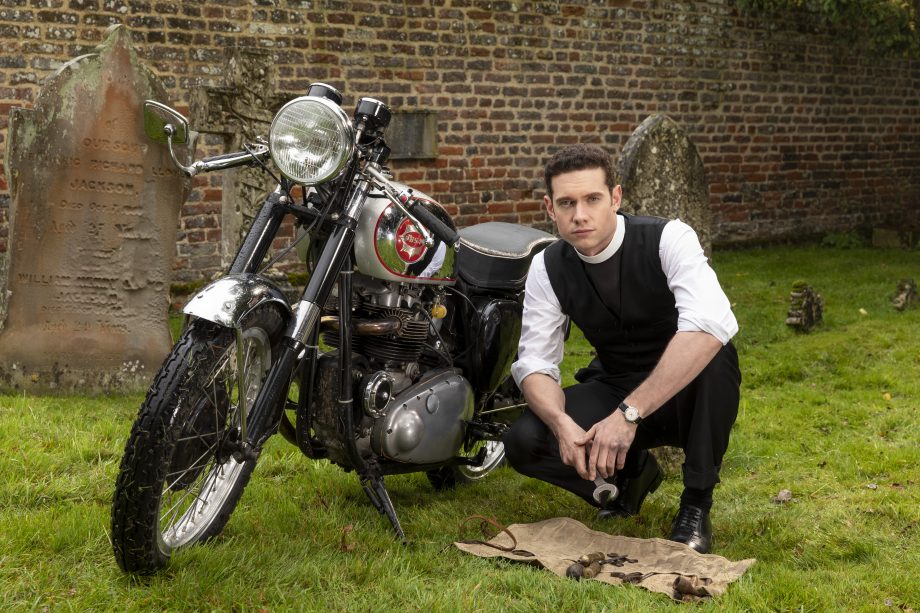
Every other detective, sleuth, and crime-solving amateur in this collection arrives by car. Reverend Will Davenport arrives on a motorbike—leather jacket on, engine roaring, straight out of the age of rock ‘n’ roll and into a sleepy Cambridgeshire village that has absolutely no idea what’s about to hit it. It’s one of the most purely visual character introductions in the entire cozy crime genre: within seconds of meeting him, before he’s said a word, you already know exactly what kind of vicar Will Davenport is going to be.
The Vehicle: BSA A7
Make/Model: BSA A7 (500cc parallel twin)
Era: Mid-1950s, matching the show’s period setting
Rider: Reverend William “Will” Davenport, played by Tom Brittney
First Appearance: Season 4, Episode 1 (2019)
Unlike the cars elsewhere in this collection, the BSA isn’t chosen for its practicality, its rarity, or its patient reliability. It’s chosen for exactly one reason: to announce, the instant it appears on screen, that this new vicar is nothing like the one who came before him.
The Show: Grantchester
Network: ITV (UK) / MASTERPIECE on PBS (US)
Based on: The Grantchester Mysteries novels by James Runcie
Setting: The village of Grantchester, near Cambridge, England, 1950s
Premiered: 2014
Run: Nine seasons and counting
Grantchester follows the vicar of the fictionalised village of Grantchester as he partners with Detective Inspector Geordie Keating (Robson Green) to solve murders that keep finding their way into his quiet, close-knit parish. The show is built around a deliberate, recurring structure: the vicarage changes hands periodically, and each new vicar brings a distinct generational and temperamental contrast to the role, while Geordie—weary, decent, endlessly exasperated—remains the constant at his side.
The original vicar, Sidney Chambers (James Norton), was a WWII veteran with a fondness for jazz, whisky, and introspective melancholy—every inch the traditional, world-weary postwar clergyman. When Norton departed after Season 3, the show made a bold choice for his replacement: rather than another Sidney, it introduced Will Davenport, a chaplain from Corpus Christi College Cambridge with a “rebellious reputation” to match Sidney’s own student days, but expressed in an entirely different register—leather, rock ‘n’ roll, and two wheels instead of two legs and a good coat.
Why the BSA Works for Will Davenport
The motorbike is, quite deliberately, the single most efficient piece of characterisation the show ever deploys:
An Instant Generational Statement: Executive producer Emma Kingsman-Lloyd put it plainly when Will was introduced: “he’s a bit younger, he hasn’t fought in the Second World War, and he’s very outward-looking, whereas Sidney is more introspective and backward-looking.” A vicar riding into the village on a BSA, dressed in leather, says all of that before a single line of dialogue is spoken.
Freedom From the War’s Shadow: Sidney’s melancholy is inseparable from his wartime service; Will, coming from an upper-class family that kept him out of service, carries none of that particular burden—a fact that causes real, ongoing tension with Geordie, who very much did serve. The motorbike, fast and unencumbered, suits a man whose defining struggles are entirely his own rather than inherited from a global conflict.
Rock ‘n’ Roll Made Physical: Will’s own official character profile lists his hobbies as “motorcycles, rock ‘n’ roll, and boxing”—a trio of interests that all share the same restless, physical, faintly dangerous energy. The BSA isn’t incidental to that description; it’s the clearest possible expression of it.
A Boat-Rocker on Wheels: Both Sidney and Will are described by their superiors, almost word for word, as “boat-rockers” and “liabilities”—men whose faith doesn’t sit quietly within institutional expectations. Where Sidney’s rebellion stayed largely internal, Will wears his “on the outside,” in the show’s own words—and there’s no more literal way to wear rebellion on the outside than arriving at a new parish on a motorbike in a leather jacket.
A Foreshadowing the Show Wasn’t Afraid to Use: The BSA’s presence isn’t purely decorative window-dressing—by Season 9, a motorbike accident in which Will accidentally kills a man becomes a genuine, life-altering plot point, threatening to unravel everything he’s built by that point in the series. A detail introduced purely for character flavour in Season 4 pays off, five seasons later, as real dramatic stakes.
The BSA A7: A Proper British Postwar Twin
Origins and Design
The BSA A7 traces its design origins back to the late 1930s, when designer Val Page began work on it in direct response to Triumph’s game-changing Speed Twin of 1938—a bike that had suddenly made every British manufacturer scramble to field its own vertical twin. War intervened before BSA could bring the design to market, and it fell to engineer Herbert Perkins, described by contemporary Bert Hopwood as “a first class engineer,” to pick up the project after peace returned and finally launch the A7 in 1946.
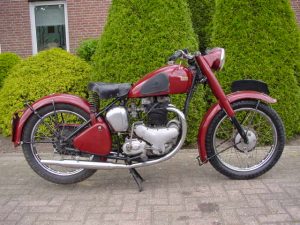
The first A7s were 495cc, 26bhp iron-head twins with a single camshaft, pushrod-operated overhead valves, and a single Amal carburettor—housed, initially, in a rigid duplex frame with BSA’s own telescopic front forks. Contemporary road testers were enthusiastic: The Motor Cycle‘s 1947 test squeezed 82mph out of the bike even in foul weather, with the tester dressed for the rain, and pronounced it “an outstandingly attractive machine” assured of “a brilliant future among discriminating riders.”
Evolution Through the 1950s
The A7 was continually refined across its production run, tracking almost exactly the mid-1950s setting Grantchesterportrays:
1949: Plunger rear suspension offered as an option, a genuine improvement in rider comfort over the original rigid frame
1950: BSA introduced a thoroughly revised engine and gave the A7 its own dedicated frame, distinct from the singles-derived setup of earlier models; bore and stroke changed to 66mm x 72.6mm, growing displacement slightly to 497cc
1953: Rear suspension upgraded again, this time to a proper swinging-arm design, replacing the wear-prone plunger system that BSA had grown concerned about
1955: By this point—right in the heart of Grantchester‘s period setting—the A7 featured swing-arm rear suspension, telescopic front forks with hydraulic damping, and 7-inch single-leading-shoe drum brakes front and rear, representing genuinely state-of-the-art specification for a mid-range British twin of the era
The 497cc version, in its final and most developed form, produced around 30bhp at 5,800rpm and could reach a genuine 90mph—brisk, characterful performance for a mid-1950s parish priest with somewhere urgent to be.
A Gentler Reputation Than Its Triumph Rivals
BSA’s twins earned a specific, well-defined reputation within the British motorcycle world: not quite as outright fast as their Triumph rivals, but noticeably more oil-tight, quieter, and smoother in everyday use. One period assessment summed the A7 up neatly as one of “motorcycling’s gentlefolk” rather than its “ruffians”—a genuinely well-mannered machine among more boisterous contemporaries. There’s a nice, understated irony in giving a bike with that particular reputation to a character whose entire purpose on the show is to seem disruptive and unconventional; underneath the leather jacket, the BSA itself was actually one of the more civilised, dependable choices a rider of the era could make.
The End of the A7 Line
The A7, alongside its larger 650cc A10 sibling (introduced in 1950 by essentially enlarging the A7 platform), continued in production with only minor detail changes through to 1961-62, when BSA replaced both with the unit-construction A50 and A65 twins. Industry historians have generally judged that switch to unit construction, however well-engineered, as coinciding with—or perhaps even contributing to—the beginning of BSA’s long commercial decline as a major player in the British motorcycle market, a slow fade that would culminate in the company’s eventual collapse in the 1970s.
The Details Fans Noticed
Grantchester‘s production team has been open, in interviews, about not treating motorcycle authenticity as a top priority—and enthusiast communities have noticed. British motorcycle forum BritBike has picked over the show’s engine sound mixing at some length, noting the audio dubbed over Will’s rides never quite matches an authentic BSA engine note. One particularly memorable observation, from a BritBike member, concerned an episode where Will starts the bike without any visible kick-starting at all: “Did you see the episode where he starts the bike without kick-starting? God works in mysterious ways.”
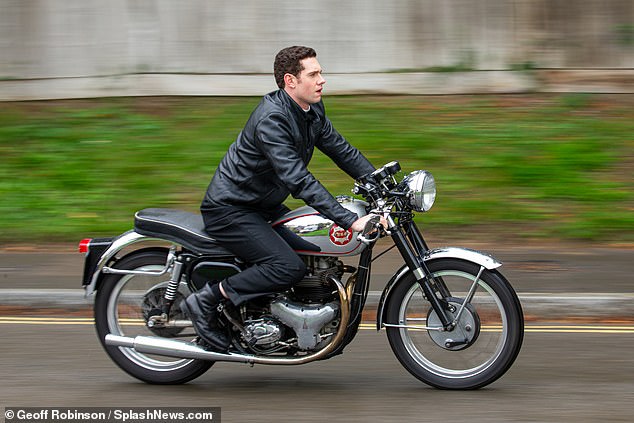
There’s a charming behind-the-scenes footnote to all this, too: actor Tom Brittney had never ridden a motorcycle before landing the role, and had to learn specifically for the part. By Season 5, he’d progressed enough to have obtained his own motorcycle licence in real life—a nice piece of life imitating art, discussed candidly on the show’s own official podcast.
Tom Brittney and Five Seasons on Two Wheels
Tom Brittney played Will Davenport from Season 4 through Season 9, taking the character on a journey the actor himself has described as a transformation “from rash youth to family man.” Prior to Grantchester, Brittney was known for roles in Outlander and Call the Midwife. Reflecting on the character’s arc as he departed the show, Brittney noted that Will “came roaring into the sleepy Cambridgeshire village of Grantchester—and our hearts—on the back of his motorbike all the way back in Season 4,” a description that captures precisely how central that first, leather-clad, engine-roaring entrance became to the character’s entire identity across the show’s run.
By the time of his own departure, Will has married, become a father, and—in a serious late-series storyline—been involved in a motorbike accident that accidentally kills a man, a devastating turn that threatens to unravel everything he’s built. It’s a striking piece of long-form storytelling: the same motorbike introduced purely to signal youthful rebellion becomes, seasons later, the instrument of one of the show’s most consequential tragedies.
Three Vicars, Three Vehicles
Grantchester‘s vicarage has now seen three occupants, and their choice of transport (or lack of one) tracks their personalities with real precision.
Sidney Chambers gets around Grantchester the old-fashioned way—on a bicycle. PBS’s own promotional material for the show lists “picnics, pints in the pub, bicycle rides…and murders” among the series’ defining ingredients, and it’s a fitting choice for a man more inclined toward quiet reflection than restless motion. No motor vehicle, no engine noise, no entrance to make—just a vicar pedalling thoughtfully between the vicarage, the pub, and whatever crime scene Geordie’s turned up at.
Will Davenport arrives on the BSA, announcing rebellion and rock ‘n’ roll before he’s said a word—covered in full above.
Alphy Kottaram, introduced in Season 9 (set in 1961) and played by Rishi Nair, arrives by red Triumph convertible—a different kind of confidence again, open-topped rather than leather-clad, but still visibly a man happy to be seen and to make an entrance of his own. Robson Green, reflecting on the character’s introduction, called it “a great entrance for any character… him bombing in that red car along a country lane,” adding that the Triumph “really evokes that period of people wanting to live in the fast lane… new forms of status.” Nair himself has made much the same point about the character: “The fact that he is rolling around Grantchester in 1961 in a red sports car, and he’s a vicar, is absurd. I think it’s such a great character trait in that he’s worked hard, he’s earned his money and he feels like, ‘If this is what I want, then this is what I want. I don’t care what people think.'” A 1961 setting puts the car right at the cusp of Triumph’s TR3A giving way to the newly launched TR4, though which exact model appears on screen isn’t confirmed in production materials.
The car wasn’t without its own behind-the-scenes drama, echoing the “details fans noticed” theme of Will’s own BSA: during one long shot, the Triumph stalled mid-take, and a paparazzi photo of Robson Green pushing the car down a country lane while Nair tried to jump-start it ended up as front-page news in a British tabloid.
Across three vicars and three very different approaches to arriving in a village—a bicycle, a motorbike, and a sports car—Grantchester quietly makes the same point as every other post in this collection: what a detective, or in this case a crime-solving clergyman, chooses to arrive in tells you who they are before they’ve said a single word.
Technical Specifications: BSA A7 (1955-era)
Manufacturer: Birmingham Small Arms Company (BSA)
Designer: Val Page (original concept); Herbert Perkins (production design)
Production: 1946-1962
Assembly: Small Heath, Birmingham, England
Engine: 497cc air-cooled parallel twin (pre-unit construction), single camshaft, pushrod OHV, single Amal carburettor
Power: Approx. 30 bhp @ 5,800 rpm
Ignition: Magneto
Transmission: 4-speed, foot-shift, duplex primary chain
Frame: Half-duplex cradle (from 1950); swinging-arm rear suspension (from 1953)
Front Suspension: Telescopic forks with hydraulic damping
Brakes: 7-inch single-leading-shoe drums, front and rear
Top Speed: Approx. 90 mph (497cc version)
Dry Weight: 366 lb (166 kg)
Fuel Capacity: 3.5 imperial gallons
Successor: BSA A50 Royal Star (unit-construction, from 1962)
See Also: Detective Cars (and Vehicles) on Screen
- Roy Grace’s Alfa Romeo 159 – The scruffy black Alfa of Brighton’s most troubled detective
- Phryne Fisher’s Hispano-Suiza – Miss Fisher’s glamorous red 1920s French luxury tourer
- “Hercules” – Father Brown’s Morris Minor Traveller – Mrs Devine’s beloved wood-framed workhorse from Kembleford
- Van der Valk’s Jeep Cherokee XJ – A battered American workhorse loose on Amsterdam’s canals
- Columbo’s Peugeot 403 Cabriolet – The rumpled LA detective’s deceptively rare French convertible
- Mack’s Mini Moke – Return to Paradise’s reluctantly inherited, hammer-started beach runabout
- Ben Cooper’s Volvo XC90 – Cooper & Fry’s understated Peak District family SUV
- Lily Petal’s Triumph Spitfire 1500 – The Hairdresser Mysteries’ yellow 1970s roadster
- Harry Wild’s BMW 3 Series E30 – Jane Seymour’s red 1980s BMW from Dublin’s literary detective drama
- Inspector Lynley’s Jensen Interceptor – The aristocratic detective’s British-American grand tourer
- Inspector Morse & Endeavour Jaguars – The burgundy Mk2 and later XJ6/XJ40 synonymous with Oxford’s finest detective
- Gene Hunt’s Ford Cortina – The Sweeney-style Ford from Life on Mars
- Rosemary & Thyme’s Land Rover Series III – The gardening detectives’ practical British 4×4
- Vera’s Land Rover Defender – The battered blue workhorse of Northumberland
- Bergerac’s Triumph Roadsters – Two different Triumph Roadsters both wearing Jersey registration J 1610
- Jonathan Creek’s Citroën 2CV – The windmill-dwelling magician’s green French minimalist runabout
- Whitstable Pearl’s 2CV Fourgonnette – The van variant of the 2CV used by Pearl’s seaside restaurant detective
- Queens of Mystery Morris Traveller – Matilda’s mother’s other 1960s woodie, driven in every investigation
- The Coroner’s Land Rover – Jane Kennedy’s blue Series III soft top
- Lord Peter Wimsey’s Daimler Double-Six – “Mrs Merdle,” the aristocratic sleuth’s stately 12-cylinder saloon
- Foyle’s Humber Super Snipe – The elegant wartime saloon of Hastings
- More Detective Cars – Explore the complete collection
Further Reading
- WhatClassicCar.co.uk – Classic car and motorcycle reviews, buying guides, and market analysis
- BSA Owners Club – Model history, technical resources, and restoration support
Grantchester airs on ITV in the UK and MASTERPIECE on PBS in the US, based on James Runcie’s novels. Tom Brittney played Reverend Will Davenport across Seasons 4-9. The BSA A7 was produced from 1946-1962 and remains one of the most affordable, practically-minded entry points into pre-unit British twin-cylinder motorcycle ownership today—a genuinely dependable machine, whatever leather-jacketed reputation it acquired on screen.
This article is part of the Detective Cars collection on CozycrimeIndex.com. You may also want to read about more Cozy Crime TV Shows set in the Cambridge area.
