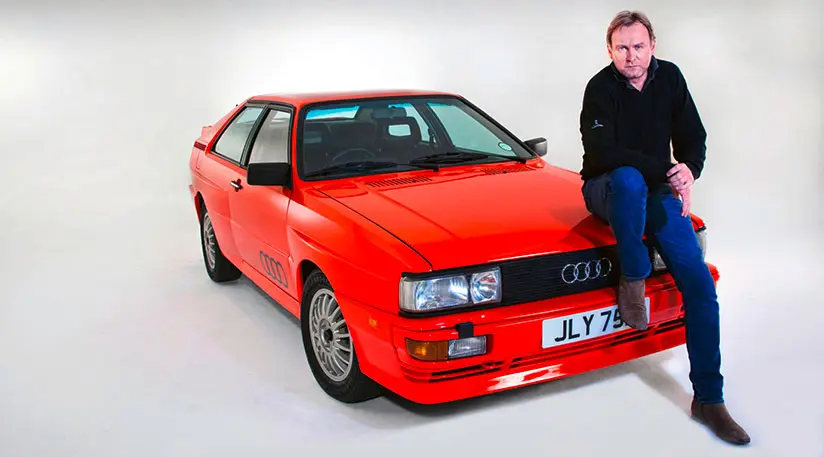
When the production team behind Ashes to Ashes sat down to choose a car for DCI Gene Hunt’s move from 1970s Manchester to 1980s London, they had a problem. Nobody in the room could think of a car that summed up the early 1980s. According to Philip Glenister, the only suggestion on the table was a Mini Metro.
It’s hard to imagine “Fire up the Metro!” entering the national vocabulary. Glenister, who had spent his childhood Saturday mornings watching rallying on television, suggested something else: the Audi quattro. The rest is television history, and a fair slice of British political history too.
Gene Hunt’s gold Ford Cortina had been the perfect car for a copper who policed 1973 Manchester like a western sheriff. The bright red quattro was its 1980s answer: German, turbocharged, four-wheel drive, expensive and loud. It was a car for a decade of shoulder pads and big money, driven by a man who wanted nothing to do with either.
Ashes to Ashes is darker and grittier than most of the shows on Cozy Crime Index, with violence and strong language throughout. But its car is one of the most famous in British television, and no collection of detective cars would be complete without it.
The Car: Audi quattro
Make and model: Audi quattro (known to enthusiasts as the “ur-quattro”) Body: Two-door, four-seat coupé Production: 1980–1991 Screen cars: Two red 1983 right-hand-drive cars On-screen registration: JLY 751V Colour: Bright red, non-metallic Engine: 2,144cc turbocharged five-cylinder, 10 valves (the “WR” engine) Power: 200bhp Drive: Permanent four-wheel drive Price new in 1981: About £14,500
The Show: Ashes to Ashes
Network: BBC One Run: 7 February 2008 to 21 May 2010 Series: Three series of eight episodes (24 in total) Creators: Matthew Graham and Ashley Pharoah Production: Kudos Film and Television, with BBC Wales and Monastic Productions Stars: Philip Glenister (DCI Gene Hunt), Keeley Hawes (DI Alex Drake), Dean Andrews (Ray Carling), Marshall Lancaster (Chris Skelton), Montserrat Lombard (Shaz Granger) Setting: London, 1981–1983 Prequel: Life on Mars (2006–2007) Content: Dark and gritty; violence, gunfire and strong language
Ashes to Ashes picks up where Life on Mars left off. In 2008, Metropolitan Police psychological profiler DI Alex Drake (Keeley Hawes) has spent years studying the case notes of Sam Tyler, the detective who woke up in 1973. Then she is shot, and wakes up in 1981, face to face with the man she has only read about: DCI Gene Hunt, now running CID at Fenchurch East in London, with Ray Carling and Chris Skelton still at his side.
Each series moves the clock on a year. Series 1 is set in 1981, Series 2 in 1982 against the backdrop of the Falklands War, and Series 3 in 1983. Across the run, Alex tries to work out why she is in the past, what happened to Sam Tyler, and who Gene Hunt really is. The final episode answers that last question, and it is one of the more talked-about endings in British television drama.
The show was a solid ratings success, averaging more than six million viewers in each of its three series. The first episode drew around seven million on the night.
Gene Hunt has divorced since we last saw him, and the Cortina has gone. In its place is an imported Audi quattro, which he treats with rather more care than he ever showed the Ford.
Reading the Clues: The Car That Couldn’t Have Been There
Car enthusiasts noticed the problem almost as soon as the first episode aired. Gene Hunt’s quattro could not have existed in 1981.
The quattro was launched at the Geneva Motor Show in March 1980, but early cars were left-hand drive only. Right-hand-drive quattros weren’t announced for the UK until October 1982. At the same point Audi replaced the original four-lens headlamp arrangement with one-piece Cibié headlamp units. The screen cars are 1983 right-hand-drive models with the later lamps, so they are at least eighteen months too new for Series 1.
Glenister is reported to have said that the production knew about the error and decided it didn’t matter, because the quattro was simply a cool car.
The Number Plate
The registration on screen is JLY 751V. A V-suffix plate dates a car to between August 1979 and July 1980, so the plate at least looks right for a car Hunt might have bought in 1981. It doesn’t belong to an Audi, though. According to DVLA records, as reported by the Psycho on Tyres blog, JLY 751V belongs to a 1979 Nissan Sunny: about as far from a 200bhp rally-bred coupé as you could get.
Whatever the reason for the choice, the V plate keeps the car looking older than it really is.
Two Cars, One Character
Like many TV hero cars, Hunt’s quattro was really two cars. Both were red 1983 right-hand-drive models, and both survived filming, though not unscathed.
The car that stayed with the BBC. One car remained in the BBC’s care after the series ended. In November 2014 the BBC auctioned it on eBay for BBC Children in Need. Before the sale, Audi UK gave it a major restoration, though the advert noted it still carried some battle scars from filming. Glenister signed the underside of the bonnet with Hunt’s catchphrase. It sold for £38,598, with all of the money going to the charity. The timing had a neat symmetry: the quattro and Children in Need were both born in 1980.
“HWX”, the car from Series 2 and 3. The second car was sold on eBay in February 2014. Its seller had worked for the production company during filming, and also for the firm that originally supplied the car. He referred to it as “HWX”. According to his advert, it appeared in all sixteen episodes of Series 2 and 3. Its last day on set was 6 February 2010, at RAF Northolt in West London. When it came up for sale it was still riddled with bullet holes from the Series 3 finale, had no MoT, and hadn’t run for eighteen months. It had covered little more than 100 miles in five years. With no reserve, it sold for £15,100 after 48 bids.
The two sale prices make an interesting comparison. The restored, signed charity car fetched roughly two and a half times the price of the battle-damaged car that had done most of the later filming. Provenance helps, but condition still matters.
Not every account agrees on which car did what. A fan wiki claims the Series 1 car had no sunroof and that the second car was written off during a Series 3 stunt. The 2014 sale reports don’t support the write-off claim, since the Series 2 and 3 car survived to be sold.
The End of the Quattro
The quattro’s on-screen story ends in the final episode of Series 3, when it is shot to pieces while shielding Hunt and Alex Drake from a gang of Dutch diamond thieves. Hunt’s reaction is pure Gene: he arrests one of them for “murdering my car”. One reviewer noted that he looked more stirred by the loss of the Audi than by his farewell kiss with Alex.
“Fire Up the Quattro!”
Hunt’s rallying cry as the team headed out on a shout became the show’s best-known line. It turned the car from a prop into a character.
The line’s fame was confirmed in April 2010, a few weeks before the final episode aired, during the general election campaign. Labour unveiled a poster showing Conservative leader David Cameron’s head on Gene Hunt’s body, sitting on the quattro’s bonnet, with the slogan “Don’t let him take Britain back to the 1980s.” Within hours, the Conservatives had put out their own version of the same image with a new line: “Fire up the Quattro. It’s time for change.” Several commentators felt the poster had backfired on Labour.
Three years later, in 2013, an Auto Express poll ranked the Ashes to Ashes quattro fourth in its list of the 40 most famous TV cars of all time.
Why the quattro Suits Gene Hunt
The Right Car for the Wrong Man
On paper, the quattro is an odd choice for Gene Hunt. It’s German, technical and sophisticated, and a dinosaur who distrusts anything new shouldn’t really own one. But that’s the joke and the point. Hunt has been dragged into the 1980s along with everyone else, and the quattro is his concession to modernity. He’ll accept the future if it has a turbo and four-wheel drive.
Rally Car Meets Street Cop
The quattro was built to win rallies, and it did. That suited a detective who drives the way Hunt does. The production made full use of it: deserted London streets, sliding corners and the five-cylinder engine’s distinctive warble became part of the show’s identity.
Expensive Taste on a Copper’s Wage
At around £14,500 new, the quattro was a very expensive car in 1981, far beyond a DCI’s salary. Glenister joked that Hunt “probably would have nicked it”. The show never explains how he paid for it, and that fits a character whose methods never bore close inspection.
The Colour of Gene
Hunt dresses in black and drives a bright red car. You always know where he is, and so does everyone else.
The quattro Story: How Audi Changed the Rules
From Military Jeep to Rally Coupé
The quattro’s four-wheel-drive system has unlikely roots. Its lineage runs back to the 1962 DKW Munga, Auto Union’s first four-wheel-drive vehicle, and then to the Volkswagen Iltis, a military off-roader of 1976. During winter testing of the Iltis, Audi engineers noticed how well the little utility vehicle handled snow and ice, and wondered what the same idea might do for a performance car.
The project was driven by Ferdinand Piëch, grandson of Ferdinand Porsche, then Audi’s head of technical development. Engineers Jörg Bensinger and Walter Treser led the team, and Treser came up with the name. They combined the Iltis-derived four-wheel-drive system with the platform of the second-generation Audi 80 and the turbocharged five-cylinder engine from the Audi 200 5T. Martin Smith styled the coupé body.
Launch and Rally Glory
The quattro made its debut at the 1980 Geneva Motor Show. Rally regulations required Audi to build 400 road-going versions, but demand quickly overtook that figure.
The quattro transformed world rallying. Audi won the manufacturers’ title in only its second season, 1982, and again in 1984. Hannu Mikkola won the drivers’ championship in 1983, and Stig Blomqvist followed in 1984. Within a few years, any team that wanted to win needed four-wheel drive.
The road car wasn’t quite the first four-wheel-drive performance car. Jensen had done it fourteen years earlier with the FF. But only 318 FFs were sold, so Audi has a fair claim to being the first maker to turn a four-wheel-drive performance coupé into a commercial success.
The Last of the Line
Production ended in spring 1991, after 11,452 cars in total. Audi UK kept the last right-hand-drive quattro ever built. It was never registered and has covered no miles. When Ashes to Ashes first aired in 2008, Audi revealed that the car was stored in a sealed, dehumidified environment at a secret UK location. It is finished in the same bright red as Gene Hunt’s car, and Audi said it will never be sold.
Generations and Changes: WR, MB and RR
The quattro changed constantly over its eleven-year life, but enthusiasts split it into three main types, named after their engine codes.
The WR (1980–1987)
The original 2,144cc 10-valve turbocharged five-cylinder produced 200bhp. Both of Gene Hunt’s cars are WRs. Key changes during this era:
- October 1982: Right-hand drive arrives for the UK, along with one-piece Cibié headlamps in place of the original four lenses.
- 1983: Analogue dials give way to a digital LCD dashboard, first in green and later in orange. Some sources date this change to the 1984 model year. Later dashboards included a synthesised voice that read out warnings.
- 1985: A facelift brings a sloping grille, colour-coded spoiler, smoked tail lights, matt-black trim, a restyled interior and a rotary switch for the differential locks.
The MB (1987–1989)
A larger 2,226cc 10-valve engine delivered its power lower down the rev range, through a smaller water-cooled turbo. A Torsen torque-sensing centre differential replaced the manual centre locker. A sunroof became standard, and the bootlid changed to glassfibre.
The RR 20V (1989–1991)
The final quattro had a 20-valve twin-cam version of the 2.2-litre engine, producing 220bhp, plus twin catalytic converters, a tougher transmission, revised suspension and more galvanising. It is the most powerful and most developed of the standard cars, and usually the most valuable today.
Telling Them Apart
The quickest check is the bootlid. WR cars carry a stick-on “quattro” decal. MBs have chrome Audi lettering and the four-rings badge. RRs have only the chrome rings.
The Sport quattro
Separate from the main line, the short-wheelbase Sport quattro of 1984–1986 was a homologation special for Group B rallying. It had a 306bhp four-valve engine, and only 224 were built. It cost more than £51,000 new in 1985 and is now a serious collector’s car.
Under the Bonnet
The heart of every quattro is its in-line five-cylinder engine: smoother than a four, more compact than a six, and with a distinctive off-beat sound. The WR unit in Gene Hunt’s car produced 200bhp at 5,500rpm and 210lb ft of torque. That was enough for 0–60mph in 6.5 seconds and a top speed of around 138mph, which was serious performance in 1981.
The four-wheel-drive system is the quattro’s real party trick. Early cars had a centre differential that the driver could lock, and the MB brought in the Torsen differential, which could send up to three-quarters of the engine’s torque to whichever axle had more grip. Walter Röhrl, a two-time world rally champion, famously found his first drive in the snow frustrating, because the car insisted on going straight on. The quattro’s nose-heavy weight distribution, with about 61% of its weight over the front wheels, made it a car that had to be driven a particular way.
Buying a quattro Today
Prices
The ur-quattro has become a properly collectable classic, and the Ashes to Ashes effect has helped. When the show first aired in 2008, Audi UK said it expected demand for the original quattro to rise sharply.
Classic & Sports Car’s February 2025 price guide gives these values, for restoration project, average and show condition:
- WR: £15,000 / £30,000 / £50,000
- MB: £17,000 / £35,000 / £60,000
- RR 20V: £20,000 / £40,000 / £85,000
- Sport quattro: £80,000 / £125,000 / £200,000
Recent UK sales sit comfortably within those ranges. A rare early 1982 right-hand-drive car sold at Historics in May 2026 for £37,180. A 1989 MB sold through The Market in September 2026 for £32,000.
If you want the Gene Hunt look specifically, you’re after a red 1983–1984 WR with one-piece headlamps.
What to Check
Rust: This is the biggest risk. Check the sills, door edges and wheel arches carefully. The body wasn’t galvanised until the 1985 facelift, so early cars like Hunt’s are the most vulnerable. A cheap quattro needing major bodywork can quickly cost more than a good one.
Engine: The five-cylinder is strong if it has been looked after. A WR should give at least 150,000 miles before an overhaul, and the MB and RR engines are good for 200,000 or more. The WR’s turbo needs to idle for a while before switching off; the MB’s smaller water-cooled turbo is less sensitive.
Brakes: MB and RR cars use a hydraulic accumulator for the brake servo, and it can fail. A specialist inspection is worthwhile.
Electrics and the digital dash: The LCD dashboard is the quattro’s most 1980s feature and one of its weak points. Display elements can fail, and taking the dash apart is slow and expensive. Make sure every display works, every warning light comes on with the ignition and goes off once the engine starts, and, on cars that have it, the voice works.
Parts: Headlamps and rear lights are shared with the front-drive Audi Coupé but are no longer available from Audi. Specialists supply new old stock, and some rear lamps have been remanufactured.
Living With One
The quattro has a reputation for complexity, but its mechanical basics are simple, and there’s a strong specialist and owners’ club network in the UK. Buy the best body you can afford, budget for the electrics, and keep it out of the salt. And learn to say “quattro” with a lower-case q: that’s how Audi writes it.
Spotting London on Screen
Ashes to Ashes is set in London, and much of its 1980s cityscape was filmed on location. The Series 2 and 3 car’s final day on set was at RAF Northolt in West London, on 6 February 2010. The show’s empty-street driving sequences gave the quattro room to show off, and they became one of the show’s visual signatures.
For then-and-now views of London’s streets, see GhostViewer.
The quattro in Film and Television
The Ashes to Ashes car is easily the quattro’s most famous screen role in Britain. Its fame spilled well beyond the show itself:
- “Fire Up the Quattro” (2008): a short special made for BBC Children in Need, in which the Ashes to Ashes cast teamed up with Top Gear‘s Richard Hammond.
- The 2010 general election: the Labour and Conservative posters described above.
- Video games: a quattro appears in Forza Horizon 4, where its description refers to a previous owner with a habit of getting into shoot-outs.
Technical Specifications
Audi quattro (WR), 1983, as used in Ashes to Ashes
Engine: 2,144cc in-line five-cylinder, turbocharged and intercooled, 10 valves Power: 200bhp at 5,500rpm Torque: 210lb ft Transmission: Five-speed manual Drive: Permanent four-wheel drive with lockable differentials Weight: About 1,290kg 0–60mph: 6.5 seconds Top speed: About 138mph Price new (1981): About £14,500 Total production (all quattros, 1980–1991): 11,452 Screen cars: Two red 1983 right-hand-drive WRs On-screen registration: JLY 751V (a period plate belonging to a 1979 Nissan Sunny)
See Also: Detective Cars on Screen
- Gene Hunt’s Ford Cortina Mk III – The gold Cortina Hunt drove in Life on Mars, before the move to London
- Inspector Lynley’s Jensen Interceptor – The British grand tourer whose maker built the four-wheel-drive FF, fourteen years before the quattro
- Inspector Morse & Endeavour Jaguars – The burgundy Mk2 and later XJ6/XJ40 synonymous with Oxford’s finest
- Dalgliesh’s Jaguar E-Type – Another detective car that arrived on screen slightly out of its time
- Dr Ethan Winter’s MGB GT – The pathologist’s 1973 coupé from ITV’s gritty Winter
- Roy Grace’s Alfa Romeo 159 – A haunted detective’s worn Italian saloon in Brighton
- Bergerac’s Triumph Roadsters – Another hero car that was really two cars
- Harry Wild’s BMW 3 Series E30 – The quattro’s 1980s German contemporary, in Dublin
- Van der Valk’s Jeep Cherokee XJ – A battered four-wheel-drive workhorse in Amsterdam
- Columbo’s Peugeot 403 Cabriolet – The rumpled detective’s French convertible
- Foyle’s Humber Super Snipe – The elegant wartime saloon of Hastings
- More Detective Cars – Explore the complete collection
Further Reading
- WhatClassicCar.co.uk – Classic car reviews, buying guides and market analysis
- The Audi quattro owners’ club – UK club for owners of quattros and other Audis, with technical help and events
- IMCDb.org – The Internet Movie Cars Database’s listing of vehicles seen in Ashes to Ashes
Ashes to Ashes ran for three series on BBC One from 2008 to 2010, following Life on Mars (2006–2007). Created by Matthew Graham and Ashley Pharoah, it starred Philip Glenister as DCI Gene Hunt and Keeley Hawes as DI Alex Drake. It is darker and grittier than most shows on Cozy Crime Index, with violence and strong language throughout. The Audi quattro was built from 1980 to 1991; just 11,452 were made, and Gene Hunt’s red 1983 car remains the most famous of them all on British television.
This article is part of the Detective Cars collection on CozyCrimeIndex.com.
