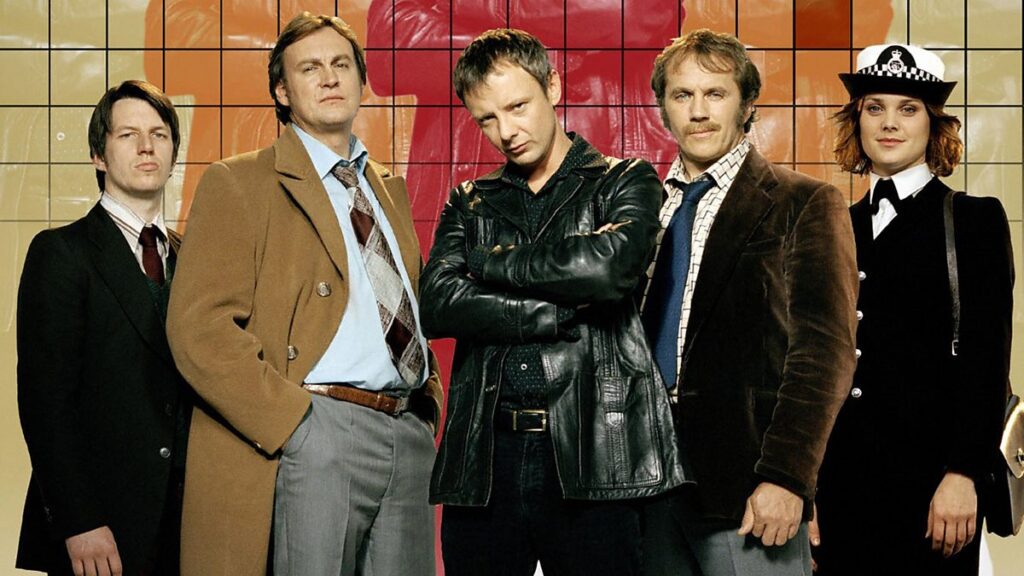
After being hit by a car in 2006, Manchester Detective Chief Inspector Sam Tyler wakes up in 1973, where he’s now a Detective Inspector working under the command of the brutal, hard-drinking DCI Gene Hunt. Uncertain whether he’s mad, in a coma, or has genuinely travelled back in time, Sam must navigate 1970s policing methods while trying to find his way home. Find out more about Gene Hunt’s Ford Cortina Mk III.
Life on Mars aired on BBC One from January 2006 to April 2007, running for two series and becoming one of the most innovative and acclaimed British dramas of its era. Created by Matthew Graham and Ashley Pharoah, the series won two International Emmys for Best Drama and a BAFTA Audience Award, blending science fiction, police procedural, and psychological drama into something wholly original.
The series follows DCI Sam Tyler of the Greater Manchester Police who, while investigating a case in 2006, is struck by a car while listening to David Bowie’s “Life on Mars.” He awakens to find himself in 1973, working as a Detective Inspector for the Manchester and Salford Police—the same location but a different era entirely. The central mystery that drives the series is deliberately ambiguous: Is Sam mad? Is he in a coma, experiencing elaborate hallucinations? Or has he genuinely travelled back in time? Neither Sam nor the audience can be certain, and this uncertainty permeates every aspect of the show.
The culture clash between Sam’s modern, by-the-book approach to policing and the brutal, unreconstructed methods of 1970s police work provides both drama and dark comedy. Sam’s new superior, DCI Gene Hunt, is everything Sam abhors—an overweight, chain-smoking, borderline-alcoholic who has no qualms about roughing up suspects, bending rules, and operating on gut instinct rather than forensic evidence. Hunt’s team embodies the era’s casual sexism, homophobia, and political incorrectness, presenting Sam with constant moral dilemmas as he tries to solve crimes while maintaining his 21st-century ethical standards.
Yet beneath the fish-out-of-water premise, Life on Mars explores deeper themes about memory, nostalgia, and cultural mythology. Sam isn’t just experiencing 1973—he’s experiencing a version of 1973 filtered through television shows like The Sweeney, rock music, and cultural shorthand. The show suggests that Sam may be trapped not in the actual past but in a broadcast version of it, built from fragments of memory and media. Strange voices periodically call to Sam from 2006, suggesting he’s lying in a hospital bed in a coma, while a mysterious Test Card girl appears at uncanny moments, hinting at the constructed, televisual nature of his reality.
Sam finds an ally in WPC Annie Cartwright, a sympathetic policewoman who represents the caring, professional side of policing that exists even in this harsh environment. As Sam bonds with Annie and gradually adapts to this world, he begins to question whether he actually wants to return to 2006. The series features outstanding performances from John Simm as the increasingly conflicted Sam and Philip Glenister as the scene-stealing Gene Hunt, whose brutish exterior occasionally reveals unexpected depth.
The show is steeped in 1970s atmosphere—from the Ford Cortina Mark III that Hunt drives with abandon, to the soundtrack featuring David Bowie, T. Rex, and other glam rock classics, to the smoky, dark police stations and Manchester’s gritty urban landscape. Life on Mars doesn’t just recreate the 1970s; it interrogates how we remember that decade through popular culture.
The series concluded with an ambiguous, much-discussed ending that writer Matthew Graham has said indicates Sam is in the afterlife, though the show deliberately leaves room for other interpretations. A sequel series, Ashes to Ashes, continued the story from 2008-2010, set in the 1980s and eventually revealing more about the nature of Gene Hunt’s world. Life on Mars remains a landmark of British television—innovative, thought-provoking, and utterly compelling.
Yes, just Register and you will then be able to add notes to every character. Just click/tap on the character. The notes can only be seen by you (when you are Logged In)
🔒 More characters will unlock as you update your progress
Credits and More
Credits
🎬 TV Series Creator
Original Concept/TV Series Creators:Matthew Graham and Ashley Pharoah – The screenwriters who conceived Life on Mars in 1998 and created the series for the BBC. There was no original novel or book series; Life on Mars was created directly for television as an original concept inspired by the 1960 Twilight Zone episode “A Stop at Willoughby” written by Rod Serling.
The series was produced by Kudos and became one of the most innovative and acclaimed British dramas of its era, winning two International Emmys and a BAFTA Audience Award.
 United Kingdom
 United Kingdom