
Twenty minutes into the very first episode of the 2020 reboot, a character sums up Commissaris Piet van der Valk’s car with a line that could double as a mission statement for the whole show: “Jaded interior, slightly shabby exterior.” His partner Eddie doesn’t miss a beat—”You can tell a lot about someone from the vehicle they drive.” They’re ostensibly talking about the jeep. They both know they’re really talking about Van der Valk himself.
The Car: Jeep Cherokee (XJ)
Make/Model: Jeep Cherokee, second generation (XJ)
Screen Example: 1998 model, European specification
Colour: Dark blue (often reading as near-black on screen)
Trim: Believed to be a Limited-spec Euro model, per enthusiast forum observations
Body Style: 4-door SUV
Not a squad car, not a sleek unmarked saloon—Van der Valk’s Amsterdam runs on a battered American SUV that’s spent so long on European roads it barely reads as American anymore.
The Show: Van der Valk
Network: ITV (UK) / MASTERPIECE on PBS (US)
Based on: Nicolas Freeling’s Van der Valk novels
Star: Marc Warren as Commissaris Piet van der Valk
Setting: Amsterdam, the Netherlands
Run: 2020–2024, four seasons
Predecessor: An earlier Van der Valk series starring Barry Foster ran on British television from 1972 to 1992
Marc Warren plays Van der Valk as a “bad-tempered lead detective who dresses like a skateboarder but thinks like a forensic psychologist”—comfortable in his own skin, instinctive, unapologetic, and carrying a grief he doesn’t discuss. In the Season 1 finale, we learn why: a high-speed car chase after a corrupt cop ended with Van der Valk’s vehicle rammed and flipped, badly injuring his boss Chief Julia Dahlman and killing his wife Arlette, who was thrown from the car. He never gets over it. Alongside his trusted colleague Lucienne Hassell (Maimie McCoy), scruffy sergeant Brad de Vries (Luke Allen-Gale), and eager newcomer Job Cloovers (Elliot Barnes-Worrell), Van der Valk investigates cases that expose Amsterdam’s contrasts—squatters and gallerists, canal-side wealth and street-level violence, classical musicians and sex traffickers—all filmed on location among the city’s canals, bridges, and bicycle-choked streets.
Why the Jeep Works for Van der Valk
The Cherokee is a small but telling piece of characterisation, and it works on several levels at once:
A Foreign Object That’s Gone Native: A boxy American SUV navigating Amsterdam’s narrow, canal-lined streets and cyclist-dominated junctions is, on paper, a mismatch. But that’s rather the point—Van der Valk himself is a man permanently a half-step out of alignment with the polished, cosmopolitan city around him. The Jeep, like its owner, doesn’t quite belong and doesn’t much care.
Jaded, Not Broken: The show’s own dialogue does the character work for us—”jaded interior, slightly shabby exterior” is as much a description of Van der Valk as it is of his dashboard. A man carrying an unspoken loss, still functioning, still sharp, but visibly worn at the edges. The car wears its mileage the same way he wears his grief: openly, without much fuss, and without any interest in disguising it.
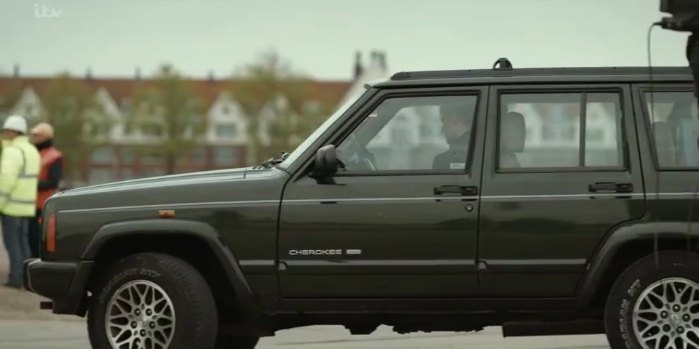
Utility Over Image: Van der Valk isn’t a status-symbol detective. He’s described as street-smart and instinctive rather than image-conscious, and a rugged four-wheel-drive SUV—built originally for unpaved American roads, not Amsterdam’s cobbles—signals a man who values function over appearance in every part of his life, right down to what he drives.
Built to Take a Hit: Given what happens to Van der Valk’s vehicle in the Season 1 flashback—rammed by a corrupt cop, flipped, with devastating consequences—there’s a grim logic in his choice of a genuinely tough, body-on-unibody 4×4 with real off-road pedigree, rather than something built purely for comfort or speed. It’s a car that’s supposed to survive things.
A European Jeep: Few viewers realise that the XJ Cherokee wasn’t purely American in either origin or reach—it was co-developed with European engineering input from the start and sold across the continent for years. Van der Valk’s Jeep isn’t an implausible import; it’s a genuinely well-established European used-car, adding a note of everyday believability that a flashier choice would have undercut.
The Jeep Cherokee (XJ): America’s Compact SUV Goes Global
Origins: An Unlikely Transatlantic Partnership
Development of the Cherokee XJ began in the late 1970s at American Motors Corporation (AMC), the smaller rival that owned Jeep at the time. Struggling for capital, AMC forged a partnership with Renault that gave the French carmaker a foothold in the American market and, crucially, gave AMC access to European engineering expertise. The XJ Cherokee, launched for the 1984 model year, was the first genuine product of that collaboration—and it was designed from the outset with European sale in mind. That transatlantic pedigree explains the Cherokee’s comparatively “tidy, continental appearance” and its trim dimensions next to the larger, more traditionally American SUVs of the era.
Designed by Dick Teague, the XJ was groundbreaking in one crucial technical respect: it was only the second Jeep ever built with unibody (unitary) construction rather than a traditional body-on-frame chassis. This made the Cherokee significantly lighter than its rivals, improving both fuel economy and off-road agility—a combination that would help define the entire modern compact SUV segment for decades afterward.
An 18-Year Production Run
The XJ Cherokee had a remarkably long life for a single generation of vehicle. Introduced for 1984, it remained in continuous US production until June 2001—an 18-year run during which 2,884,172 examples rolled off the line at Jeep’s Toledo, Ohio complex alone. Ownership of the Jeep brand itself changed hands twice during that span: from American Motors (1983-1987), to Chrysler Corporation after its 1987 acquisition of AMC, and finally to DaimlerChrysler from 1998.
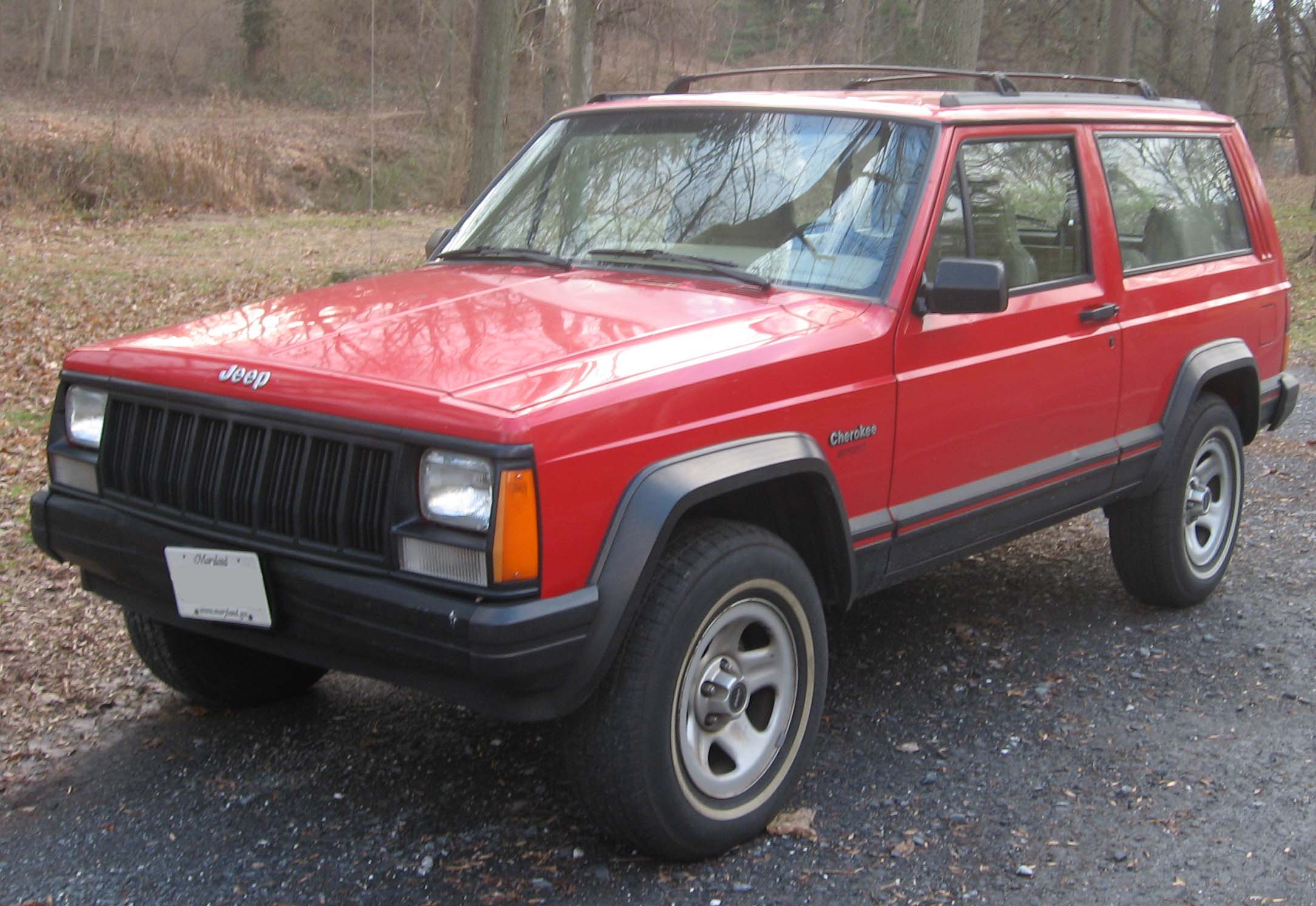
Beyond North America, the Cherokee XJ had a genuinely global manufacturing footprint, with production continuing in China (through 2014), Venezuela, Argentina, and Egypt long after the US line had closed—among the most widely built Jeep platforms in the company’s history.
Engines: A Long Evolution
Across its lifespan, the XJ Cherokee was offered with a wide spread of engines, evolving significantly as the years went on:
Four-Cylinder
- 2.5L AMC 150 (1984-1985): Carburettor, 105 hp, 132 lb-ft torque
- 2.5L AMC 150 TBI (1986-1990): Throttle-body fuel injection, 117-121 hp
- 2.5L AMC 150 MPI (1991-2000): Multi-port injection, 130 hp, 139 lb-ft
V6
- 2.8L Chevrolet LR2 (1984-1986): 115 hp—a stopgap engine, never especially well-loved, dropped once the straight-six arrived
Straight-Six (the engine that made the Cherokee’s reputation)
- 4.0L AMC 242 Renix MPI (1987-1990): 173-177 hp
- 4.0L AMC 242 Chrysler MPI (1991-1995): Around 190 hp
- 4.0L High Output MPI (1996-1999): 190 hp, 235 lb-ft torque
- 4.0L “Power Tech” MPI (2000-2001): 193 hp, 243 lb-ft torque
Diesel (Europe and other export markets only, never offered in the US)
- 2.1L VM Motori Turbo Diesel: 86 hp
- 2.5L VM Motori Turbo Diesel: 140 hp, 236 lb-ft torque
The arrival of the 4.0-litre inline-six for 1987 was the single biggest change in the Cherokee’s history, developed directly from the existing 2.5-litre four-cylinder architecture. It became the engine most associated with the model—and the one most enthusiasts, decades later, still regard as the definitive XJ powerplant, prized for its low-end torque and genuine durability.
Transmissions
Manual gearbox options included the Aisin-Warner AX5 5-speed (paired with the four-cylinder, diesel, and V6 engines) and, briefly between 1987 and mid-1989, a Peugeot-sourced BA-10/5 5-speed matched to the new 4.0-litre six—itself a small but telling piece of the model’s European engineering ties. From late 1989, the Aisin-Warner AX15 5-speed became the standard manual across most six-cylinder models. Automatic transmissions were also widely available throughout the range.
Trim Levels
Over its long run, the Cherokee XJ was offered in a range of trims, evolving as the years passed:
- Base (1984-1993) / SE (1994-2001): The entry-level spec—cloth or vinyl upholstery, AM radio, steel wheels
- Wagoneer (1984-1990): A distinctly upmarket trim, complete with faux wood laminate exterior trim (an echo of the original 1960s Jeep Wagoneer), leather trim, alloy wheels, air conditioning, and power seats
- Limited: The range-topping trim through much of the XJ’s life, and—per enthusiast forum sightings—believed to be close to the specification of Van der Valk’s own screen Jeep, described as a “pristine Euro-spec XJ Limited”
Living With an XJ Cherokee: The Good and the Bad
The Good
Genuine Off-Road Ability: Despite its unibody construction (unusual for a serious off-roader), the XJ retained solid front and rear axles on many models and earned a lasting reputation among off-road enthusiasts for its capability straight out of the factory—a reputation that persists strongly to this day.
The 4.0-Litre Six: Widely regarded as one of the most durable, torquey, and characterful engines Jeep ever built. High-mileage examples—owners regularly report 200,000-300,000+ km—are common and unremarkable, a genuine testament to the engine’s reputation for toughness.
Simplicity and Repairability: An analogue, mechanically straightforward vehicle by modern standards, the XJ remains popular with home mechanics and off-road modifiers alike, helped by a huge and enduring aftermarket.
Compact, Usable Dimensions: Unlike the boxier, larger American SUVs of its era, the XJ’s genuinely European-influenced proportions make it far more manageable in tight city environments—exactly the kind of narrow streets Van der Valk navigates through Amsterdam.
A Cult Following: The XJ’s 18-year production run and huge global sales volume have made it one of the most beloved and widely modified SUVs of all time, with strong dedicated communities (NAXJA and countless regional forums) still actively supporting the platform decades after production ended.
The Bad
Rust: Like many unibody vehicles of the era, XJs are susceptible to corrosion, particularly around the rear quarter panels, floor pans, and unibody structural points—a serious consideration on any high-mileage or long-neglected example, and doubly so on a “slightly shabby” screen car of Van der Valk’s vintage.
Dated Interior and Ride Quality: Even by the standards of contemporary compact SUVs, the XJ’s cabin and ride comfort were fairly basic—solidly built, but with limited creature comforts compared to more modern designs, and a firm, occasionally crashy ride reflecting its solid-axle underpinnings.
Weaker Early Engines: The 2.5-litre four-cylinder and 2.8-litre V6 options, particularly in early carburetted or TBI form, are generally considered underpowered and less desirable than the later 4.0-litre six—an XJ is, in most enthusiasts’ view, only really an XJ once it has the straight-six under the bonnet.
Ageing Electronics: Cherokees fitted with the early “Renix” electronic engine management system (1987-1990) have a reputation among owners for occasional idiosyncratic electrical quirks, though nothing that seriously undermines the platform’s fundamental reliability.
Basic Crash Safety by Modern Standards: As with most vehicles of its era, the XJ predates the airbags, crumple-zone engineering, and electronic driver aids taken for granted today—worth noting, given the pivotal, devastating role a car crash plays in Van der Valk’s own backstory.
Filming Amsterdam: A City as Co-Star
Van der Valk is filmed almost entirely on location across Amsterdam and the wider Netherlands, leaning heavily into the city’s canals, bridges, and architecture as a defining visual signature of the show. Locations across the series’ four seasons have included the Houthaven car ferry, Silodam, Durgerdam, the Artis zoo district, the Groote Zeesluis at Muiden, the Rijksmuseum, the Binnenhof in The Hague, the Oude Kerk, Waterlooplein market, and the rooftops of Dam Square’s Grand Hotel Krasnapolsky—among dozens more. The production’s commitment to shooting almost entirely on Amsterdam’s actual streets and waterways gives the Jeep’s every appearance a strong sense of geographic authenticity, threading a distinctly American vehicle through unmistakably Dutch surroundings episode after episode.
Marc Warren: From Jonathan Strange to Amsterdam’s Streets
Marc Warren, known previously for roles in Jonathan Strange & Mr Norrell, Band of Brothers, The Good Wife, and Beecham House, took on the title role for the 2020 reboot, following in the footsteps of Barry Foster, who originated the character across the original series’ twenty-year run from 1972 to 1992. Warren has described his Van der Valk as “quite closed, a bit impenetrable”—a quietly guarded man carrying private pain beneath a laid-back, street-smart exterior. It’s a description that, once again, could apply equally well to the “jaded interior, slightly shabby exterior” of the Jeep he drives.
Why the Cherokee Suits Van der Valk
The Jeep Cherokee XJ and Piet van der Valk share the same essential trick: neither looks like it’s trying particularly hard, and both are far more capable—and far more damaged—than their unassuming exteriors let on. A tough, European-engineered American SUV, worn but still running strong after two decades on Amsterdam’s streets, is a fitting match for a detective who’s spent years quietly carrying a loss he’ll never fully resolve, doing the job anyway, mile after canal-side mile.
As Eddie says in Season 3, you really can tell a lot about someone from the vehicle they drive. In Van der Valk’s case, that vehicle tells you almost everything you need to know before he’s said a word.
Technical Specifications: Jeep Cherokee (XJ)
Manufacturer: American Motors Corporation (1983-1987); Chrysler Corporation (1987-1998); DaimlerChrysler (1998-2001)
Designer: Dick Teague
Production: 1983-June 2001 (US); through 2014 in China and other export markets
US Production Total: 2,884,172 units
Assembly: Toledo, Ohio (primary); also Beijing, China; Valencia, Venezuela; Córdoba, Argentina; Cairo, Egypt; and others
Body Style: 2-door or 4-door SUV
Layout: Front-engine, rear-wheel drive or four-wheel drive
Construction: Unibody (one of the first Jeeps built this way)
Engine Range:
- 4-cylinder: 2.5L, 105-130 hp
- V6: 2.8L, 115 hp (1984-1986 only)
- Straight-6: 4.0L, 173-193 hp (from 1987)
- Diesel (export only): 2.1L-2.5L, 86-140 hp
Transmission: 5-speed manual (Aisin-Warner AX5/AX15, or Peugeot BA-10/5 briefly); automatic options widely available
Notable Trims: Base/SE, Wagoneer, Limited
Successor: Jeep Liberty (KJ)
See Also: Detective Cars on Screen
- Columbo’s Peugeot 403 Cabriolet – The rumpled LA detective’s deceptively rare French convertible
- Mack’s Mini Moke – Return to Paradise’s reluctantly inherited, hammer-started beach runabout
- Ben Cooper’s Volvo XC90 – Cooper & Fry’s understated Peak District family SUV
- Lily Petal’s Triumph Spitfire 1500 – The Hairdresser Mysteries’ yellow 1970s roadster
- Harry Wild’s BMW 3 Series E30 – Jane Seymour’s red 1980s BMW from Dublin’s literary detective drama
- Inspector Lynley’s Jensen Interceptor – The aristocratic detective’s British-American grand tourer
- Inspector Morse & Endeavour Jaguars – The burgundy Mk2 and later XJ6/XJ40 synonymous with Oxford’s finest detective
- Gene Hunt’s Ford Cortina – The Sweeney-style Ford from Life on Mars
- Rosemary & Thyme’s Land Rover Series III – The gardening detectives’ practical British 4×4
- Vera’s Land Rover Defender – The battered blue workhorse of Northumberland
- Bergerac’s Triumph Roadsters – Two different Triumph Roadsters both wearing Jersey registration J 1610
- Jonathan Creek’s Citroën 2CV – The windmill-dwelling magician’s green French minimalist runabout
- Whitstable Pearl’s 2CV Fourgonnette – The van variant of the 2CV used by Pearl’s seaside restaurant detective
- Queens of Mystery Morris Traveller – Matilda’s mother’s 1960s woodie driven in every investigation
- The Coroner’s Land Rover – Jane Kennedy’s blue Series III soft top
- Lord Peter Wimsey’s Daimler Double-Six – “Mrs Merdle,” the aristocratic sleuth’s stately 12-cylinder saloon
- Foyle’s Humber Super Snipe – The elegant wartime saloon of Hastings
- More Detective Cars – Explore the complete collection
Further Reading
- WhatClassicCar.co.uk – Classic car reviews, buying guides, and market analysis
- NAXJA (North American XJ Association) – Dedicated XJ Cherokee owners’ community and technical resource
- IMCDb.org – Internet Movie Cars Database, cataloguing screen-used vehicles across film and TV
Van der Valk aired on ITV in the UK and MASTERPIECE on PBS in the US from 2020-2024, across four seasons. The Jeep Cherokee XJ was produced from 1984-2001 in the US (and considerably longer elsewhere), selling nearly 3 million units in America alone and earning a lasting reputation as one of the toughest, most dependable compact SUVs ever built. If Van der Valk’s own Jeep is anything to go by, a well-worn XJ can keep working long after it stops looking the part.
This article is part of the Detective Cars collection on CozycrimeIndex.com.
