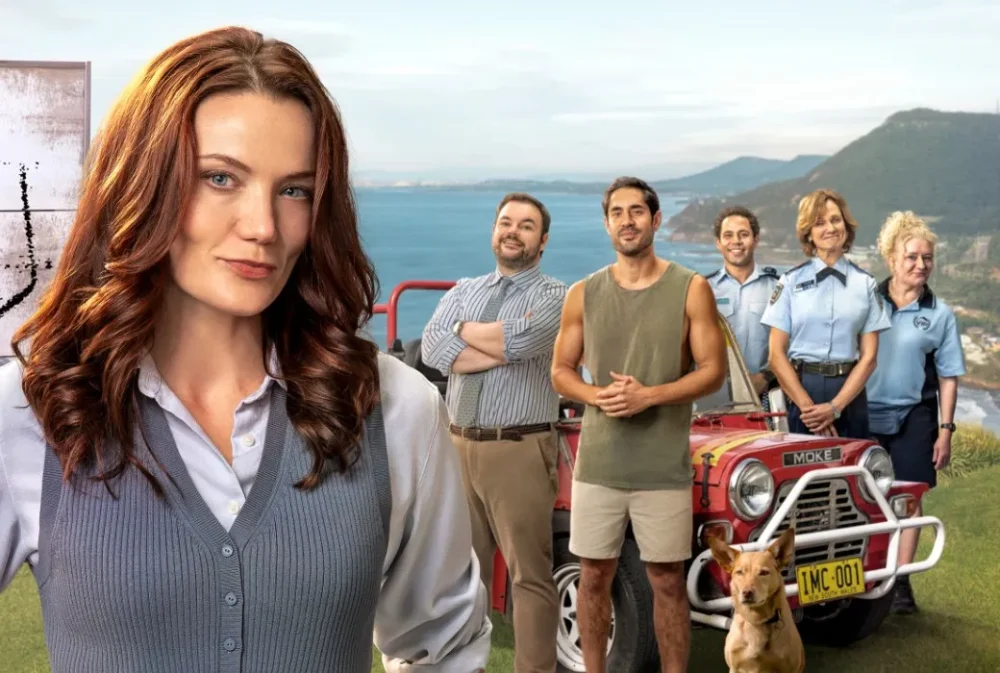
Some detectives choose their cars. DI Mackenzie Clarke inherited hers—quite literally dusted the sheet off it in her late mother’s garage, found it wouldn’t start, and had to give the engine a whack with a hammer before it grudgingly spluttered into life. That car is a Mini Moke, and the moment perfectly sets up both the vehicle and the woman driving it: neither wanted to be back in Dolphin Cove, and neither is entirely sure it’s going to cooperate once it’s there.
The Car: Mini Moke
Make/Model: Mini Moke
Body Style: Open-top, doorless utility vehicle (4-seat convertible configuration)
Origin: British Motor Corporation (BMC), designed by Sir Alec Issigonis
Mack’s Example: Inherited from her mother, of significant vintage, notoriously unreliable
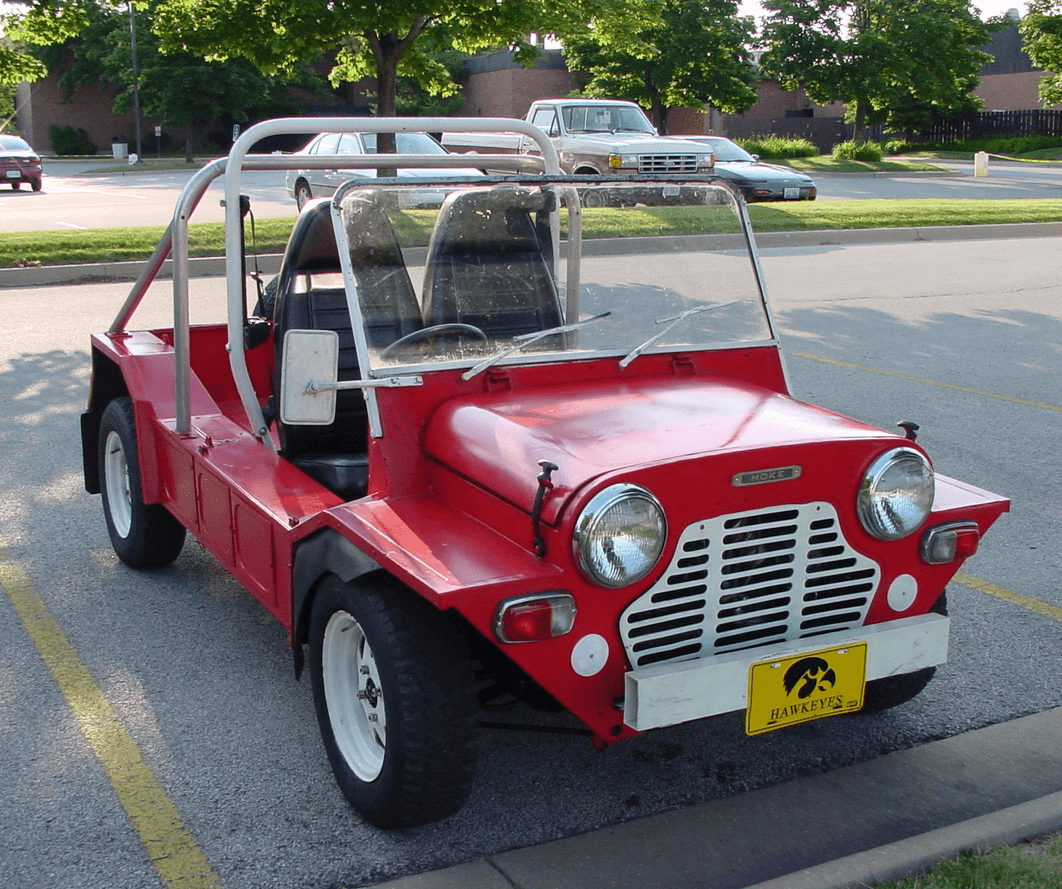
It’s about as far from a conventional detective’s car as it’s possible to get—no doors, no roof to speak of, and an engine that apparently responds better to percussion than to the ignition key.
The Show: Return to Paradise
Network: ABC (Australia) / BBC One (UK) / BritBox (International)
Premiered: 8 September 2024 (Australia), 22 November 2024 (UK)
Creator/Spin-off of: Death in Paradise (via Beyond Paradise, its second spin-off)
Star: Anna Samson as Detective Inspector (later Detective Sergeant) Mackenzie “Mack” Clarke
Setting: The fictional coastal town of Dolphin Cove, Australia
Awards: Silver Logie for Best Drama Program (2025 Logie Awards), with Samson, Tai Hara, and Lloyd Griffith all receiving nominations
Mack Clarke is the golden girl of London’s Metropolitan Police—until circumstances force her back to Dolphin Cove, the small Australian hometown she fled six years earlier and swore never to return to. Nobody there is especially pleased to see her either; the local taxi driver, recognising her, kicks her out of his cab mid-journey and leaves her to drag her suitcase across the beach. It’s not the homecoming she wanted, and she makes it repeatedly clear the arrangement is “temporary.” Naturally, murder finds her within days, and her instinctive, occasionally infuriating gift for solving impossible cases drags her back into police work alongside local officers Colin Cartwright and Felix Wilkinson—whose job she used to hold before she left under circumstances the show takes its time revealing.
Every episode, in keeping with the Death in Paradise formula (and unlike its more character-driven sibling show Beyond Paradise), centres on a murder discovered just before the opening credits roll.
Why the Moke Works for Mack
The Mini Moke isn’t a car Mack would ever have chosen for herself—and that’s exactly the point:
A Homecoming She Didn’t Ask For: The Moke belonged to Mack’s mother. Driving it isn’t a lifestyle choice; it’s an obligation, much like her return to Dolphin Cove itself. Both the car and the town represent a past she thought she’d escaped, and both keep dragging her back in whether she likes it or not.
Percussive, Reluctant, and Slightly Absurd: The image of a sharp, London-trained detective having to hit her car’s engine with a hammer before it will start is comic gold—and it tells you everything about how competence and chaos collide in Mack’s life. She’s brilliant at solving murders and hopeless at everything domestic, including keeping a forty-year-old car running.
Small-Town Practicality (Sort Of): A doorless, roofless open utility vehicle makes a certain sense for a laid-back coastal town where nobody locks anything and the biggest hazard is sand in the footwell—even if it’s a world away from the Met’s fleet vehicles Mack left behind in London.
Character Over Competence: Like Bergerac’s Triumph Roadster or Jonathan Creek’s 2CV, the Moke isn’t chosen for performance or reliability—it’s chosen because it says something about the person who owns it. In Mack’s case, what it says is complicated: family history, small-town roots, and a past she’d rather have left in the garage under a dust sheet.
A Fish Out of Water, On Wheels: Mack is a Londoner who grew up in Dolphin Cove and never expected to return; the Moke, similarly, is a car far more at home pottering along a beachfront than dealing with anything resembling proper roads or traffic. Neither one quite fits where it’s ended up—which is, of course, the entire premise of the show.
The Mini Moke: From Failed Army Vehicle to Cult Beach Icon
Origins: A Jeep That Wasn’t
The Moke’s story begins with a failure. Sir Alec Issigonis, fresh from designing the original Mini, conceived the Moke as a lightweight military vehicle that could be stacked two-high for air transport and dropped by parachute—a genuine attempt to win business away from Land Rover. BMC had working prototypes as early as 1959, under the codename “The Buckboard.” The British Army tested it, and rejected it flat: the Mini’s 10-inch wheels and a mere 133mm of ground clearance made it hopeless in real field conditions. The US Army came to the same conclusion. Prototypes were tried with shorter wheelbases and even twin engines with four-wheel drive, but none of it solved the fundamental problem—there simply wasn’t enough clearance underneath.
Rather than abandon the project, BMC pivoted. If the military didn’t want a rugged off-roader, perhaps the public would want a cheap, characterful runabout. Launched in August 1964 at £405, the Moke leaned entirely into personality rather than capability—no doors, minimal weather protection, and a design so spartan that promotional material showed burly soldiers simply lifting it out of trouble by its tubular steel bumpers.
Three Production Lives, Three Different Countries
The Moke’s manufacturing history splits into three distinct chapters, each shaped by a different market’s needs:
British Phase (1964-1968)
Built first at Longbridge, Birmingham, and briefly at the Morris factory in Oxford, the original Moke used an 848cc BMC A-series engine, 10-inch wheels, and a 2,032mm wheelbase, weighing just 534kg—around 50kg lighter than a standard Mini saloon. British production totalled roughly 14,518 units, with the vast majority exported; British weather and a doorless open-top car were never destined to get on. Barely 1,500 were sold to UK buyers. This is by far the rarest and most collectible phase today.
Australian Phase (1966-1981)
Demand from warmer climates was strong enough that BMC opened a dedicated Moke plant in Zetland, a Sydney suburb, in 1966, and by 1968 had moved production there entirely. Australian Mokes received real practical upgrades: bigger 13-inch wheels and significantly improved ground clearance from 1968, canvas hammock-style seats swapped in for the original Mini seats, and extra bracing and gusseting to strengthen the bodyshell for rougher local roads. Engine capacity grew progressively—998cc, then 1,098cc (with the 1969 Mark 2, which also added synchromesh on all gears and better cooling), and eventually up to 1,275cc. Around 26,142 units were built across this phase, making it the largest of the Moke’s three production runs.
Portuguese/Cagiva Phase (1980-1993)
The final chapter saw production shift to Vendas Novas and later Setúbal in Portugal, initially under British Leyland/Austin Rover badging and, from 1990, under Italian manufacturer Cagiva. These cars used a 998cc A+ engine and represented the most mechanically refined version of the Moke, particularly after a significant 1986 revision that introduced, among other things, a full roll-cage as standard equipment—a tacit admission of just how exposed occupants had always been. Between 10,000 and 11,500 units were built in Portugal before production finally ended in 1993, closing out a 29-year run.
A Global Cult Object
Despite its very modest specifications, the Moke found genuine cult status wherever sun, sand, and short journeys mattered more than weather protection or motorway pace—the Seychelles, the Caribbean, and Australia in particular. It became a fixture of tropical resorts, beach communities, and anywhere a car needed to look fun more than it needed to be fast.
The Moke even had a genuine motorsport moment: in 1977, a 1,275cc Cooper S-engined Moke, sponsored by Coca-Cola, was entered in the gruelling Singapore Airlines London-Sydney Marathon—covering more than 30,000 kilometres over 30 days and finishing an entirely respectable 35th.
Living With a Mini Moke: The Good and the Bad
The Good
Simplicity Itself: Sharing its engine, transmission, and suspension with the standard Mini, the Moke is mechanically straightforward and easy for home mechanics to maintain—assuming you can get parts.
Lightweight and Nimble: At just over 500kg in early form, the Moke is remarkably light, giving it a certain go-kart charm despite its modest power outputs.
Unmistakable Character: Few cars announce “beach holiday” or “small coastal town” quite as effectively. It’s impossible to take too seriously, which is precisely the appeal.
Strong Parts and Club Support: A dedicated global community of enthusiasts, particularly around the Australian-built cars, keeps specialist knowledge and parts supply alive.
The Bad
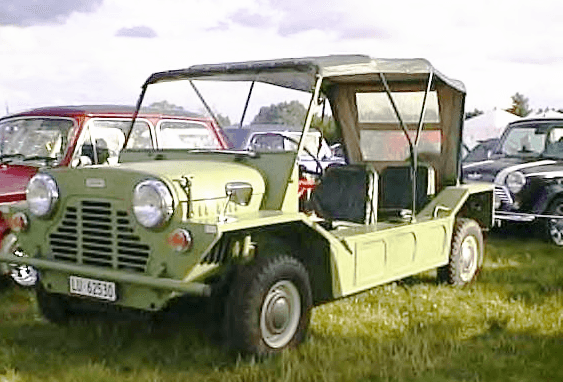
Virtually No Weather Protection: No doors, a minimal folding roof at best, and open sides mean the Moke offers next to no protection from rain, cold, or, frankly, hammers—metaphorical or otherwise.
Woeful Ground Clearance (Early Cars): The very flaw that sank its military ambitions—133mm of clearance—makes early British and pre-1968 Australian Mokes hopeless on anything but smooth surfaces.
Safety, or the Lack Thereof: There’s no getting around it: a post-war design with no doors, no seatbelts in early examples, and no rollover protection until the 1986 Portuguese revision introduced a roll-cage means the Moke offers essentially none of the crash protection expected of a modern vehicle.
Reliability Concerns on Older Examples: Mack’s own experience—having to strike the engine with a hammer to coax it into starting—will ring true to anyone who’s owned a well-worn, decades-old Moke. Ignition, fuel delivery, and general electrical gremlins are common on tired examples.
Rust and Wear: Like most British-derived cars of the era, corrosion is a constant threat, particularly around the sills, floor, and subframes—critical structural areas on a car with such a minimal bodyshell to begin with.
The Moke Today: A Cult Classic’s Market Value
Mini Mokes have become a genuine cult collectable, with the rare early British cars commanding the highest premiums given their scarcity (just 14,518 built, with only around 1,500 staying in the UK). Australian-built examples, being far more numerous, are generally more affordable and easier to source parts for, while the later Portuguese/Cagiva cars—benefiting from the 1986 safety and mechanical revisions—are often considered the most usable and reliable of the three generations for anyone wanting to actually drive one regularly rather than simply display it.
Given how firmly the Moke trades on charm and character rather than outright capability, values have risen steadily as classic car buyers look for something distinctive, affordable relative to more mainstream classics, and unmistakably fun.
Why the Moke Suits Mack Clarke
Mack Clarke and her mother’s old Mini Moke are, in their own ways, both reluctant returnees pressed back into service. Neither was built—or in Mack’s case, chosen a career—for small-town coastal life; both are more at home somewhere else entirely. And yet, week after week, both turn out to be exactly what Dolphin Cove needs: a car with more character than sense, driven by a detective with more competence than she’d ever admit to having missed.
The hammer-to-the-engine gag in that very first episode isn’t just a bit of physical comedy. It’s a mission statement for the whole show: nothing in Dolphin Cove works quite the way it’s supposed to, everyone would rather be somewhere else, and somehow, against considerable odds, it all keeps running anyway.
Technical Specifications: Mini Moke
Manufacturer: BMC (1964-1968); Leyland Australia (1966-1981); British Leyland/Cagiva Portugal (1980-1993)
Designer: Sir Alec Issigonis, with John Sheppard
Production: 1964-1993 (three distinct phases, three different countries)
Total Built: Approximately 50,000-52,000 across all phases
Body Style: 4-seat convertible / 2-seat pickup, doorless
Layout: Front-engine, front-wheel drive
Dimensions:
- Wheelbase: 2,020 mm (79.5 in)
- Length: 3,050 mm (120.1 in)
- Width: 1,300 mm (51.2 in)
- Height: 1,400 mm (55.1 in), roof and windscreen raised
- Weight: approx. 534 kg (British early cars)
Engine Range:
- 848cc A-series I4 (British phase)
- 998cc A-series I4 (Australian and Portuguese phases)
- 1,098cc A-series I4 (Australian Mark 2, from 1969)
- 1,275cc A-series I4 (later Australian cars, including Cooper S-engined examples)
Transmission: 4-speed manual
Wheels: 10-inch (British and early Australian); 13-inch (Australian from 1968)
Production by Phase:
- British (1964-1968): 14,518 units
- Australian (1966-1981): 26,142 units
- Portuguese/Cagiva (1980-1993): 10,000-11,500 units
See Also: Detective Cars on Screen
- Ben Cooper’s Volvo XC90 – Cooper & Fry’s understated Peak District family SUV
- Lily Petal’s Triumph Spitfire 1500 – The Hairdresser Mysteries’ yellow 1970s roadster
- Harry Wild’s BMW 3 Series E30 – Jane Seymour’s red 1980s BMW from Dublin’s literary detective drama
- More Detective Cars – Explore the complete collection
Further Reading
- WhatClassicCar.co.uk – Classic car reviews, buying guides, and market analysis
- Mini Moke Club – Dedicated owners’ resource and technical archive
- MINI Heritage – Official BMW Group/MINI history pages covering the Moke’s story
Return to Paradise airs on ABC in Australia and BBC One in the UK, with international streaming via BritBox. Series two premiered in November 2025, and a third series began production in early 2026. The Mini Moke was produced from 1964-1993 across British, Australian, and Portuguese manufacturing phases, and remains a cult classic prized more for its character than its practicality. If you’re considering one of your own, budget for a thorough inspection of the sills, floor, and subframes—and perhaps keep a hammer in the glovebox, just in case.
This article is part of the Detective Cars collection on CozycrimeIndex.com.