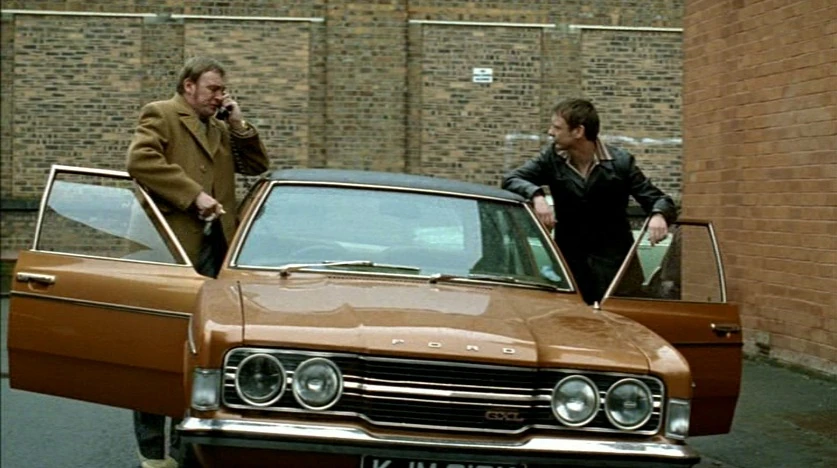
In the annals of British television, few cars have been as integral to a character’s identity as DCI Gene Hunt’s copper-brown Ford Cortina Mk III. From 2006 to 2007, this muscular 1970s saloon tore through the streets of Manchester in Life on Mars, becoming as iconic as Hunt’s leather jacket, his un-PC one-liners, and his refusal to apologise for anything. The car wasn’t just transport—it was a time machine, a symbol of old-school policing, and possibly the most gloriously politically incorrect vehicle ever to grace British television.
The Car: Registration KJM 212K
Gene Hunt’s Ford Cortina Mk III, with its distinctive copper-brown metallic paintwork and black vinyl roof, became one of the most recognisable cars in British television history.
Registration: KJM 212K
The K registration indicates the car was registered in 1971-72, fitting perfectly with the show’s 1973 setting. This detail mattered enormously to fans and classic car enthusiasts, even though—as we’ll discover—the actual car used in filming was considerably more complex than it appeared.
Affectionately known as “Tina” to fans, the Cortina was as much a character in Life on Mars as any of the human actors. Its bronze-gold bodywork, quad headlights, and vinyl roof represented everything about 1970s Britain—bold, unapologetic, and built for going fast without asking permission.
The Show: Life on Mars (2006-2007)
A Copper in a Coma—Or Is He?
Life on Mars premiered on BBC One on 9 January 2006 and immediately became a cultural phenomenon. The premise was brilliantly simple yet endlessly intriguing: DCI Sam Tyler (John Simm), a modern Manchester police officer, is hit by a car in 2006 and wakes up in 1973.
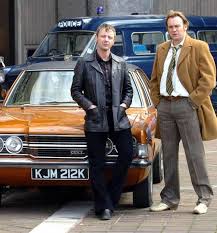
Tyler finds himself working for the Manchester and Salford Police (the predecessor to Greater Manchester Police), now demoted to Detective Inspector, under the command of the bombastic, hard-drinking, rule-breaking DCI Gene Hunt (Philip Glenister).
The show’s genius lay in its ambiguity. Each episode began with Tyler’s monologue:
“My name is Sam Tyler. I had an accident, and I woke up in 1973. Am I mad, in a coma, or back in time? Whatever’s happened, it’s like I’ve landed on a different planet. Now, maybe if I can work out the reason, I can get home.”
Is Tyler really in 1973? Is he in a coma in 2006, constructing this elaborate fantasy? Is he mad? The series never gave easy answers, and that ambiguity kept over 7 million viewers tuning in for the final episode in April 2007.
Two Series, Sixteen Episodes, Infinite Impact
Life on Mars ran for just two series comprising 16 episodes total (eight per series). Despite its relatively brief run, the show won:
- Two International Emmy Awards for Best Drama Series (2006 and 2008)
- BAFTA Audience Award (2006)
- Best New Programme at the Broadcast Magazine Awards (2007)
- Broadcasting Press Guild Awards for Best Drama Series and Writers’ Award (2007)
The series mixed police procedural with science fiction, 1970s nostalgia with modern sensibility, and created something entirely unique. It was both a love letter to and a critique of 1970s policing—a time when forensics took weeks, political correctness didn’t exist, and detectives like Gene Hunt ruled through force of personality and fists.
The Man Behind the Wheel: DCI Gene Hunt
The Guv’nor
Gene Hunt, portrayed brilliantly by Philip Glenister, became an instant television icon. He was:
- Politically incorrect to an almost weaponised degree
- Brutal in interrogations
- Corrupt in the “noble cause” sense (planting evidence to secure convictions of known criminals)
- Hard-drinking, chain-smoking, and unreconstructed
- But fundamentally good
Hunt represented everything 21st-century policing wasn’t supposed to be—and audiences loved him for it. He was dubbed a “national hero” and an “unlikely sex symbol.” His politically incorrect one-liners became watercooler conversation, his methods were simultaneously horrifying and effective, and his relationship with the modern-minded Sam Tyler created television gold.
Hunt believed there was “a very fine line between a criminal and a copper” and operated in that grey area with absolute confidence. His approach to policing was visceral, instinctive, and often legally questionable, but he got results.
The Gene Genie
Hunt first referred to himself as “The Gene Genie” in Series 1, Episode 3—a play on David Bowie’s song “The Jean Genie” (released in late 1972, heard in Episode 4). The nickname stuck, and in the sequel series Ashes to Ashes, an instrumental version of “The Jean Genie” retitled “Gene Genie” became his character theme music.
The nickname perfectly captured Hunt’s larger-than-life personality and the show’s blend of gritty realism and surreal fantasy.
Why the Ford Cortina Mk III Was Perfect
The choice of a Ford Cortina Mk III for Gene Hunt was inspired for multiple reasons:
1. The People’s Performance Car
The Cortina was Britain’s best-selling car throughout the 1970s. It was everywhere—family runabout, police car, getaway vehicle, company car, and sporty saloon for those with aspirations. Choosing a Cortina grounded Hunt in working-class authenticity while the GXL specification showed he had taste and a touch of flash.
2. Raw, Unapologetic Power
The Cortina Mk III represented peak 1970s Ford—angular, aggressive styling with genuine performance to back it up. It was fast enough to chase down criminals, tough enough to take punishment, and simple enough to fix with a hammer and curses.
3. Police Heritage
Cortinas were extensively used by British police forces in the 1970s. Seeing Hunt behind the wheel of a Cortina felt authentic—this was a car that belonged in police work, even if Hunt’s was his personal vehicle rather than a fleet car.
4. The Vinyl Roof
That black vinyl roof was pure 1970s aspiration. In an era before widespread air conditioning, vinyl roofs were a mark of luxury and style. On Hunt’s Cortina, it added menace—like a muscle car in a Savile Row suit.
5. The Color
Copper brown metallic wasn’t subtle, but then neither was Gene Hunt. The bronze-gold color made the car instantly recognizable and matched Hunt’s bold personality. It stood out in every scene, just like the Guv’nor himself.
The Truth Behind “Tina”: A Television Bitsa
Here’s where things get interesting for classic car enthusiasts. The Cortina used in Life on Mars was what collectors call a “bitsa”—bits of this, bits of that. The production team created a car that looked right for 1973, even if the details didn’t quite add up.
The Real Specification
The hero car (used for close-ups) was actually a 1974 Ford Cortina 2000E that had been modified to resemble a GXL:
Modifications included:
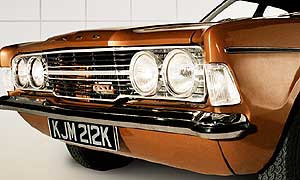
- GXL grille and quad headlights fitted
- Dashboard from a facelifted early 1974 model
- Black vinyl roof (available on 2000E and GXL models)
- KJM 212K registration plates (indicating 1971-72)
The Anachronisms
Car enthusiasts and Top Gear noticed several period inaccuracies:
- The spoiler wouldn’t be available until 1975
- The copper brown metallic color wasn’t offered until July 1972 (L registration onwards); it would have been “tawny brown” on a K-reg car
- The dashboard was wrong for a GXL—should have had deep-dished clocks and early dash
- A 1974 2000E couldn’t have a K registration; 2000E models didn’t come out until September 1973 (M registration)
Three Cortinas
The production actually used three different Cortinas:
- Hero car: The 1974 2000E/GXL hybrid for close-ups
- Stunt car: Believed to be a 1600 model for action sequences
- Backup car: Another hybrid for continuity
This allowed the production to film demanding sequences without risking their primary vehicle. The stunt car took the punishment—and given the high-speed chases, dramatic stops, and general abuse Hunt put the Cortina through, there was plenty of punishment.
The Ford Cortina Mk III: Engineering for the Masses
The Ford Cortina Mk III, produced from 1970 to 1976, was a revolution in British motoring. It replaced the popular Mk II with a design that emphasised space, comfort, and performance.
Design and Development
Designed by Roy Haynes, the Mk III featured:
- Coke-bottle styling: Aggressive, angular lines with flared wheel arches
- Larger interior: More passenger and boot space than the Mk II
- Modern engineering: Improved suspension, better handling
- Range of engines: From economical 1.3L to powerful 2.0L
The GXL model, which Hunt’s Cortina represented, was the sporty luxury variant featuring:
- Quad headlights: Four round headlights instead of two
- Vinyl roof: Black vinyl covering on the roof
- Upgraded interior: Better trim, more equipment
- Alloy wheels: Sporty appearance (often RS-style on later models)
- Performance engines: Typically 2.0L variants
The 2000E Specification
The actual car used was a 2000E, which was even more upmarket:
Technical Specifications (2000E):
- Engine: 2.0-litre (1,993cc) OHC four-cylinder
- Power: 98 bhp (later models up to 100 bhp)
- Transmission: 4-speed manual or 3-speed automatic
- Top Speed: Approximately 105 mph
- 0-60 mph: Around 10 seconds
- Brakes: Servo-assisted disc/drum
- Steering: Rack and pinion
The 2000E featured luxuries like:
- Vinyl roof as standard
- Upgraded interior trim
- Better instrumentation
- Enhanced exterior brightwork
- More soundproofing
Performance and Handling
The Cortina Mk III 2.0 models were genuinely quick for their era. The punchy OHC engine delivered smooth power, and the improved suspension gave respectable handling for a family saloon.
For police work—or chasing villains through Manchester—the 2.0-litre Cortina had enough grunt to close gaps and enough weight to intimidate. The manual gearbox (assuming Hunt’s wasn’t automatic) allowed full control, and the simple, robust engineering meant it would keep running despite punishment.
Gene Hunt and His Cortina: A Love Story
Throughout Life on Mars, the Cortina wasn’t just Hunt’s transport—it was an extension of his character.
Protective to the Point of Paranoia
Hunt was fiercely protective of his Cortina. In one memorable exchange, he warns a group of youngsters:
“If anything happens to this car, I will come round your house and break all your toys.”
This wasn’t hyperbole. Hunt’s Cortina represented his identity, his independence, and his standards. Harming the car was harming Hunt himself.
No One Else Drives
Except in the direst emergencies, Hunt did not let anyone else drive his Cortina. This wasn’t just territoriality—it was about control. The Cortina was Hunt’s domain, and behind its wheel, he was in command.
Sam Tyler occasionally drove it, but usually only out of necessity. The contrast between modern-minded Sam trying to navigate 1973 Manchester in Gene’s Cortina provided some of the show’s best comedy and drama.
The Car as Character
The Cortina appeared in virtually every episode, often playing a crucial role:
- High-speed chases through Manchester streets
- Stakeouts with Hunt chain-smoking inside
- Confrontational conversations between Hunt and Tyler
- Dramatic arrivals at crime scenes
- The occasional donut in car parks
The car’s copper-brown bodywork became as recognizable as the opening titles. Seeing that Cortina meant Gene Hunt was about to arrive, invariably with cigarette in hand, ready to solve crimes with methods that would horrify modern police.
Cultural Impact
The success of Life on Mars and Gene Hunt’s Cortina had significant cultural impact:
On Ford Cortina Values
The show sparked renewed interest in Cortina Mk III models, particularly 2000E and GXL variants. Values began climbing as collectors sought to own “a Gene Hunt Cortina.” Copper brown examples with vinyl roofs commanded particular premiums.
Merchandising
Corgi produced a 1:43 scale model (VA10306) of Hunt’s Cortina, complete with KJM 212K registration plates. Limited to 1,500 pieces worldwide, it became a collector’s item.
The Comic Relief Auction
After filming concluded, the hero car was auctioned on eBay for Comic Relief in 2007. Fan Paul Shedden bought it for £10,000—a significant premium over typical Cortina values, but a bargain for television history.
The car came complete with:
- Holes in the vinyl roof where cameras had been mounted
- Dents in the bonnet where DCI Sam Tyler had landed during stunts
- Battle scars from filming
- A screwed-up script with John Simm’s parts from the final episode found in the glovebox
Shedden stated he was “over the moon” to own such an iconic piece of British television.
Influence on Television
The pairing of period car with strong character influenced subsequent British television. Shows began paying more attention to vehicles as character elements rather than mere props.
The Sequel: Ashes to Ashes and the Audi Quattro
Following the conclusion of Life on Mars in 2007, the BBC commissioned a sequel series, Ashes to Ashes, which ran from 2008 to 2010 for three series.
Gene Hunt Moves On
Set in 1981, Ashes to Ashes revealed that Gene Hunt had worked with Sam Tyler for seven more years until Tyler’s death in a high-speed pursuit in 1980. Shortly thereafter, Hunt transferred from Greater Manchester Police to the Metropolitan Police’s Fenchurch East CID, bringing DS Ray Carling (Dean Andrews) and DC Chris Skelton (Marshall Lancaster) with him.
The new series featured DI Alex Drake (Keeley Hawes), a police psychologist who—like Sam before her—finds herself apparently transported back in time after being shot in 2008.
The Quattro
In the 1980s setting, Hunt had divorced and replaced his beloved Cortina with an Audi Quattro—the ultimate 1980s performance car. Philip Glenister explained the car was “imported from Germany” in the show’s universe.
The Quattro represented Hunt’s evolution:
- More professional than in 1973
- Less aggressive (slightly)
- Calmer and more controlled
- Still fundamentally the same Gene Hunt
The car choice sparked debates among fans: Ford Cortina or Audi Quattro—which was the better crime-fighting car? Cortina fans appreciated its British heritage and raw character. Quattro fans loved the advanced four-wheel-drive technology and turbo power.
But for many, the copper-brown Cortina from Life on Mars remained Hunt’s definitive ride—the car that established the character and became inseparable from his legend.
Life on Mars: The Broader Context
The Time-Travel Mystery
The brilliance of Life on Mars lay in maintaining ambiguity about Sam Tyler’s situation. Was he:
- In a coma in 2006, constructing an elaborate fantasy?
- Back in time somehow physically transported to 1973?
- Dead and in purgatory, working through issues?
- Mad, suffering a complete psychotic break?
Throughout both series, the show provided evidence for all these theories while confirming none. Tyler heard voices from 2006 (his girlfriend, doctors, machines) translated into 1973 contexts (radios, televisions, overhead conversations).
The final episode’s ending—Tyler leaping from a Manchester building to return to 1973, where he truly felt alive—was deliberately ambiguous. Writer Matthew Graham intended it to suggest Sam had died and chosen the afterlife he preferred, but John Simm interpreted it differently.
The 1970s Setting
The show’s depiction of 1970s Manchester was detailed and evocative:
- Period-accurate locations: Real Manchester buildings and streets
- Authentic props: Cars, phones, typewriters, furniture
- Music: Brilliant soundtrack of 1970s hits (David Bowie, T. Rex, Roxy Music, The Sweet)
- Fashion: Perfectly awful 1970s clothing
- Attitudes: Shocking political incorrectness, casual racism and sexism, drinking and smoking everywhere
Former Deputy Chief Constable John Stalker (who was a DI in 1973) praised the show’s accuracy in depicting the era’s policing methods, even as he acknowledged some methods shown would be unacceptable today.
The Cast
Beyond Simm and Glenister, the show featured:
- Liz White as WPC Annie Cartwright (sympathetic female officer, Hunt’s conscience)
- Dean Andrews as DS Ray Carling (Hunt’s loyal lieutenant)
- Marshall Lancaster as DC Chris Skelton (young, eager detective)
- Tony Marshall as DCI/Superintendent Phyllis Dobson
- Noreen Kershaw as WPC/WDC Phyllis Dobson
The ensemble cast created a believable 1970s CID unit, with all the tensions, loyalties, and occasional corruption that entailed.
Behind the Scenes
Life on Mars was created by Matthew Graham, Tony Jordan, and Ashley Pharoah. The concept was inspired by the Twilight Zone episode “A Stop at Willoughby.”
Interestingly, the character Sam Tyler was named by creator Matthew Graham’s daughter after Rose Tyler from Doctor Who—another time-traveling BBC character. The original setting was to be London, then Leeds, before settling on Manchester as part of a BBC initiative to produce more content outside London.
John Simm decided to leave after two series, feeling he’d taken Sam Tyler as far as he could. The show concluded in 2007, though Simm later said he regretted not doing a third series.
The Legacy
Nearly two decades after its premiere, Life on Mars remains one of British television’s most beloved and influential dramas:
Critical Recognition
The show’s awards and critical acclaim established it as a modern classic. It combined genre elements (sci-fi, police procedural, mystery, drama) into something unique that worked on multiple levels.
Gene Hunt as Icon
Philip Glenister’s Gene Hunt became a cultural icon—the politically incorrect copper audiences loved despite (or because of) his outrageousness. He represented a certain nostalgia for “straightforward” times while the show critiqued those times’ less admirable aspects.
The Cortina’s Place
Gene Hunt’s Ford Cortina Mk III became one of television’s most iconic vehicles, joining ranks with:
- Starsky and Hutch’s Gran Torino
- The A-Team’s GMC van
- The Dukes of Hazzard’s General Lee
- Inspector Morse’s Jaguar Mark II
The copper-brown Cortina represented 1970s Britain—confident, brash, powerful, and utterly unapologetic.
Modern Relevance
In 2025, discussions about a possible Life on Mars revival continue. Both Simm and Glenister have expressed willingness to return, though nothing has been confirmed. The show has been called an “early anti-woke television hit” by some, with Gene Hunt’s character representing values and attitudes that wouldn’t be acceptable in modern television.
Whether one views this as refreshing honesty or problematic nostalgia depends on perspective—but that ambiguity is part of the show’s appeal.
The Cozy Crime Connection
While Life on Mars isn’t traditional cozy crime (it features violence, corruption, and explicit content), it shares some DNA with the genre:
Mystery at the Core: Every episode features a crime to solve, often with clever twists.
Character-Driven: The relationship between Sam and Gene drives the narrative as much as the crimes.
Period Charm: The 1970s setting provides nostalgia and escapism.
Humour: Despite dark themes, the show is frequently funny, with Gene’s one-liners providing comic relief.
Ensemble Cast: The CID team functions like a found family, with loyalty and bickering in equal measure.
Manchester as Character: Like Oxford in Inspector Morse or Northumberland in Vera, Manchester becomes integral to the show’s identity.
Specifications Summary
Gene Hunt’s Ford Cortina Mk III (As Depicted)
- Registration: KJM 212K
- Model: Supposedly Mk III GXL (1971-72)
- Colour: Copper brown metallic with black vinyl roof
- Engine: 2.0-litre (based on 2000E)
- Nickname: “Tina”
- Series: Life on Mars (BBC, 2006-2007), 16 episodes
- Status: Sold for £10,000 to private collector (2007)
The Actual Car Used (Hero Vehicle)
- Model: 1974 Ford Cortina 2000E modified as GXL
- Engine: 2.0-litre (1,993cc) OHC four-cylinder
- Power: Approximately 98-100 bhp
- Top Speed: ~105 mph
- Features: Vinyl roof, quad headlights, GXL grille, upgraded interior
- Modifications: Period-incorrect dashboard, modern spotlights, camera mounts
Ford Cortina Mk III Production Facts
- Production Years: 1970-1976
- Total Production: Over 1.1 million units (all variants)
- Engine Options: 1.3L, 1.6L, 2.0L, 2.3L (Savage version)
- Body Styles: 2-door, 4-door, estate
- Notable Variants: Base, L, XL, GXL, GT, 2000E
- Designer: Roy Haynes (Ford)
- Significance: Britain’s best-selling car of the 1970s
Why It Still Matters
Gene Hunt’s Ford Cortina Mk III matters because it represents a perfect marriage of character and machine. The car wasn’t just what Hunt drove—it was who he was:
Tough, powerful, British, unapologetic, functional, stylish (in a 1970s way), and utterly confident in its rightness.
When we see that copper-brown Cortina screeching around Manchester corners, we don’t just see a car—we see Gene Hunt’s character made metal. We see 1970s Britain. We see a time when police work was done with instinct and fists as much as procedure, when political correctness hadn’t been invented, and when a copper’s car said as much about him as his methods.
The Cortina was Hunt’s castle, his weapon, his sanctuary, and his statement. In a show about time travel, ambiguity, and the nature of reality, the Cortina was the one thing that was solid, real, and absolutely certain.
As Gene himself might have said: “Get your coat, Tyler. We’re going for a drive. Try not to scratch the paintwork.”
Want to explore more classic cars from detective shows? Visit What Classic Car for detailed buyer’s guides on Ford Cortinas, Inspector Morse’s Jaguar, Vera’s Land Rover Defender, and other iconic vehicles from British television.
Final Thoughts: The Gene Genie Lives On
Life on Mars ended in 2007, but Gene Hunt and his Cortina live on in repeats, streaming, and cultural memory. The show represented a unique moment in British television—bold, funny, moving, and completely original.
Philip Glenister’s performance as Hunt earned him a place among British television’s greatest characters, and the copper-brown Cortina with registration KJM 212K became as iconic as the man himself.
Whether you’re a classic car enthusiast, a British television fan, or someone who appreciates brilliant writing and acting, Life on Mars and Gene Hunt’s Cortina represent television at its best—taking familiar elements (cop shows, time travel, period drama) and creating something entirely new.
And somewhere, in some parallel universe or comatose dream or afterlife, Gene Hunt is still driving that Cortina through Manchester streets, cigarette in one hand, politically incorrect one-liner at the ready, absolutely convinced he’s right and everyone else is wrong.
Because he’s The Gene Genie. And he’s never wrong.
“Fire up the Quattro!” — Well, that was the 1980s. In the 1970s, it was all about firing up the Cortina.