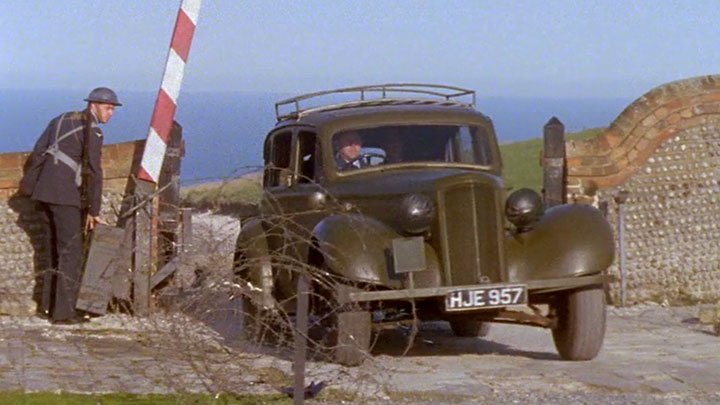
In the vast landscape of British detective television, no car is more perfectly matched to its show than the dark, imposing Humber Super Snipe that carries Detective Chief Superintendent Christopher Foyle through the bomb-scarred streets of wartime Hastings. While other detective cars are chosen for glamour, personality, or eccentricity, Foyle’s Humber was chosen for something rarer in television — historical accuracy. The Super Snipe was genuinely what a senior police officer in 1940s Britain would have driven. It was, simultaneously, the car that Winston Churchill’s cabinet ministers used, the car that Field Marshal Montgomery commanded from the North Africa desert, and the car that a quiet, methodical, unshakeable detective used to pursue justice while the world fell apart around him.
The Car
The Humber Super Snipe that appears throughout Foyle’s War‘s eight series (2002–2015) is a 1930s/early 1940s pre-war Super Snipe saloon, consistent with the show’s wartime setting of 1940–1945 and its post-war Cold War episodes thereafter.
Model: Humber Super Snipe staff car (pre-war/early wartime specification)
Era: Introduced October 1938; produced through wartime
Colour: Dark — typically black or very dark navy, as appropriate for a wartime police vehicle
Role: Foyle’s official police transport, always driven by Sam Stewart
Character: Solid, imposing, authoritative — a car that commands respect without demanding attention
Unlike many television detective cars, which are chosen partly for visual drama, the Humber is deliberately understated. It looks exactly right for 1940s Sussex — neither glamorous nor shabby, simply the appropriate vehicle for a senior police officer doing his duty in extraordinary times.
The Humber Super Snipe: A Wartime Icon
Origins
The Humber Super Snipe was introduced in October 1938 — less than a year before Britain declared war on Germany. It was created by combining the body of the existing Humber Snipe with the more powerful 4.1-litre inline six-cylinder engine from the larger Humber Pullman limousine.
The engine’s design owed something to American expertise. Delmar “Barney” Roos — who had left a successful career at Studebaker to join the Rootes Group in 1936 — contributed significantly to the Super Snipe’s engineering. This gave it something of an American character: large, smooth, powerful, and relatively refined.
Who It Was Built For
The Super Snipe was marketed to upper-middle-class managers, professional people, and government officials. It was relatively affordable for its size and capability, and offered genuine performance — a top speed of 79 mph was fast for a large saloon in 1938.
The target market was exactly the sort of person Christopher Foyle was: senior, professional, serious, and requiring a car that reflected status without ostentation. A Rolls-Royce would be too much; an Austin Ten too little. The Super Snipe sat precisely in the space between them.
The Car That Won the War
When war broke out in September 1939, the Super Snipe’s qualities — performance, reliability, size, and official prestige — made it an obvious choice for military staff car duty. It was adopted as a standard British Army staff car under the designation Car, 4-seater, 4×2, serving alongside the Jeep and the Humber Snipe in a variety of command and liaison roles.
The chassis also served as the basis for the Humber Light Reconnaissance Car Marks I and II — armoured vehicles used extensively in North Africa and Northwest Europe.
Most famously, the Humber Super Snipe was the personal transport of Field Marshal Bernard Montgomerythroughout his campaigns. His car was nicknamed “Old Faithful” and is preserved at the Imperial War Museum. The connection between the Super Snipe and Britain’s most celebrated wartime general gave the car an almost mythological status in wartime memory — exactly the resonance that Foyle’s War quietly exploited.
For a detective pursuing justice in a world at war, a car with this heritage was more than appropriate. It was almost symbolic.
Technical Specifications
Pre-war Humber Super Snipe (1938–1940):
- Engine: 4,086cc (4.1-litre) side-valve inline six-cylinder
- Power: 100 bhp at 3,400 rpm
- Top Speed: 79 mph (fast for a large saloon in 1938)
- Fuel Economy: 22–24 mpg
- Transmission: 4-speed manual
- Dimensions: 15 ft 7.5 in long, 6 ft wide, 5 ft 5.75 in tall
- Seating: Six (full bench front seat, bench rear)
- Construction: Separate chassis and body
The side-valve engine was not the most technically advanced design of the era, but it was proven, reliable, and relatively easy to maintain — qualities that mattered enormously for military and police use.
The Super Snipe was a substantial car — long, wide, and heavy. Sitting in the rear, as Foyle invariably did while Sam drove, you were in a vehicle that felt genuinely important. The high roofline provided dignity; the substantial doors provided solidity; the long bonnet provided presence.
Wartime Modifications
Military Super Snipes typically featured:
- Blackout headlamp masks (slotted covers reducing the light beam to a slit)
- Camouflage paint or dark government colours
- Removal of unnecessary chrome (resource conservation)
- Possible fitting of a radio
- Map reading lights
Civilian police versions in wartime Britain would have been similarly sombre — dark paint, minimal chrome, and the quiet authority of an official vehicle.
The Show: Foyle’s War (2002–2015)
Created After Morse
Foyle’s War was commissioned by ITV specifically to fill the gap left by Inspector Morse, which had ended in 2000. Created by Anthony Horowitz — who would later write Sherlock Holmes novels and the Hawthorne detective series — it was an immediate critical and popular success from its debut in October 2002.
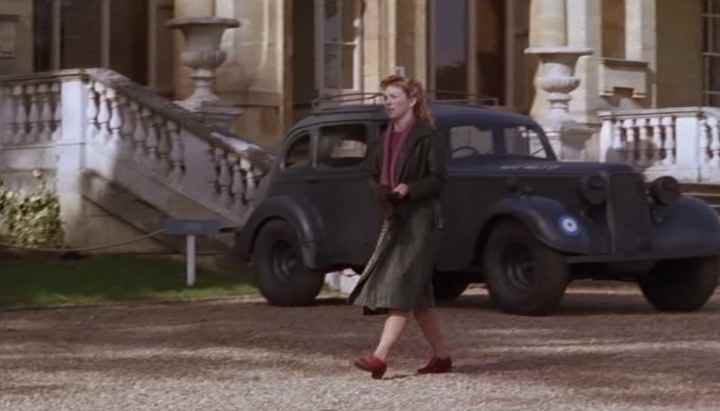
The series ran for eight series comprising 28 feature-length episodes (each 90–100 minutes), concluding in January 2015. Along the way it was cancelled once — ITV’s director of programmes Simon Shaps (the same executive who also cancelled Rosemary & Thyme) cancelled it in 2007 after series six. When the presumed final episode aired in April 2008 with an extraordinary 28 percent audience share, ITV swiftly announced it was entering discussions to bring it back.
Foyle’s War was revived, and continued for two further series — arguably its finest work.
Christopher Foyle: The Reluctant Detective
Detective Chief Superintendent Christopher Foyle (Michael Kitchen) is one of British television’s most distinctive detectives — quiet, methodical, precise, and possessed of an absolute moral compass that admits no compromise.
Foyle is:
- A widower — his wife’s death shapes his quiet gravity
- Methodical rather than inspired — where Morse had flashes of brilliance, Foyle has patience and logic
- Scrupulously honest — in a wartime world of black markets, corruption, and expedient ethics, his refusal to bend is almost radical
- Consistently underestimated — his quiet manner leads the powerful to dismiss him, invariably to their cost
- Deeply principled — he repeatedly tried to resign during the war, believing his skills were wasted on the Home Front; he was consistently refused
- A fly fisherman — his hobby perfectly embodying his character: patient, precise, unhurried
Michael Kitchen’s performance is a masterclass in restraint. Foyle communicates entire paragraphs through a slightly raised eyebrow or a moment of stillness. His silences are as expressive as other actors’ speeches.
Samantha “Sam” Stewart: The Driver
Samantha Stewart (Honeysuckle Weeks) is Foyle’s driver throughout the series — assigned from the Mechanised Transport Corps (MTC), the women’s auxiliary unit responsible for driving military and official vehicles during the war.
Sam is everything Foyle is not — warm, chatty, enthusiastic, occasionally reckless, and thoroughly likeable. Her relationship with Foyle develops from professional courtesy to genuine mutual affection and respect across the eight series, providing the show’s emotional warmth alongside its historical gravity.
Her driving of the Humber is itself character-establishing. Sam drives with confidence and capability — she is a trained MTC driver, not simply a woman put behind the wheel for convenience. When Foyle says “home, Sam” and settles into the rear seat, there is absolute trust in her competence.
The famous exchanges between Foyle in the back and Sam at the wheel — his dry observations, her cheerful commentary — became one of the great pleasures of British television. The Humber’s interior, with its high-backed seats and generous space, was the perfect setting for these conversations.
DS Paul Milner
Detective Sergeant Paul Milner (Anthony Howell) completed the primary trio. Milner lost a leg in the Norwegian campaign of 1940 and returned to civilian police work, where his experience and tenacity proved invaluable. His marriage difficulties across the series provided personal drama alongside the cases.
The Historical Setting
What distinguishes Foyle’s War from almost all other detective series is its rigorous engagement with history. Anthony Horowitz was determined, as he said, to “honour the veterans” by getting the details right.
Each episode is set against specific wartime events:
- The Battle of Britain
- The London Blitz
- The fall of Singapore
- Operation Dynamo (Dunkirk)
- D-Day and its aftermath
- VE Day
- The beginning of the Cold War
The historical research is meticulous. The Imperial War Museum is credited as an advisor. Period details — clothing, vehicles, rationing, blackouts, military procedure, government bureaucracy — are carefully authentic. This authenticity extended to the vehicles, making the Humber Super Snipe not a prop but a genuine period artefact.
Cases: Wartime Crimes
Foyle’s cases consistently explore the moral complexities of war:
- Black market profiteering — civilians enriching themselves while others die
- War profiteers — businessmen exploiting the chaos
- Collaboration — British subjects helping the enemy
- Corruption — officials abusing their wartime power
- Espionage — the Home Front as battleground for intelligence
- Murder against a wartime backdrop — passion, greed, and desperation magnified by crisis
Foyle frequently found himself in conflict with military officers, intelligence agencies, and government officials who wanted crimes buried for the greater good. His refusal to comply — his insistence that murder remained murder regardless of wartime expedience — gave the series its moral backbone.
The Post-War Series
In series seven and eight, set after the war, Foyle came out of retirement to work for MI5 on Cold War espionage cases. The Humber remained, now a slightly anachronistic presence in a world rapidly modernising — much like Foyle himself, applying wartime integrity to peacetime corruption.
The Humber in the Show
Sam and the Super Snipe
The Humber Super Snipe is always Sam’s domain. She maintains it, drives it, and treats it with proprietary care appropriate to an MTC driver responsible for her officer’s transport.
The scenes of Sam driving Foyle through wartime Hastings — streets shadowed by sandbags, windows crossed with blast tape, occasional bomb damage visible — are some of the most evocative images in the series. The large dark Humber moving carefully through a damaged England somehow encapsulates everything the show is about: authority and care, persistence and dignity, doing the right thing in terrible circumstances.
The Interior Conversations
Many of Foyle’s War‘s best scenes take place in the Humber’s interior. The formal arrangement — Foyle in the rear, Sam at the wheel — created a unique conversational space. Foyle’s dry observations, delivered to the back of Sam’s head; Sam’s cheerful responses; the occasional silence as Foyle processed something; all of these played out against the moving Sussex countryside visible through the Humber’s large windows.
The car was not just transport but meeting room, thinking space, and emotional safety valve. In a world of constant surveillance and official scrutiny, the inside of the Humber was somewhere to speak freely.
Authenticity as Character
Where other detective cars assert their character through glamour (Bergerac’s Roadster), eccentricity (The Wagon), or period swagger (Gene Hunt’s Cortina), the Humber Super Snipe asserts its character through absolute historical authenticity.
Seeing the Humber on screen immediately signals that this is a show taking history seriously. The production has not chosen a convenient approximation or a photogenic substitute — it has found the actual car that a senior police officer in 1940s Britain would have driven, the same type of car that Montgomery drove across North Africa, the same car that senior civil servants used to navigate bombed London. The message is clear: everything here is as it was.
Reception and Legacy
Critical Acclaim
Foyle’s War consistently received excellent reviews:
- Praised for Michael Kitchen’s performance above all else
- Cited for its historical research and period authenticity
- Appreciated for its moral seriousness and lack of compromise
- Valued for its portrayal of women (Sam in particular) as capable professionals
- Recognised as among the finest British period drama ever made
American Audiences
Foyle’s War found a particularly devoted audience in the United States through PBS and Acorn TV. American viewers, many with family connections to the Second World War and strong interest in British history, responded to the show’s combination of quality detective fiction and authentic wartime history.
The Humber Super Snipe, exotic to American eyes (nothing quite like it was ever made in America), became part of the show’s appeal — a tangible piece of British wartime history driving across screens.
Why It Still Matters
Foyle’s War concluded in 2015 but remains one of the most-watched classic series on streaming platforms, particularly among older viewers and history enthusiasts. Its combination of excellent detective fiction, scrupulous historical research, and outstanding central performance has given it lasting relevance.
For US audiences in particular, it offers something rare: a serious, adult, beautifully made British drama that treats the Second World War with both accuracy and emotional depth.
The Humber Super Snipe Today
The Humber Super Snipe is rare today. Production ended during the war (with limited civilian production resuming post-war), and the relatively small numbers made combined with decades of attrition mean that surviving pre-war examples are genuinely uncommon.
Those that do survive command respect from classic car enthusiasts who appreciate:
- The historical significance (Montgomery’s car, government service)
- The quality of pre-war British engineering
- The imposing, authoritative presence
- The Foyle’s War connection adding television history
The post-war Humber Super Snipe Mk IV (1952 onwards), powered by a new 4,138cc overhead-valve engine producing 113 bhp, offered improved performance (0-60 in 14.7 seconds, top speed 91 mph) while retaining the same authoritative character. These later models are more commonly seen at classic car events.
Why Foyle’s Humber Worked
The Humber Super Snipe succeeded as a character element for reasons different from most detective cars:
Historical Truth: It wasn’t chosen to look good — it was chosen because it was right. That authenticity resonates throughout the show.
Character Matching: The Humber’s qualities — solid, reliable, authoritative, understated, doing its job without complaint — perfectly mirrored Christopher Foyle’s character.
Period Atmosphere: The dark Humber in blacked-out wartime streets creates atmosphere that no modern car could approach.
The Driver Relationship: The formal arrangement of Foyle in back and Sam driving gave the car a social dimension unique in detective television. The car was a microcosm of their relationship and of wartime Britain’s social structures.
Moral Weight: Montgomery’s “Old Faithful” was fighting a just war. Foyle’s Humber was fighting a just peace. The connection — unstated but felt — gave the car a moral gravity beyond mere transport.
Specifications Summary
Foyle’s Humber Super Snipe
- Model: Humber Super Snipe (pre-war/early wartime specification, c.1938–1940)
- Engine: 4,086cc side-valve inline six-cylinder
- Power: 100 bhp at 3,400 rpm
- Top Speed: 79 mph
- Fuel Economy: 22–24 mpg
- Transmission: 4-speed manual
- Colour: Dark (black or very dark navy)
- Military Role: Staff car, Light Reconnaissance Car basis, Montgomery’s personal transport
- Series: Foyle’s War (ITV, 2002–2015), 28 episodes
The Show
- Title: Foyle’s War
- Network: ITV (UK); PBS / Acorn TV (USA)
- Run: October 2002 – January 2015
- Series: 8
- Episodes: 28 (each 90–100 minutes)
- Stars: Michael Kitchen (DCS Christopher Foyle), Honeysuckle Weeks (Sam Stewart), Anthony Howell (DS Paul Milner)
- Creator: Anthony Horowitz
- Setting: Hastings, Sussex; wartime Britain 1940–1945; post-war Cold War 1945–1950s
- Historical Advisor: Imperial War Museum
Want to explore classic cars from other detective shows? Visit What Classic Car for detailed articles on the Humber Super Snipe, Bergerac’s Triumph Roadster, Inspector Morse’s Jaguar, and other iconic vehicles from British television history.
“There is a war on, and it seems to me it would be rather useful if everyone remembered that.” — Christopher Foyle