Jonathan Creek, a magician's creative consultant with a natural ability for solving puzzles, works from his home in a converted windmill and uses his abilities to solve impossible crimes and mysterious murders. More about Jonathan Creek's Citroen 2CV.
Jonathan Creek represents one of British television’s most original contributions to the detective genre, blending lateral thinking, stage magic, and seemingly impossible crimes into a uniquely entertaining formula that earned it a BAFTA for Best Drama Series in 1998. Created and written by David Renwick, the BBC series aired from 1997 to 2016, starring comedian Alan Davies in a career-defining dramatic role as the titular sleuth—a dishevelled, duffle-coated designer of magic tricks who possesses an extraordinary talent for solving mysteries that defy logical explanation. Unlike traditional detectives who rely on forensic evidence or police procedure, Jonathan uses his intimate knowledge of misdirection, illusion, and lateral thinking to unravel crimes that appear supernatural or physically impossible, making him the perfect investigator for locked-room murders, vanishing corpses, and other bewildering puzzles.
Jonathan Creek lives and works in a converted windmill in the English countryside, designing elaborate illusions and stage tricks for the egotistical American magician Adam Klaus, played by Stuart Milligan. His day job provides both his income and the unique skillset that makes him invaluable when confronted with impossible crimes. Jonathan understands that what appears miraculous or supernatural usually results from meticulous planning and exploitation of human perception—the same principles that underpin stage magic. His ability to think in terms of misdirection, timing, and hidden mechanisms allows him to see solutions that elude conventional investigators. However, Jonathan would much rather be left alone to tinker with his illusions; he’s socially awkward, reclusive by nature, and genuinely reluctant to involve himself in criminal investigations, preferring the ordered world of mechanical puzzles to the messy complications of human violence.
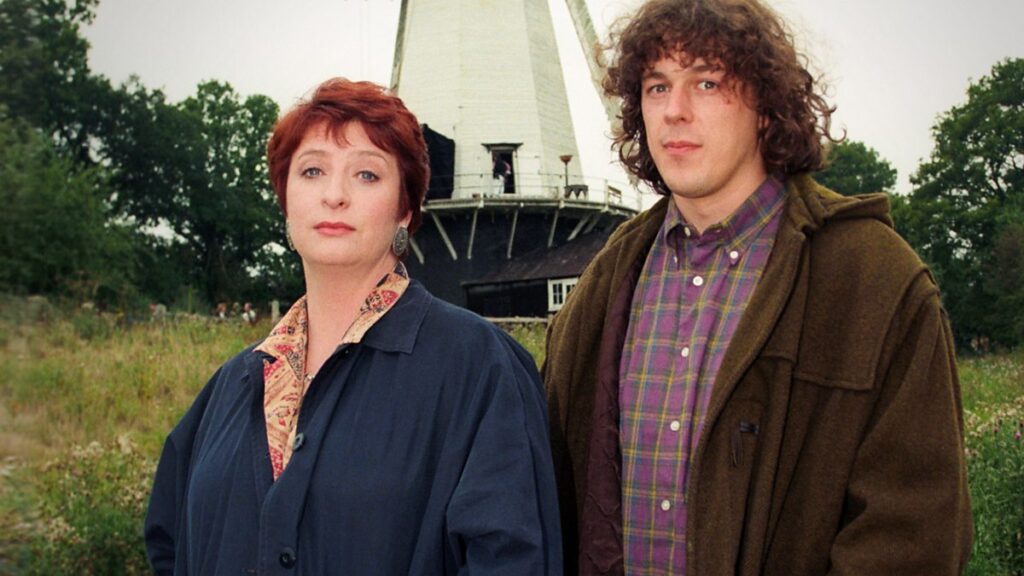
His involvement in crime-solving begins when he encounters Madeline “Maddy” Magellan, an ambitious and pushy investigative journalist played brilliantly by Caroline Quentin. Maddy specialises in writing about crimes the police cannot solve, and she immediately recognises Jonathan’s potential value to her work. Where Jonathan is passive and introverted, Maddy is aggressive and extroverted; where he prefers solitude, she thrives on confrontation and excitement. She essentially bullies him into investigating cases, ignoring his protests and exploiting his inability to resist a good puzzle. Their partnership, which lasted through the first three series until 2000, created one of television’s most memorable detective duos, with genuine chemistry that blended awkward romantic tension with a odd-couple dynamic. Quentin and Davies proved thoroughly engaging precisely because they didn’t look like conventional television stars—their flesh-and-blood genuineness grounded even the most preposterous mysteries.
The cases themselves showcase Renwick’s considerable ingenuity as a puzzle constructor. Episodes typically present crimes that appear physically impossible: a man shoots himself in a sealed underground bomb shelter despite crippling arthritis that makes it impossible for him to pull the trigger; a woman disappears when she enters a room with no other exits; a murder victim is found in circumstances that seem to defy the laws of physics or require supernatural intervention. The pleasure of Jonathan Creek lies in watching Jonathan methodically deconstruct these impossibilities, revealing the elaborate (and often absurdly complicated) human efforts required to create the illusion of the impossible. Renwick plays fair with viewers, providing all necessary clues whilst misdirecting attention in the manner of a skilled conjuror, making the solutions both surprising and satisfying.
After Caroline Quentin departed following the third series, the show introduced Julia Sawalha as Carla Borrego, a theatrical agent who proves even more aggressive than Maddy in dragging Jonathan into investigations. Carla marries television producer Brendan Baxter, played by Adrian Edmondson, and transitions into television presenting, creating new contexts for Jonathan’s involvement in criminal mysteries. The chemistry between Sawalha and Davies differed from the Quentin era but maintained the show’s essential dynamic of an introverted genius reluctantly partnered with a forceful woman who refuses to let him retreat into his windmill sanctuary.
Following the fourth series in 2003-2004, Jonathan Creek continued irregularly through occasional feature-length specials on New Year’s Day and at Christmas, introducing Jonathan’s wife Polly, played by Sarah Alexander. These later specials experimented with format, including episodes that showed the audience the crime before presenting it as a mystery to the characters, and episodes that gently parodied Sherlock Holmes during the height of the BBC’s Sherlock phenomenon. The 2016 Christmas special “Daemon’s Roost” served as a fitting conclusion, featuring callbacks to previous cases and forcing Jonathan to confront the possibility that he may have made a wrong call years earlier and allowed a murderer to walk free.
Davies’ portrayal transformed him into an unlikely star, with the role establishing him as what some called the “thinking woman’s sex symbol” of the late 1990s. His trademark duffle coat—which actually belonged to Davies and which he wore to his audition—became iconic, helping him secure the role when producers decided it perfectly suited the character. Over the course of the series, Jonathan gradually evolved from an asocial oddity into a man with considerable wit and charm, though he never lost his fundamental awkwardness or his reluctance to leave the safety of his windmill and his illusions.
The series benefited enormously from exceptional guest casting, including numerous well-known comedy and dramatic actors such as Rik Mayall as the irrepressible Detective Inspector Gideon Pryke, Warwick Davis, Bill Bailey, Joanna Lumley, and many others. Renwick’s scripts combined intricate plotting with genuine humour, avoiding the trap of being either too comic to sustain dramatic tension or too serious to accommodate the absurdity inherent in some of the murder methods. The show’s distinctive theme music, Camille Saint-Saëns’ “Danse Macabre”, perfectly captured the series’ blend of darkness and playfulness.
Jonathan Creek occupied a unique space in British television—produced by the BBC’s Entertainment department rather than Drama (because Renwick preferred working with familiar collaborators), it defied easy categorisation as either pure mystery or comedy-drama. Its legacy lies in proving that impossible crime fiction could work brilliantly on television, that comedians could carry dramatic roles with authority, and that the most unlikely hero—a windmill-dwelling, duffle-coat-wearing designer of magic tricks—could become one of Britain’s most beloved detectives.
Yes, just Register and you will then be able to add notes to every character. Just click/tap on the character. The notes can only be seen by you (when you are Logged In)
![Jonathan Creek – The Complete Collection [DVD] [](https://m.media-amazon.com/images/I/61IYeuuU+LL._AC_UY218_.jpg)
![Jonathan Creek - Series 5 [DVD]](https://m.media-amazon.com/images/I/61oCQkt70gL._AC_UY218_.jpg)

![Jonathan Creek – Daemons’ Roost [DVD] [2017]](https://m.media-amazon.com/images/I/81jp5bsZZzL._AC_UY218_.jpg)
![Jonathan Creek - The Grinning Man [DVD]](https://m.media-amazon.com/images/I/81Fk39LpynL._AC_UY218_.jpg)
![Jonathan Creek [DVD]](https://m.media-amazon.com/images/I/510Dq59c7HL._AC_UY218_.jpg)

![Jonathan Creek - The Judas Tree [DVD]](https://m.media-amazon.com/images/I/81dWysU+BML._AC_UY218_.jpg)
![Jonathan Creek - Christmas Specials [DVD]](https://m.media-amazon.com/images/I/51jfDySLVlL._AC_UY218_.jpg)

![Jonathan Creek- Series Three [DVD]](https://m.media-amazon.com/images/I/81xHU9s-cpL._AC_UY218_.jpg)

![Jonathan Creek - Series 1 and 2 Box Set [DVD] [199](https://m.media-amazon.com/images/I/51eT22HxQrL._AC_UY218_.jpg)