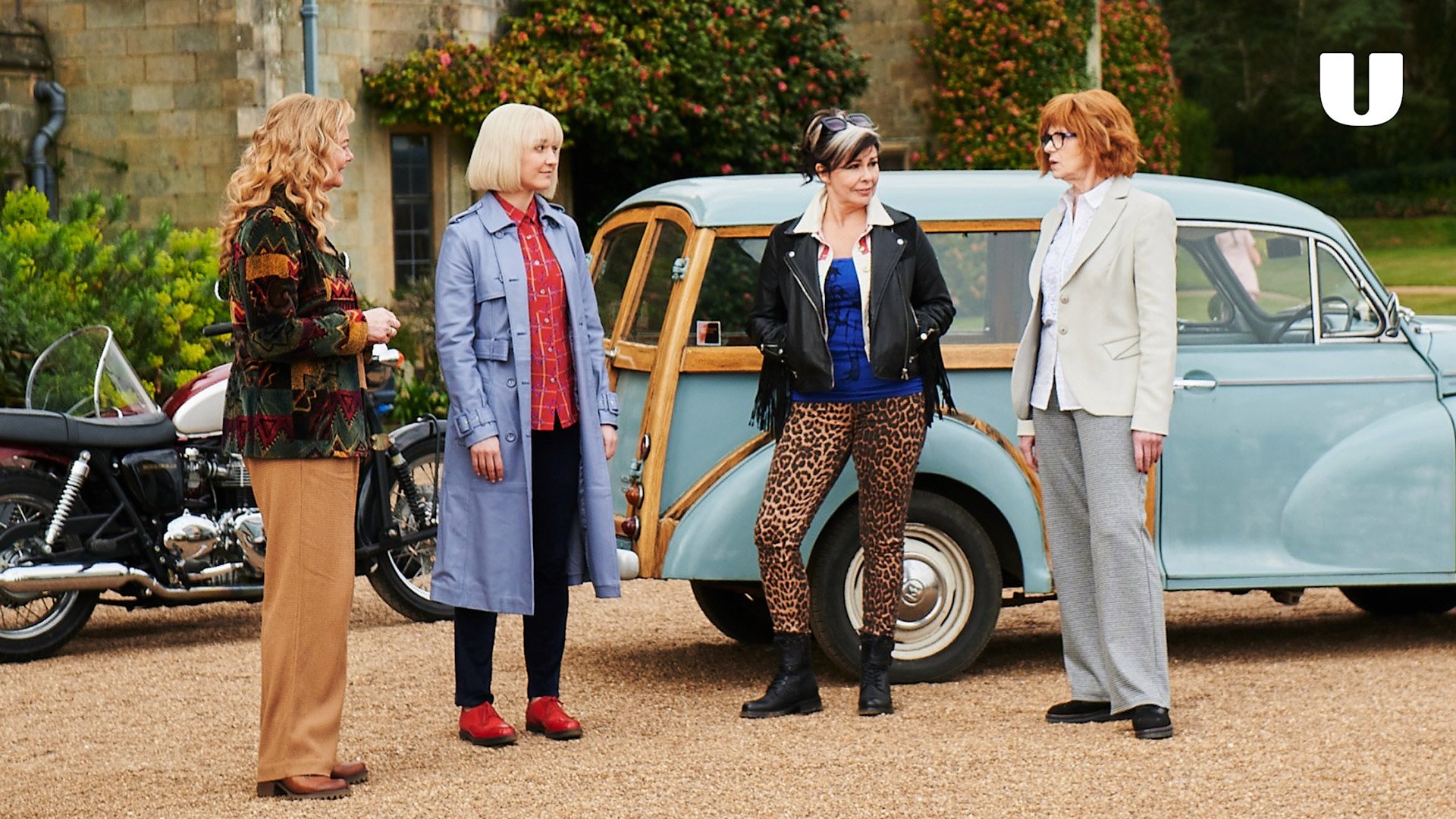
Some detective cars are chosen for practicality. Some for speed. Some for status. Matilda Stone’s Morris Minor Traveller was chosen for love.
The distinctive wood-framed estate car — with its varnished ash frame, split rear doors, and quintessentially English character — wasn’t just Detective Sergeant Matilda Stone’s vehicle in Queens of Mystery. It was her mother’s car. The same Morris Traveller her mother drove before she mysteriously disappeared when Matilda was exactly three years, three days, three hours, and three minutes old.
Her three crime-writing aunts — Beth, Cat, and Jane — lovingly restored the Traveller and gave it to Matilda when she became a detective. Every investigation she conducts, every murder she solves in the picturesque village of Wildemarsh, she does so behind the wheel of the car that connects her to the unsolved mystery at the heart of her own life.
It’s the perfect vehicle for a show that The New York Times called “whimsical,” that critics compared to Murder, She Wrote and Pushing Daisies, and that represents some of the coziest crime television ever broadcast. The Morris Traveller — Britain’s last true production “woodie” — is as much a character as the detective herself.
The Show: Queens of Mystery (2019–2021)
A Detective Raised by Crime Writers
Queens of Mystery is an Acorn TV Original series created by Julian Unthank, following Detective Sergeant Matilda Stone (Olivia Vinall in Series 1, Florence Hall in Series 2) as she investigates murders in her fictional hometown of Wildemarsh, England — a picturesque village where literary puns abound, from The Crepe Gatsby Restaurant to The Call to Arms Arms public house.
Matilda was raised by three extraordinary aunts after her mother’s mysterious disappearance:
Cat Stone (Julie Graham) — a former rocker who now writes mystery graphic novels. Defined as lesbian but “known to have brief affairs with men in the past,” one of which produced her estranged daughter Annie. Represents the “Loner” detective archetype (Philip Marlowe style).
Beth Stone (Sarah Woodward) — the most motherly of the three, a conventional mystery writer who owns a mystery-themed bookshop. Represents the “Intuitive” detective archetype (Miss Marple style).
Jane Stone (Siobhan Redmond) — author of a sci-fi mystery series, the most analytical of the sisters. Represents the “Uber Rational” detective archetype (Sherlock Holmes style).
Matilda Stone — represents the “Normal” detective archetype: the serving police officer, methodical and professional, à la Georges Simenon’s Maigret. She combines elements of all three aunts’ approaches, using both intuition and logic, personal connection and professional distance.
The Format: Wickedly Offbeat
The series ran for two seasons (2019 and 2021) with six episodes per season — three separate feature-length mysteries, each split across two 45-minute episodes titled “First Chapter” and “Final Chapter.” It featured:
- A fairy-tale narrator: An omniscient voice providing whimsical commentary
- Light-hearted tone: Quirky rather than gritty, charming rather than dark
- Classic archetypes: Each character represents a different detective tradition
- Literary atmosphere: The aunts’ crime-writing expertise informs every investigation
- The central mystery: Matilda’s search for answers about her mother’s disappearance runs through both series
The show deliberately positioned itself as cozy crime — “fluffy nonsense” as one affectionate reviewer called it, but with genuine heart and clever mysteries. It’s the sort of show that UK channel ALIBI would air alongside Father Brownand Shakespeare & Hathaway, offering Sunday afternoon comfort rather than Saturday night grit.
Wildemarsh: Picture Postcard England
The fictional village of Wildemarsh exemplifies everything Americans and international viewers imagine about rural England:
- Twee architecture and stone buildings
- Village greens and local bookshops
- Tea shops and traditional pubs
- Close-knit community where everyone knows everyone’s business
- Locations that wouldn’t look out of place in Midsomer Murders or Agatha Raisin
Reviewers compared the setting to the “picture postcard settings in largely rural England” that define the British cozy mystery tradition. It’s England as theatre, England as comfort, England as escape.
And through those narrow village lanes, past those stone cottages and mystery bookshops, Matilda drives her mother’s Morris Traveller — the perfect vehicle for this particularly English form of storytelling.
The Car: Morris Minor Traveller
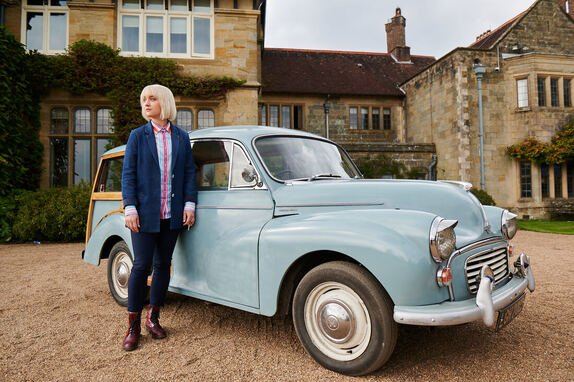
The World’s Last Production Woodie
The Morris Minor Traveller holds a unique place in automotive history: it was the last true production “woodie” station wagon built anywhere in the world. When production finally ended in April 1971, it marked the end of a tradition that stretched back to the 1920s — the tradition of wood-framed estate cars built by actual cabinetmakers.
Unlike American “woodies” of the 1950s that used simulated wood on all-metal bodies, or the later Morris Mini Traveller that used decorative non-structural wood, the Morris Minor Traveller featured a fully structural wooden rear section. From the B-pillar back, the body was framed in real seasoned ash, with aluminum panels fitted within the timber structure. If you lost the wood, you lost the car.
Production figures:
- 215,000 Morris Minor Travellers built (1953–1971)
- This made it the world’s highest-volume woodie ever produced
- Total Morris Minor production: over 1.6 million (all body styles, 1948–1971)
- First British car to sell over 1 million units (1960)
The Engineering: Issigonis and Ash
The Morris Minor was designed by Sir Alec Issigonis — who would later create the iconic Mini — and introduced at the London Motor Show in October 1948. It represented cutting-edge small car engineering for its era:
- Unit construction body (monocoque)
- Torsion bar front suspension
- Rack and pinion steering (revolutionary for the time)
- Low center of gravity (small 14-inch wheels)
- Independent front suspension
The Traveller estate variant was introduced in October 1953, adding the distinctive wood-framed rear section. The construction process was extraordinary:
- Cowley factory built the floor and “cab” section (unit construction)
- Shipped to MG factory at Abingdon (60 miles away)
- Wood rear bodies built in Coventry by specialist cabinetmakers
- Final assembly at Abingdon where the wooden structures were mated to chassis
Only the British would have cabinetmakers build the back ends, then ship them 60 miles to the assembly plant. But the MG factory at Abingdon was phasing out the wood-framed MG TF to make way for the all-steel MGA, so their fully staffed woodshop was perfect for Traveller assembly.
The Wood: 50 Pieces of Seasoned Ash
The wooden frame wasn’t decorative — it was structural, load-bearing, and beautifully crafted:
- 50 separate pieces of seasoned ash wood
- Varnished, not painted (the wood grain remained visible)
- Side-hinged rear doors (the “church doors” or “barn doors”)
- Aluminum roof and side panels fitted within the timber frame
- Maintenance requirement: Regular varnishing to protect the wood from weather
The ash frame gave the Traveller its instantly recognizable silhouette — those vertical and horizontal timbers creating a pattern that said “British countryside” as clearly as a thatched cottage or a dry-stone wall.
Enthusiasts today can still buy complete wood kits for restoration, though the carpentry skills required are considerable. The wood is genuinely structural — lose it, and the rear of the car literally falls apart.
Technical Specifications (1960s Morris Minor 1000 Traveller)
Engine:
- Type: BMC A-Series overhead valve four-cylinder
- Displacement: 948cc (late models: 1,098cc)
- Power: 37 bhp (948cc), 48 bhp (1,098cc)
- Top Speed: 75 mph (948cc), slightly higher with 1,098cc
- 0–60 mph: 31.3 seconds (948cc)
Drivetrain:
- Transmission: 4-speed manual
- Drive: Front-engine, rear-wheel drive
Suspension & Steering:
- Front: Independent torsion bar
- Rear: Leaf springs
- Steering: Rack and pinion (precise and light)
Brakes:
- Standard: Drum brakes all round
- Common upgrade: Front disc brakes from MG Midget (safety improvement)
Dimensions:
- Weight: Approximately 1,700 lbs
- Wheelbase: 86 inches
- Fuel consumption: 35–40 mpg
Why It Suited British Life
Morris Minor Travellers became beloved relics of British cultural history, known by generations as:
- Family cars: Practical, economical, dependable
- British Army staff vehicles: Durable and serviceable
- District Nurse workhorses: Tough enough for rural rounds
- Driving school cars: A remarkable number of Brits over 40 learned to drive in them
They said “Britain” in a way few other cars could. Used in period films and television, they instantly evoke post-war England, village life, and a particular kind of practical British charm. The Traveller was classless — equally at home outside a manor house or a council estate, on a farm or in a suburb.
The Car in Queens of Mystery
Matilda’s Beloved Morris
The specific Morris Traveller used in Queens of Mystery is owned by one of the show’s producers, Tim Vaughan — making it a genuine 1960s example rather than a replica or modified later model. In the series, it serves multiple narrative purposes:
Emotional connection: The Traveller was Matilda’s mother’s car before her disappearance. Every time Matilda drives it, she’s connected to the unsolved mystery at the heart of her life — the case she can’t crack, the crime she can’t solve.
The aunts’ gift: Beth, Cat, and Jane restored the car and gave it to Matilda when she became a detective. It represents their love, their support, and their belief in her abilities. They couldn’t give her back her mother, but they could give her something precious that belonged to her mother.
Visual identity: The wood-framed Traveller is instantly recognizable in every episode. It marks Matilda as someone connected to tradition, to family, to the past — not a London detective imposing metropolitan methods on a village, but someone who belongs to Wildemarsh.
Practical transport: As a working detective’s vehicle, the Traveller is perfect — spacious enough for evidence, distinctive enough to be remembered, tough enough for rural lanes, economical enough for a police salary.
Cozy crime aesthetic: The Morris Traveller is as much a visual shorthand for “British village mystery” as a thatched cottage or a tea shop. It tells viewers immediately what kind of show this is — warm, whimsical, rooted in tradition.
The Character Archetypes
The show’s creators deliberately structured the main characters around classic detective archetypes:
- Jane = Sherlock Holmes (Uber Rational)
- Beth = Miss Marple (Intuitive)
- Cat = Philip Marlowe (Loner)
- Matilda = Maigret (Normal serving officer)
The Morris Traveller itself represents a fifth archetype: the classic British amateur detective’s vehicle. Think Miss Marple’s imagined transport, or the cars that village sleuths would drive in Agatha Christie adaptations. It’s not flashy or fast — it’s dependable, distinctive, and deeply rooted in a particular vision of England.
The Legacy: Britain’s Last Woodie
When the last Morris Minor Traveller rolled off the production line in April 1971, it marked the end of an era. No manufacturer would build another genuine wood-framed production car. The tradition of structural timber bodywork — stretching back to the horse-drawn era, through the great American woodies of the 1930s and 1940s, to the British post-war estate cars — was finished.
The Traveller outlasted them all:
- American woodies ended with the 1953 Buick
- Morris kept building them for another 18 years
- 215,000 units made it the highest-volume woodie in history
Today, Morris Minor Travellers are cherished classics. Values have risen steadily, though they remain “absurdly affordable” compared to American woodies — about one-third to one-half the cost. Virtually every part is still available, including complete wood kits for restoration. Specialist suppliers cater to a devoted enthusiast community who appreciate the Traveller’s honest utilitarianism and its refusal to be anything other than exactly what it was.
They remain a common sight at British classic car shows, often driven rather than trailered — testament to the Minor’s reputation for reliability. Many are still in daily use, their 1960s A-Series engines proving as “unburstable” as their reputation suggests.
Echoes of the Traveller design lived on into the current century. Two generations of the modern Mini Clubman (2007–2024) used the central speedometer and vertically split rear “church doors” pioneered on the Minor — a direct homage from one Issigonis design to another.
Why the Traveller Works for Queens of Mystery
The Morris Traveller succeeds as a character element for several reasons:
Quintessentially English: The wood-framed estate says “rural Britain” more clearly than almost any other car. It’s the automotive equivalent of a village green or a stone cottage.
Nostalgic but not dated: The Traveller evokes the past without being stuck in it. It’s a classic that still functions in modern contexts — like Queens of Mystery itself, which updates traditional mystery tropes without abandoning them.
Personal history: The emotional connection to Matilda’s mother gives the car narrative weight beyond simple transport. It’s a clue, a memory, and a mystery all at once.
Visual charm: The varnished ash frame photographs beautifully in Wildemarsh’s picturesque settings. It’s as much part of the show’s aesthetic as the village architecture or the literary puns.
Cozy crime credentials: The Traveller represents everything the genre values — tradition, community, comfort, and a particular vision of England where mysteries can be solved, wrongs can be righted, and detective work happens at a human scale.
The aunts’ love: The fact that Beth, Cat, and Jane restored it specifically for Matilda demonstrates the show’s central theme: unconventional families, female solidarity, and the power of shared knowledge.
For a show described as “perhaps the coziest mystery television series in a while,” the Morris Traveller is the perfect vehicle.
Specifications at a Glance
The Car
- Make/Model: Morris Minor 1000 Traveller
- Era: 1960s (specific year not publicly documented)
- Real ownership: Owned by producer Tim Vaughan
- Fictional history: Matilda’s mother’s car, restored by her aunts as a gift
- Engine: BMC A-Series 948cc or 1,098cc four-cylinder
- Power: 37–48 bhp (depending on engine variant)
- Top Speed: 75+ mph
- Construction: Structural ash wood frame (50 pieces), aluminum panels
- Production: October 1953 – April 1971
- Total production: 215,000 units (world’s highest-volume woodie)
- Status: Active in series, owned privately by producer
The Show
- Title: Queens of Mystery
- Network: Acorn TV Original
- Run: 2019–2021 (2 series, 12 episodes total)
- Format: Three feature-length mysteries per series, split into “First Chapter” and “Final Chapter”
- Creator: Julian Unthank
- Star: Olivia Vinall (Series 1), Florence Hall (Series 2) as Detective Sergeant Matilda Stone
- Supporting cast: Julie Graham (Cat Stone), Sarah Woodward (Beth Stone), Siobhan Redmond (Jane Stone)
- Setting: Fictional village of Wildemarsh, England
- Tone: “Wickedly offbeat” (Parade), whimsical, cozy crime
Cultural Impact
- Compared favorably to Pushing Daisies, Murder, She Wrote, and Agatha Raisin
- Deliberate homage to classic detective archetypes (Holmes, Marple, Marlowe, Maigret)
- Literary puns throughout (The Crepe Gatsby Restaurant, The Sound & The Fury Records)
- Fairy-tale narrator and whimsical tone
- Strong female characters representing different detective traditions
- Central mystery of Matilda’s mother running through both series
Discover more about detective cars: For other British detective vehicles, explore Inspector Morse’s Jaguar Mark II, Bergerac’s Triumph Roadsters, or Jonathan Creek’s Citroën 2CV. For classic car details, visit What Classic Car.
“The Morris Traveller — Britain’s last true production woodie, and the car that connects one detective to the mystery she can’t solve: her mother’s disappearance.”