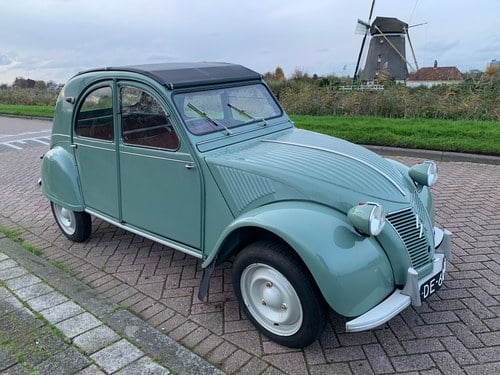
Some detective cars announce their arrival — the roar of Morse’s Jaguar, the rumble of Gene Hunt’s Cortina. Jonathan Creek’s car arrived with the apologetic wheeze of a 602cc air-cooled twin-cylinder engine that sounded, as one reviewer noted, “like a sewing machine in a biscuit tin.”
The battered, scruffy Citroën 2CV driven by Alan Davies’ duffle-coated genius was as much a part of the character as the windmill, the lateral thinking, and the impossible crimes. For nineteen years across thirty-two episodes, that Jade Green 2CV6 Special — registration B251 GEV in the early seasons — became one of British television’s most beloved detective vehicles: not despite its unfashionability, but precisely because of it.
Jonathan Creek didn’t need a car that impressed. He needed one that worked, cost nothing to run, and allowed him to
think while he drove. The 2CV delivered all three — and became, in the process, the automotive equivalent of Creek himself: underestimated, deeply practical, and considerably more intelligent than it looked.
The Show: Jonathan Creek (1997–2016)
An Improbable Detective
Created and written by David Renwick, Jonathan Creek represented one of British television’s most original contributions to the detective genre. It won the BAFTA for Best Drama Series in 1998 and ran semi-regularly across nearly two decades, proving that impossible crime fiction — the locked-room mysteries and vanishing corpse puzzles that had fascinated readers since the golden age of detective fiction — could work brilliantly on television.
Jonathan Creek (Alan Davies) was a designer of magic tricks and stage illusions for the egotistical American magician Adam Klaus (Stuart Milligan). He lived and worked in a converted windmill in the English countryside — specifically, King’s Mill in Shipley, West Sussex — where he spent his days inventing elaborate mechanical deceptions and his evenings reluctantly solving murders that appeared to defy logical explanation.
Creek’s unique skillset made him invaluable when confronted with seemingly impossible crimes:
- A man shoots himself in a sealed underground bomb shelter despite crippling arthritis
- A killer evaporates from a garage with only one guarded exit
- A murder victim is found in circumstances that appear to require supernatural intervention
- A man is positively identified in two continents at exactly the same time
Where police saw the impossible, Jonathan saw misdirection, timing, hidden mechanisms — the same principles that underpin stage magic. His understanding of how illusions work allowed him to deconstruct mysteries that baffled conventional detectives.
The Unlikely Partnership
Jonathan’s involvement in crime-solving began when he encountered Madeline “Maddy” Magellan (Caroline Quentin), an ambitious and pushy investigative journalist who specialised in writing about crimes the police couldn’t solve. Where Jonathan was passive and introverted, Maddy was aggressive and extroverted. She essentially bullied him into investigating cases, ignoring his protests and exploiting his inability to resist a good puzzle.
Their partnership — which lasted through the first three series until 2000 — created one of television’s most memorable detective duos. Quentin and Davies proved thoroughly engaging precisely because they didn’t look like conventional television stars. Their flesh-and-blood genuineness grounded even the most preposterous mysteries.
After Quentin’s departure in 2001, the show introduced Julia Sawalha as Carla Borrego, a theatrical agent who proved even more aggressive than Maddy in dragging Jonathan into investigations. The dynamic remained essentially the same: an introverted genius reluctantly partnered with a forceful woman who refused to let him retreat into his windmill sanctuary.
Following the fourth series in 2003–2004, Jonathan Creek continued irregularly through occasional feature-length specials, introducing Jonathan’s wife Polly (Sarah Alexander) and experimenting with format — including episodes that gently parodied Sherlock during the height of the BBC’s Sherlock phenomenon.
The 2016 Christmas special “Daemons’ Roost” served as a fitting conclusion, featuring callbacks to previous cases and forcing Jonathan to confront the possibility that he may have made a wrong call years earlier.
The Windmill and the Car
Two locations defined Jonathan Creek’s world:
The windmill — King’s Mill in Shipley, West Sussex, built in 1879 and once owned by the writer Hilaire Belloc — served as both home and workspace. The interior was entirely created by production designer John Asbridge, who brought all the magic memorabilia and kitchen fittings for each filming session and removed them afterwards. The windmill is no longer open to visitors but remains visible from the adjacent footpath.
The 2CV — Creek’s scruffy, practical transport — was parked outside the windmill in most exterior shots, a visual shorthand for the character’s personality. While the windmill represented Creek’s cerebral isolation, the 2CV represented his connection to the outside world: reluctant, functional, and utterly unpretentious.
The Car: Citroën 2CV
“Deux Chevaux”: Two Horses, One Icon
The Citroën 2CV (French: deux chevaux, meaning “two taxable horsepower”) was conceived in the 1930s by Citroën Vice-President Pierre Boulanger to help motorise the large number of farmers still using horses and carts in France. The design brief was magnificently simple:
- Enable four people to transport 50kg of farm goods to market at 50km/h
- Cross a freshly ploughed field with a basket of eggs on the passenger seat without breaking them
- Use no more than 3L/100km of fuel
- Be cheap to buy, cheap to maintain, cheap to run
The prototype was developed in the late 1930s, with a pilot run of 250 cars produced in 1939. Brochures were printed for the October 1939 Paris Motor Show — but on 3 September 1939, France declared war on Germany. The show was cancelled. The 2CV launch was abandoned.
During the German occupation, Boulanger personally refused to collaborate with German authorities to the point where the Gestapo listed him as an “enemy of the Reich.” Many prototype 2CVs were hidden or destroyed to prevent them falling into German hands.
The 2CV finally launched at the 1948 Paris Salon de l’Automobile. When the cover was removed, people pushed and shoved to see it. Opinions were divided. The British Autocar correspondent wrote that the 2CV “…is the work of a designer who has kissed the lash of austerity with almost masochistic fervour.” One American motoring journalist quipped, “Does it come with a can opener?”
Despite critics, Citroën was flooded with customer orders. Waiting lists stretched to several years. The 2CV was the car France needed: simple, robust, economical, and genuinely classless. Between 1948 and 1990, over 3.8 million 2CVs were produced, with more than 9 million 2CVs and derivative models in total.
A 1953 technical review in Autocar described “the extraordinary ingenuity of this design, which is undoubtedly the most original since the Model T Ford.”
Technical Specifications: Jonathan Creek’s 2CV6 Special
Jonathan Creek’s specific vehicle:
- Model: Citroën 2CV6 Special
- Registration: B251 GEV (appeared in early seasons including “The Wrestler’s Tomb” and “The Reconstituted Corpse”)
- Colour: Jade Green (officially Vert Jade, Citroën paint code AC 539)
- Note: In certain lighting conditions or on older film stock, the Jade Green can appear as a muted pale pastel green or almost “duck-egg” blue, but Vert Jade was the standard production colour
General 2CV6 specifications:
- Engine: 602cc air-cooled flat-twin
- Power: 29 bhp
- Top Speed: 71 mph (115 km/h)
- 0–60 mph: 32 seconds
- Fuel Consumption: 50+ mpg
- Transmission: 4-speed manual
- Wheelbase: 2,400mm (94.5 inches)
- Weight: 560kg (1,234 lb)
- Drive: Front-wheel drive
- Suspension: Long-travel interconnected suspension with leading arms and coil springs
- Tyres: Originally fitted with Michelin radial tyres (the 2CV was the first car designed around radials)
The “Umbrella on Wheels”
The 2CV’s most distinctive features made it instantly recognisable:
The corrugated bonnet: Originally designed for strength without added weight, it became the car’s visual signature — “an upturned corrugated crab on wheels,” in comedian Jasper Carrott’s memorable description.
The roll-back canvas roof: A full-width sunroof that stretched almost to the rear bumper (until 1955), allowing the 2CV to accommodate oversized loads and giving it the nickname “an umbrella on four wheels.”
The suicide doors: Front-hinged front doors, rear-hinged rear doors — designed for easy entry and exit but earning the “suicide” nickname for the danger if opened while moving.
The minimalist interior: No fuel gauge (a dipstick was provided under the filler cap), single-spoke steering wheel, hammock-style seats that could be removed entirely and used for picnics.
The legendary suspension: Designed to cross ploughed fields without breaking eggs, the long-travel interconnected suspension gave the 2CV extraordinary ride quality over rough roads — and a dramatic lean in corners that terrified passengers but delighted drivers.
Why the 2CV Suited Jonathan Creek
The match between car and character was perfect:
Unpretentious: Creek lived in a windmill and designed magic tricks. He had no interest in status symbols or making impressions. The 2CV — frequently mocked but utterly practical — suited him completely. The subtle Jade Green of B251 GEV was understated, not flashy; it blended in rather than standing out.
Economical: As a freelance illusion designer, Creek’s income was presumably erratic. The 2CV cost almost nothing to run, required minimal maintenance, and could be fixed with a hammer and string if necessary.
Unconventional: Like Creek himself, the 2CV was intelligent in ways that weren’t immediately obvious. Its design was brilliant — air-cooled engine, front-wheel drive, interconnected suspension, radial tyres — clothed in utilitarian bodywork that looked agricultural but worked beautifully.
Functional: Creek needed transport, not performance. The 2CV got him from the windmill to crime scenes, from Sussex to London, from illusion to investigation. It never let him down — and if it had, he’d have fixed it himself.
Period-appropriate: By the late 1990s, the 2CV had been out of production for nearly a decade. Driving one marked Creek as someone who chose function over fashion, durability over disposability — someone whose priorities lay elsewhere than automotive status.
The 2CV in British Popular Culture
By the time Jonathan Creek premiered in 1997, the 2CV had achieved cult status in Britain. Originally sold poorly in the UK due to high import duties and excessive cost, it found its audience among:
- Students (cheap to buy, cheap to run, easy to repair)
- Bohemians and artists (the anti-establishment car)
- Eccentrics and individualists (proudly unfashionable)
- Classic car enthusiasts (by the 1990s, recognising the design’s brilliance)
The 2CV had become the automotive equivalent of a duffle coat — deeply practical, slightly eccentric, beloved by those who valued function over form. For Jonathan Creek, it was the only possible choice.
The 2CV’s Television Legacy
The Citroën 2CV appeared in numerous British television productions, but Jonathan Creek gave it one of its most memorable roles. The car suited the character so completely that it became inseparable from him — as iconic as the windmill, as recognisable as the duffle coat.
Interestingly, the 2CV played a very different role in another British detective series: The Whitstable Pearl’s Citroën 2CV Fourgonnette, where the commercial van version served as restaurant owner and part-time detective Pearl Nolan’s catering vehicle. Same basic design, entirely different context — demonstrating the 2CV’s extraordinary versatility across classes, professions, and television genres.
What Happened to Jonathan Creek’s 2CV?
Unlike some television cars whose fates are carefully documented, the specific whereabouts of B251 GEV — the Jade Green 2CV6 Special that appeared in the early seasons of Jonathan Creek — has not been publicly confirmed. Given the show’s nearly twenty-year run, it’s likely that multiple vehicles were used across different series, though the BBC has not released comprehensive details.
The lack of documentation is itself rather appropriate. Jonathan Creek’s car was never meant to be remarkable. It was transport, not spectacle — which is precisely why it worked so well.
The Show’s Legacy
Jonathan Creek proved that impossible crime fiction could thrive on television, that comedians could carry dramatic roles with authority, and that the most unlikely hero — a windmill-dwelling, duffle-coat-wearing designer of magic tricks — could become one of Britain’s most beloved detectives.
The 2CV played its part perfectly. It never upstaged Creek, never drew attention to itself, never tried to be more than it was. In a television landscape filled with glamorous sports cars and aggressive 4x4s, it represented something different: intelligence, practicality, and a quiet refusal to conform.
As L.J.K. Setright wrote of the 2CV itself: “the most intelligent application of minimalism ever to succeed as a car.” For Jonathan Creek — brilliant, reclusive, and thoroughly unconventional — it was the perfect vehicle.
Specifications at a Glance
The Car
- Make/Model: Citroën 2CV6 Special
- Registration: B251 GEV (early seasons)
- Colour: Jade Green (Vert Jade, paint code AC 539)
- Engine: 602cc air-cooled flat-twin
- Power: 29 bhp
- Top Speed: 71 mph
- Production: 1948–1990 (2CV6: 1970–1990)
- Total production: 3.8 million 2CVs; over 9 million including derivatives
- Status: B251 GEV’s current whereabouts not publicly documented; multiple cars likely used across 19-year series run
The Show
- Title: Jonathan Creek
- Network: BBC One
- Run: 1997–2016 (19 years, 32 episodes including specials)
- Creator/Writer: David Renwick
- Star: Alan Davies as Jonathan Creek
- Partners: Caroline Quentin (1997–2000), Julia Sawalha (2001–2004), Sarah Alexander (2009–2016)
- Award: BAFTA Best Drama Series, 1998
- Filming location (windmill): King’s Mill, Shipley, West Sussex
- Theme music: Camille Saint-Saëns’ “Danse Macabre”
Cultural Impact
- Proved impossible crime fiction could work on television
- Established Alan Davies as a dramatic actor
- BAFTA-winning series that ran for nearly two decades
- The duffle coat, windmill, and 2CV became iconic television imagery
- Regularly cited as one of the BBC’s finest detective dramas
Discover more about detective cars: The Citroën 2CV also appeared in The Whitstable Pearl in its Fourgonnette (van) form, serving a very different detective in a very different context. For more iconic vehicles from British television, visit What Classic Car.
“The most intelligent application of minimalism ever to succeed as a car.” — L.J.K. Setright on the Citroën 2CV