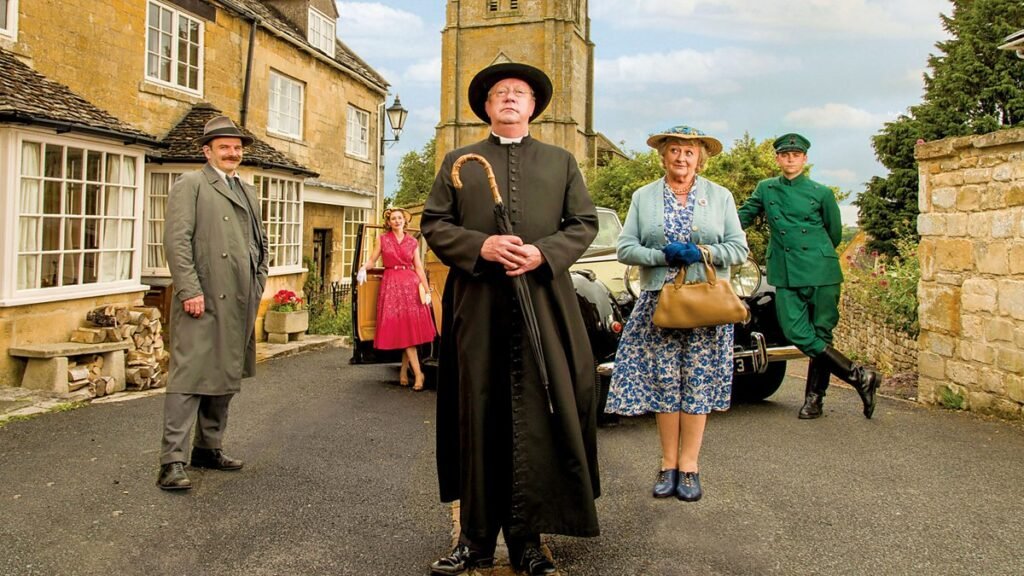
Set in the fictional Cotswold village of Kembleford in the early 1950s, Father Brown follows a slightly rumpled, mild-mannered Catholic priest whose apparent innocence and unassuming manner belie a razor-sharp intellect and profound understanding of human nature. As the priest at St Mary's Church, Father Brown solves murders and mysteries throughout the village and surrounding countryside, driven not by a desire to judge but by his compassion and determination to save souls, drawing on his experiences as a veteran of both World Wars.
Father Brown is a beloved British period detective drama produced by BBC Studios Birmingham that premiered on BBC One on 14 January 2013 and has become one of the network’s most enduring daytime series. Loosely based on the Father Brown short stories by G.K. Chesterton, the show stars Mark Williams (best known as Arthur Weasley in the Harry Potter films) in the titular role of the crime-solving Roman Catholic priest. As of January 2026, the series has aired 140 episodes across thirteen series, making it the second-longest-running daytime drama broadcast by the BBC.
While Chesterton’s original stories were set between 1911 and 1936 and had Father Brown travelling worldwide, the television adaptation repositions the narrative to the early 1950s in post-war Britain, creating a fixed setting in the sleepy fictional village of Kembleford in the Cotswolds. By Series 12, the timeline has progressed to 1955. This period setting allows the show to explore a Britain still struggling with the aftermath of the Second World War, where rationing remains in effect, the coronation of Queen Elizabeth II has recently taken place, capital punishment has not yet been abolished, and homosexuality and abortion remain illegal.
Father Brown himself is wonderfully portrayed by Mark Williams as a shambolic, unassuming figure who, based on appearance alone, would be easily forgotten or dismissed. He shuffles about in his cassock, seemingly distracted and innocent, yet beneath this gentle exterior lies a playful wit and formidable deductive powers. His greatest strength as both priest and detective is his deep love and understanding of people—he seeks not to condemn but to comprehend, to save souls rather than simply solve crimes. This compassionate approach stems partly from his own experiences: he served with the Gloucestershire Regiment as an infantryman in the First World War and as a Catholic chaplain in the Second, giving him insight into the darkness humans are capable of and the redemption they seek.
The series’ charm lies in its ensemble cast and the warm relationships that develop around Father Brown. For the first nine series, he was aided by the stalwart Mrs Bridgette McCarthy (Sorcha Cusack, 2013-2022), his Irish parish secretary who checked facts, acted as his confidante on Church matters and everything else, defended him from congregation complaints, and made sure he actually ate. Other beloved early characters included the beautiful and clever socialite Lady Felicia Montague (Nancy Carroll), her chauffeur Sid Carter (Alex Price), and later the daring Bunty Windermere (Emer Kenny). The various police inspectors who reluctantly work with—or more often against—Father Brown have included Inspector Valentine, Inspector Mallory (Jack Deam), and Chief Inspector Sullivan (Tom Chambers).
Series 10 marked significant cast changes that received mixed reactions from longtime fans. By current series, Father Brown’s household consists of the chaotic Mrs Isabel Devine (Claudie Blakley, née Sullivan, wife of Inspector Sullivan), his blunt housekeeper Brenda Palmer (Ruby-May Martinwood), and the loyal Sergeant Goodfellow (John Burton). The recurring villain Hercule Flambeau (John Light) provides memorable adversarial encounters, with Light’s sterling performances leading many fans to wish for a Flambeau spin-off series.
Each episode presents a self-contained murder mystery that Father Brown must unravel using his intuition, knowledge of human psychology, and keen observation skills. The mysteries range from murders at village fêtes and church gatherings to crimes involving visiting aristocrats, theatrical companies, and occasionally other members of the clergy. Some episodes adapt Chesterton’s original stories (such as “The Blue Cross”), though the television adaptations are notably pacier and more thrilling than their literary sources, while other episodes feature entirely original mysteries created for the series.
The production values are exceptional for a daytime series. Filming takes place primarily in the Gloucestershire village of Blockley, with the Church of St Peter and St Paul serving as St Mary’s Catholic Church and a local vicarage transformed into Father Brown’s presbytery. Other picturesque Cotswold villages used include Winchcombe, Upper Slaughter, Kemerton, and Guiting Power. Heritage railway locations on the Gloucestershire Warwickshire Railway and stately homes like Sudeley Castle add period authenticity. The beautiful cinematography showcases the English countryside at its most idyllic, creating a gentle, nostalgic atmosphere that contrasts pleasingly with the dark deeds being investigated.
Developed by Rachel Flowerday and Tahsin Guner, Father Brown has achieved remarkable international success. BBC Worldwide has sold the series to 232 territories worldwide, including major markets across Europe, Australia, Brazil, and the United States, where it airs on PBS stations. The series proved so successful that it spawned a spin-off, Sister Boniface Mysteries (2022-present), starring Lorna Watson reprising her role from the Father Brown episode “The Bride of Christ.”
The show’s appeal lies in its accessibility and warmth. It’s explicitly family-friendly viewing—relaxing, enjoyable entertainment that avoids graphic violence, excessive darkness, or cynicism. The mysteries are clever without being impenetrable, the characters are charming without being saccharine, and the village setting provides a comforting, nostalgic escape. Father Brown himself embodies decency, intelligence, and compassion without sanctimony, making him an immensely likeable protagonist whose success comes not from superior forensics but from superior humanity.
While some critics note that the series has become formulaic over its long run, and cast changes in later series have divided opinion, Father Brown remains hugely popular with audiences who appreciate its gentle approach to crime drama. It represents classic British cozy mystery at its finest—beautifully filmed, well-acted, intelligently written, and thoroughly decent. Mark Williams’ performance anchors everything, bringing warmth, humour, and quiet wisdom to a character who proves that kindness and understanding can be as effective as deduction in solving the darkest of crimes.
For fans of traditional British mystery series who value charm and character over grit and gore, Father Brown delivers consistent, high-quality entertainment with genuine heart—a rare achievement for any series, let alone one that has sustained such quality across thirteen series and more than a decade on air.
Yes, just Register and you will then be able to add notes to every character. Just click/tap on the character. The notes can only be seen by you (when you are Logged In)
🔒 More characters will unlock as you update your progress
Credits and More
Credits
📚 Original Author
G.K. Chesterton (Gilbert Keith Chesterton, 1874-1936) was an English writer, philosopher, critic, and theologian who created the Father Brown character in 1910. The priest-detective appeared in 53 short stories published in five collections between 1911 and 1936, becoming one of the most enduring characters in detective fiction. Chesterton based Father Brown partly on Father John O'Connor, a Catholic priest who became his friend and later presided over Chesterton's own conversion to Catholicism in 1922. The original stories were set between 1911 and 1936 and featured Father Brown travelling worldwide, solving mysteries through his profound understanding of human nature and sin rather than through forensic science or physical clues. Chesterton's Father Brown was less a detective in the traditional sense and more a student of the human soul, using his priestly insight into moral weakness and capacity for evil to understand criminal motivations. The stories were known for their paradoxical plots, philosophical depth, and Chesterton's distinctive writing style—witty, profound, and deeply concerned with questions of morality, faith, and human nature.
🎬 TV Series Creator
he 2013 BBC television adaptation was developed by Rachel Flowerday and Tahsin Guner, who reimagined Chesterton's stories for contemporary audiences while maintaining the essential character of the compassionate priest-detective. The series was conceived when BBC Daytime sought a home-grown detective series for weekday afternoon slots on BBC One. Rather than commissioning entirely original ideas from writers, the BBC opted for something less risky and already well-known, leading to the revival of Father Brown, which hadn't been produced for British television since a 1974 series starring Kenneth More (and before that, a 1966 series). The production is a BBC Studios Birmingham Drama Village venture, with early series produced by Jonathan Phillips and later series involving producers including Peter Bullock and executive producers John Yorke and Helen Munson. The decision to relocate the stories from Chesterton's globe-trotting original to a fixed Cotswold village setting was driven by budgetary considerations—requiring fixed locations, established sets, and a small regular cast—but this limitation ultimately became one of the show's greatest strengths, creating the warm, community-focused atmosphere that has made it such enduring comfort viewing.
🏢 ProductionBBC Worldwide, BBC, BBC Drama Productions, BBC Studios Productions