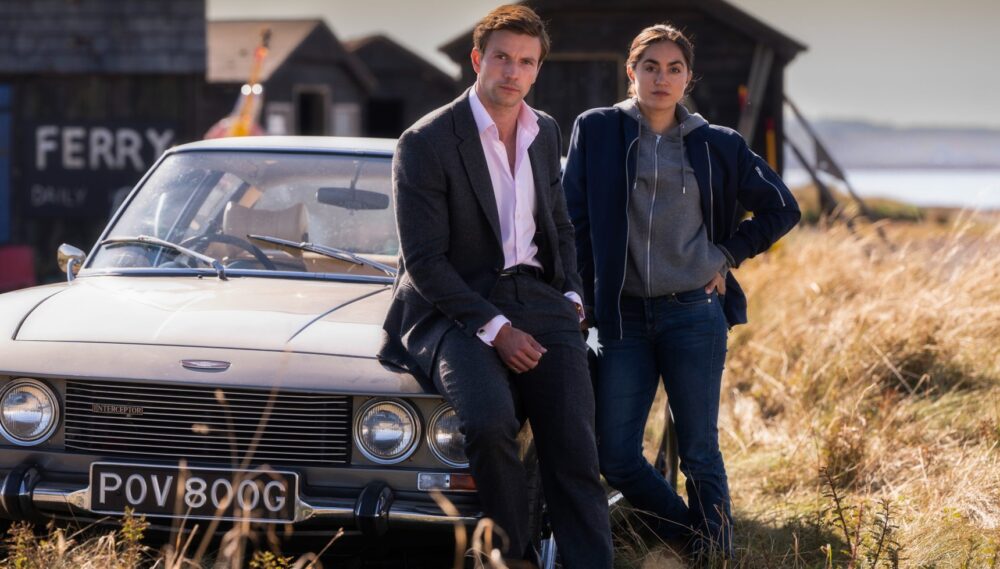
When Detective Inspector Thomas Lynley arrives at a crime scene in his vintage Jensen Interceptor, it’s not just transport—it’s a statement. This British grand tourer has become as much a character in the Inspector Lynley detective series as the aristocratic detective himself, embodying the perfect blend of British refinement and American muscle.
A British Icon with Italian Styling
The Jensen Interceptor entered production in 1966, a time when British sports cars were making their mark on the world stage. Hand-built at Jensen Motors’ Kelvin Way Factory in West Bromwich, near Birmingham, the Interceptor represented a significant departure from the company’s earlier fiberglass-bodied vehicles.
The design was penned by Italian coachbuilder Carrozzeria Touring, with early bodies built by Vignale in Milan before Jensen brought production in-house. The result was a stunning fastback coupe that married European sophistication with raw American power.
Read more about The Jensen Motor Car Company and the Jensen Interceptor on What Classic Car
The Distinctive Design
The Jensen Interceptor’s most striking feature is its large, curved wraparound rear window that doubles as a hatchback—a remarkably practical touch for such an elegant grand tourer. The design may have taken inspiration from the Brazilian Brasinca Uirapuru, but Jensen made it entirely their own.
The original specification was impressively luxurious for 1966:
- Electric windows
- Reclining front seats
- Wood-rimmed steering wheel
- Twin-speaker radio
- Reversing lights
- Electric clock
With its low beltline and handsome 2+2 design, the Interceptor looked every inch the gentleman’s express it was intended to be.
American Muscle Under the Bonnet
Jensen’s decision to fit Chrysler V8 engines proved inspired. The original 6.3-litre (383 cubic inch) V8 produced 325-330 horsepower and delivered genuinely exciting performance. When Autocar tested the Interceptor, they achieved:
- 0-60 mph in 7.3 seconds
- 0-100 mph in 19 seconds
- Top speed of 133 mph
- Quarter-mile in 15.7 seconds
These figures put it in the same performance bracket as the Aston Martin DB6, Jaguar E-Type, and Porsche 911S—impressive company for a British GT car.
Power was transmitted through Chrysler’s reliable TorqueFlite automatic transmission to a limited-slip differential at the rear wheels. While a four-speed manual option existed, only 23 were ever built with this configuration.
Evolution Through the Years
The Interceptor evolved through several iterations during its decade-long production run:
Mark I (1966-1969): The original model, with early bodies built in Italy before production moved to West Bromwich.
Mark II (1969-1971): Featured revised styling including updates to the grille and lights, plus a more comfortable interior. Around 694 right-hand drive examples were built for the UK market.
Mark III (1971-1976): Introduced a larger 7.2-litre engine and featured alloy wheels. This became the most common version.
Jensen SP (1971-1973): The ultimate Interceptor, fitted with Chrysler’s 440 cubic inch “Six Pack” engine featuring three two-barrel carburettors. This powerhouse produced 385 bhp and achieved a top speed of 147 mph, making it one of the most powerful road cars anywhere in the world at the time. Only 232 were built, identifiable by their louvred bonnets and vinyl roof panels.
A convertible version arrived in 1974, with 267 examples built before production ended in 1976. The main Jensen Factory was situated in Kelvin Lane, West Bromwich – see historical images of West Bromwich with GhostViewer.
You may also like to read – Jensen Interceptor Ultimate Portfolio 1966-1992 – available from Amazon
Inspector Lynley’s Interceptor
The Jensen Interceptor found an unlikely second life as a television star when it was chosen as the vehicle for Detective Inspector Thomas Lynley in the BBC’s adaptation of Elizabeth George’s mystery novels.
In the original “Inspector Lynley Mysteries” series (2001-2008), actor Nathaniel Parker drove a distinctive blue Jensen Interceptor Mark II through the early series. The car perfectly captured Lynley’s character—an aristocratic, Oxford-educated detective whose refined tastes and upper-class background contrasted sharply with his working-class partner, Detective Sergeant Barbara Havers.

The choice of the Interceptor was particularly apt. Like Lynley himself, the car represented British heritage powered by American muscle, elegant yet capable, refined but never pretentious.
In the brand new 2025 “Lynley” series on BritBox, the tradition continues. Actor Leo Suter drives a 1969 Jensen Interceptor Mark I, specifically a silver example with the registration POV800G (which is indeed registered with the DVLA as a 1969 Jensen Interceptor registered on 2 April 1969).
Suter himself was thrilled with his screen car: “Getting to drive the Jensen Interceptor was most certainly a highlight. There was one sequence where I got to skid across a gravel drive, which felt very exhilarating.”
The Interceptor has become so closely associated with the character that viewers frequently describe it as one of the “stars of the show,” comparing it favourably to other iconic detective cars like Gene Hunt’s Audi Quattro in “Life on Mars.”
The Jensen FF: Four-Wheel Drive Pioneer
Worth mentioning is the Interceptor’s technological tour de force sibling, the Jensen FF (Ferguson Formula). Introduced alongside the standard Interceptor in 1966, the FF featured full-time four-wheel drive and Dunlop Maxaret anti-lock brakes—technologies that wouldn’t become mainstream until Audi’s Quattro appeared nearly 15 years later in 1980.
The FF was visually similar to the Interceptor but had a 5-inch longer wheelbase, identifiable by an additional air vent on the front flanks. Despite its advanced technology, only a limited number were built, making it even rarer than the standard Interceptor today.
The End and Brief Revivals
Jensen Motors fell on hard times in 1975, hit by the global recession and problems with the Jensen-Healey sports car. The company entered receivership, and production of the Interceptor ended in 1976 when the available cache of parts was exhausted.
The Interceptor briefly returned as the Series 4 in the late 1980s, updated with a smaller Chrysler-supplied 360 cubic inch (5.9-litre) engine. Production continued until 1993 with approximately 36 cars built, though the car had lost its distinctive large rear window by this point.
Owning an Interceptor Today
For classic car enthusiasts today, the Jensen Interceptor represents a fascinating alternative to more mainstream British GTs like the Aston Martin DBS or Jaguar E-Type. Values have been steadily rising, with usable examples starting from around £30,000.
However, prospective owners should be aware of a few key points:
Rust is the enemy: Being hand-built steel cars, Interceptors are susceptible to corrosion. The chassis side beams are particularly critical and must be thoroughly inspected.
Body panels are expensive: As hand-built cars, body panels require significant adjustment to fit properly. Even simple changes like replacing a bonnet can cost around £1,000.
Earlier is better: The earlier Mark I and II models were generally better screwed together than the later Mark III cars.
Fuel consumption: Don’t expect economy—these are thirsty beasts. Many owners have fitted LPG systems to manage running costs.
The good news is that the Chrysler V8 engines are robust and parts are readily available. The TorqueFlite automatic is similarly reliable. Many Interceptors have been sensibly upgraded over the years with improved brakes or engine tuning, modifications that are generally accepted within the Jensen community.
The Detective’s Choice
The choice of a Jensen Interceptor for Inspector Lynley—both in the original series and the 2025 reboot—demonstrates the enduring appeal of this British classic. It’s a car that commands respect without being ostentatious, delivers exhilarating performance without being crude, and represents the best of British automotive ambition.
For fans of detective dramas and classic cars alike, the Jensen Interceptor has earned its place in television history. And for those of us who appreciate fine British engineering married to American power, it remains one of the most desirable GTs of the 1960s and 70s.
If you’re interested in other classic cars featured in detective series, you might enjoy exploring our comprehensive database of cozy crime TV shows where you can discover what other detectives drive, from Vera’s Land Rover Defender to Bergerac’s Triumph Roadster.
Specifications (Jensen Interceptor Mark III)
- Engine: Chrysler V8, 7.2 litres (440 cubic inches)
- Power: 280 bhp (later models, SAE net)
- Transmission: Chrysler TorqueFlite 3-speed automatic
- 0-60 mph: Approximately 7.3 seconds
- Top speed: 133 mph (standard), 147 mph (SP model)
- Wheelbase: 105 inches
- Weight: 3,500 lbs (1,575 kg)
- Production: 1966-1976 (main production run)
- Total built: Approximately 6,400 (all variants)
See Also: Detective Cars on Screen
- Harry Wild’s BMW 3 Series E30 – Jane Seymour’s red 1980s BMW from Dublin’s literary detective drama
- Inspector Morse & Endeavour Jaguars – The burgundy Mk2 and later XJ6/XJ40 synonymous with Oxford’s finest detective
- Gene Hunt’s Ford Cortina – The Sweeney-style Ford from Life on Mars
- Rosemary & Thyme’s Land Rover Series III – The gardening detectives’ practical British 4×4
- Bergerac’s Triumph Roadsters – Two different Triumph Roadsters both wearing Jersey registration J 1610
- Jonathan Creek’s Citroën 2CV – The windmill-dwelling magician’s green French minimalist runabout
- Whitstable Pearl’s 2CV Fourgonnette – The van variant of the 2CV used by Pearl’s seaside restaurant detective
- Queens of Mystery Morris Traveller – Matilda’s mother’s 1960s woodie driven in every investigation
- More Detective Cars – Explore the complete collection
- Jensen on What Classic Car
You may also like to read – Jensen Interceptor Ultimate Portfolio 1966-1992 – available from Amazon
This article is part of the Detective Cars collection on CozycrimeIndex.com – The Cars That Cozy Crime Detectives Love to Drive
