Strike (C.B. Strike)
 United Kingdom
About This Show
War veteran Cormoran Strike operates a struggling private detective agency from a cramped London office, taking on complex cases that have baffled the police, aided by his assistant Robin Ellacott, who proves far more capable than her temporary secretary role suggests. As they solve increasingly dangerous cases together, Strike battles his physical and psychological war wounds whilst an unspoken attraction grows between the mismatched pair, complicated by Robin’s engagement and Strike’s determination to keep their relationship strictly professional.
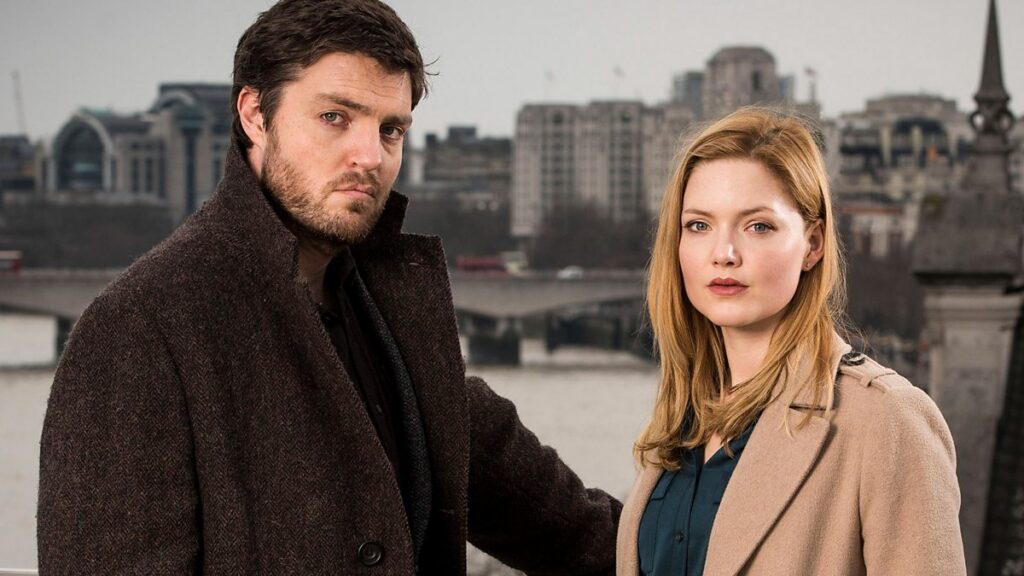
Strike (known internationally as C.B. Strike) is a British crime drama based on the detective novels by J.K. Rowling, written under the pseudonym Robert Galbraith. The series follows Cormoran Blue Strike, a former Special Investigation Branch investigator who lost part of his leg in Afghanistan and now runs a private detective agency from a shabby office above a guitar shop in London’s Denmark Street. The show premiered on BBC One in 2017 and has become one of the UK’s most-watched crime dramas, praised for its intelligent plotting, strong character development, and the compelling chemistry between its leads.
Strike himself is a complex, damaged protagonist. Large, shambling, and perpetually dishevelled, he’s the illegitimate son of legendary rock star Jonny Rokeby and Leda Strike, a beautiful model and notorious groupie who died of a heroin overdose when Strike was twenty. His chaotic childhood, spent trailing his mother through a succession of unsuitable men and temporary homes, left him emotionally guarded and mistrustful of relationships. He carries both visible and invisible scars from his military service – his prosthetic leg causes him constant pain, particularly when he pushes himself too hard during investigations, whilst the psychological trauma of combat surfaces in moments of stress.
Despite his difficulties, Strike possesses exceptional investigative skills honed through years of military police work. His background as an SIB investigator gave him expertise in dealing with complex cases, understanding human psychology, and persevering when others would give up. He approaches investigations with methodical patience, extraordinary attention to detail, and an ability to see patterns others miss. His working-class background and military experience give him access to worlds closed to more conventional detectives, whilst his famous father’s name opens doors in elite circles, though Strike himself wants nothing to do with Rokeby or his wealth.
Robin Venetia Ellacott arrives at Strike’s agency as a temporary secretary, sent by an employment agency on what should have been a brief placement. She’s engaged to her university boyfriend Matthew Cunliffe, planning a conventional life in accountancy whilst harbouring secret dreams of detective work inspired by a traumatic incident in her past. Robin is intelligent, observant, and possesses natural investigative instincts that Strike immediately recognises. She’s also warm, empathetic, and socially skilled in ways Strike isn’t, able to put witnesses at ease and extract information through genuine conversation rather than interrogation.
The dynamic between Strike and Robin forms the emotional heart of the series. What begins as employer-temporary secretary evolves into a genuine partnership, with Robin proving herself invaluable to investigations through her quick thinking, courage, and complementary skills. She brings organisation to Strike’s chaos, computer literacy to his technological incompetence, and social grace to his brusqueness. He recognises her talents, encourages her development as an investigator, and comes to rely on her professional judgment. Their working relationship is built on mutual respect, trust, and understanding that deepens with each case they solve together.
Beneath the professional partnership simmers an attraction neither can fully acknowledge. Strike, haunted by his disastrous relationship with his wealthy, mercurial ex-fiancée Charlotte Campbell Ross, is determined not to ruin his working relationship with Robin by crossing professional boundaries. Robin is committed to Matthew, though her fiancé resents her work with Strike, seeing the detective as a threat to their relationship and viewing her career aspirations as childish fantasies she should abandon. The tension between what they feel and what they can acknowledge creates ongoing emotional complexity, with near-misses, misunderstandings, and terrible timing preventing resolution.
Each series adapts one of Rowling’s novels, with the investigations ranging from the death of a supermodel to murders within the publishing world, from serial killer cases to political corruption. The mysteries themselves are intricately plotted, with multiple suspects, red herrings, and solutions that are both surprising and logically sound. Rowling’s background in creating elaborate plots serves the detective genre well, with each case requiring sustained investigation over multiple episodes rather than neat resolution within an hour.
The cases often explore different strata of British society, from the super-wealthy world of fashion and celebrity to working-class communities, from literary circles to criminal underworlds. Strike and Robin’s investigations take them across London and beyond, showcasing contemporary Britain in all its complexity. The series doesn’t shy away from depicting the darker aspects of society – violence, exploitation, misogyny, and the damage inflicted by poverty and privilege alike feature prominently in the cases they investigate.
Strike’s personal life provides ongoing subplot and character development. His complicated relationship with his famous father, whom he refuses to acknowledge publicly, creates occasional complications when investigations intersect with the celebrity world. His half-sister Lucy, happily married with children, represents the conventional life Strike can never have, loving her brother but unable to understand his choices. His on-again, off-again relationship with the beautiful, unstable Charlotte haunts him, her manipulations and cruelty having left deep emotional scars that affect his ability to trust and open himself to new relationships.
Robin’s personal life proves equally complicated. Her relationship with Matthew deteriorates as her career develops, with her fiancé becoming increasingly controlling and resentful. He sees Strike as the problem rather than recognising that Robin has found her true calling in detective work. Matthew’s passive-aggressive behaviour, his attempts to undermine Robin’s confidence, and his jealousy of her partnership with Strike create mounting tension. The series explores how Robin must choose between the life she planned and the life she’s discovered she actually wants, between security and fulfilment, between who she thought she should be and who she’s becoming.
The supporting cast includes various police contacts, Strike’s small team of subcontractors, and the rotating cast of clients, suspects, and witnesses each case requires. Detective Inspector Eric Wardle maintains a useful if occasionally strained relationship with Strike, recognising his abilities whilst resenting civilian interference in police investigations. Strike’s secretary Pat Chauncey, elderly and perpetually disapproving, provides sardonic commentary and unexpected loyalty. As the series progresses and the agency grows, additional investigators join the team, expanding the dynamics whilst maintaining focus on the central partnership.
Tom Burke brings remarkable depth to Strike, making him simultaneously formidable and vulnerable. His physical performance captures Strike’s constant pain, the way he moves differently when tired or stressed, the toll his prosthetic leg takes. Burke also conveys Strike’s intelligence, his humour, his capacity for kindness despite his gruffness, and the loneliness beneath his self-sufficient exterior. He makes Strike someone viewers root for even when he’s being difficult, stubborn, or emotionally obstructive.
Holliday Grainger matches him perfectly as Robin, playing her initial uncertainty giving way to growing confidence without losing the character’s essential warmth and decency. Grainger shows Robin’s development from capable assistant to skilled investigator, her increasing comfort with the dangerous aspects of detective work, and her growing frustration with the limitations others try to impose on her. The chemistry between Burke and Grainger is palpable, creating a “will they, won’t they” dynamic that sustains across multiple series without becoming tiresome because both characters have legitimate reasons for maintaining professional boundaries.
The production values are consistently high, with London beautifully filmed across seasons and weather conditions. Denmark Street, where Strike’s office is located, becomes a character itself – the cramped office above the guitar shop, the narrow stairs Strike struggles with, the proximity to the bustle of Tottenham Court Road. The series captures contemporary London authentically, from its grandest locations to its grimmest, showing a city of stark contrasts where extreme wealth and poverty exist side by side.
The tone balances serious crime drama with character-driven storytelling. The investigations are genuinely dark, dealing with murder, abuse, and human cruelty without sensationalising violence. The series doesn’t shy away from showing the toll detective work takes – the physical danger, the emotional burden of dealing with victims and their families, the frustration of dead ends and uncooperative witnesses. Yet it also finds moments of humour, warmth, and hope, primarily through the developing relationship between Strike and Robin and their evident care for each other despite complications.
The series has been compared favourably to classic British detective shows, particularly Inspector Morse, sharing a similar tone of melancholic intelligence, complex characterisation, and substantial running time allowing for properly developed mysteries. Like Morse, Strike explores not just who committed crimes but why, delving into character psychology and social context. The comparison is apt, with both series demonstrating that British crime drama can be intellectually rigorous, emotionally engaging, and thoroughly entertaining without resorting to gratuitous violence or procedural formula.
What distinguishes Strike from many detective series is its commitment to long-form storytelling. Each novel adaptation runs across multiple feature-length episodes, allowing the investigation to unfold at a realistic pace with proper development of suspects, witnesses, and the investigative process. This also permits substantial focus on Strike and Robin’s personal lives, showing how their cases affect them and how their developing relationship influences their work. The series understands that viewers invest in characters as much as mysteries, that watching Strike and Robin navigate their complicated feelings is as compelling as watching them solve murders.
The show has achieved remarkable success, with the most recent series averaging over eight million viewers. Critical reception has been overwhelmingly positive, with particular praise for Burke and Grainger’s performances, the faithful adaptation of Rowling’s complex plots, and the series’ visual style and production quality. The show has won multiple awards and continues to be one of the BBC’s most reliable drama hits.
Six series have aired to date, adapting The Cuckoo’s Calling, The Silkworm, Career of Evil, Lethal White, Troubled Blood, and The Ink Black Heart. A seventh series adapting The Running Grave is currently in production, confirming the show’s ongoing success and the creators’ commitment to adapting the entire novel series. Each adaptation has built upon previous entries, developing the characters whilst maintaining the quality of the mysteries and the compelling central relationship.
Ultimately, Strike succeeds because it understands that the best detective fiction is about much more than solving crimes. It’s about the detectives themselves, their damage and resilience, their relationships and growth. Strike and Robin are fully realised characters whose professional partnership and personal connection provide the series’ emotional foundation. The mysteries are clever and satisfying, but viewers return for the people solving them, for the slowly developing relationship that seems simultaneously inevitable and impossible, for two damaged people finding purpose, partnership, and perhaps eventually something more in each other’s company. The series demonstrates that classic detective fiction can thrive in contemporary television when given proper time, strong source material, talented actors, and creators committed to both plot and character in equal measure.

Locations
Setting
- London, United Kingdom
Main cast
Highlighted actors have their own page listing every show they appear in.








Character Tracker
Only shows characters you’ve met so far!
🔒 More characters will unlock as you update your progress
Credits and More
Credits
J.K. Rowling
📚 Related Books, DVDs and Merchandise
[azp_custom_product id=”15″]
Similar Shows
Shows with similar vibes and style