Detective Sergeant Matilda “Mattie” Stone returns to her hometown of Wildemarsh to work for the local constabulary, where she’s reunited with her three crime-writing aunts who raised her after her mother’s mysterious disappearance. Between investigating murders that range from the curious to the bizarre, the three aunts also attempt to help their perennially single niece find love. At the same time, Mattie struggles to keep the well-meaning amateur sleuths from interfering in her investigations. Here’s more about Matilda Stone’s Morris Traveller.
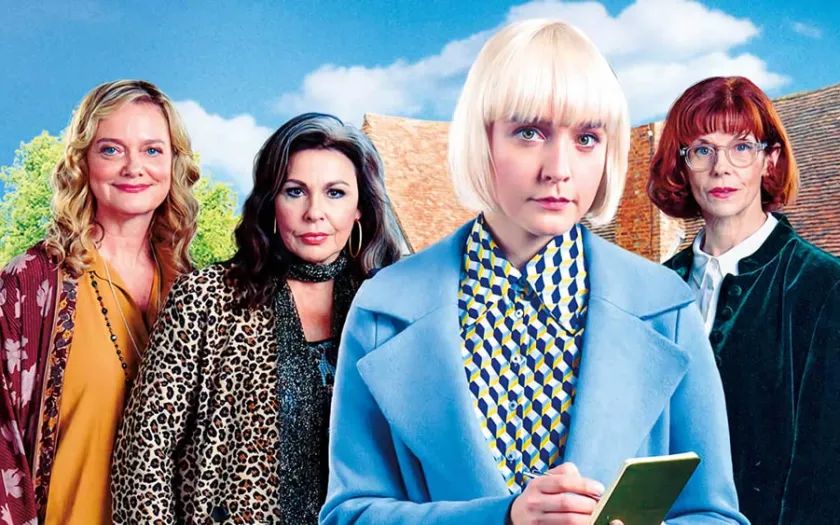
Queens of Mystery is a whimsical British murder-mystery comedy-drama that follows Detective Sergeant Matilda “Mattie” Stone, a 28-year-old detective assigned to the constabulary in her fictional hometown village of Wildemarsh, England. There she finds herself working alongside – or more accurately, attempting to work around – her three beloved but meddlesome aunts: Beth, Cat, and Jane Stone, all successful crime writers who raised Mattie after her mother Eleanor’s unexplained disappearance when she was young.
The series was created by Julian Unthank and originally starred Olivia Vinall as Matilda in Series 1, with Florence Hall taking over the role in Series 2. The show is notable for its distinctive storytelling style, featuring a fairy-tale-style omniscient narrator voiced by Juliet Stevenson pop-up storybook graphics, and a tone that balances dark comedy with genuine warmth.
The three Stone sisters represent different subgenres of crime fiction through their writing. Beth Stone, the eldest and most commercially successful, writes traditional whodunits featuring Iris Freeman, an inner-city vicar detective. Cat Stone, the middle sister, creates graphic novels about Roxanne Parker, a music industry fixer. Jane Stone, the youngest, pens futuristic crime novels featuring Henry Lambert, an android police detective. Each aunt brings their specific expertise – and fictional detective’s methodology – to bear on the real murders that plague Wildemarsh with alarming frequency.
The dynamic between Mattie and her aunts forms the comedic heart of the series. Despite her police training and professional authority, Mattie finds herself constantly outmanoeuvred by three women who’ve spent decades plotting perfect murders on paper. The aunts, armed with their encyclopaedic knowledge of crime fiction tropes and motivated by genuine affection for their niece, cannot resist involving themselves in her cases. They spot clues Mattie misses, interview witnesses under the guise of research, and generally make nuisances of themselves whilst simultaneously proving invaluable to solving the crimes.
What distinguishes Queens of Mystery is its celebration of sisterhood and female friendship across generations. The three aunts, each having experienced their own romantic tragedies – Beth lost her husband to illness, Cat’s love Nikki Holler died young, and Jane harbours unspoken feelings – channel their experiences into both their fiction and their determination to help Mattie avoid similar heartbreak. Their well-intentioned matchmaking attempts add romantic comedy to the murder mystery framework, particularly regarding Dr. Daniel Lynch, the local coroner with whom Mattie shares mutual but complicated attraction.
The show’s setting in Wildemarsh is quintessentially English – picturesque villages, grand country houses, quirky local festivals, and a literary culture that permeates everything. Murders occur at crime writers’ festivals, art galleries, wellness retreats, theatre productions, and recording studios, allowing the series to explore various creative worlds whilst maintaining its cosy mystery aesthetic. The production showcases beautiful Kent countryside locations, with charming village greens, ancient churchyards, and elegant period architecture providing the backdrop for increasingly bizarre murders.
Inspector Derek Thorne, Mattie’s boss, provides both professional tension and unexpected romantic subplot. Initially appearing as the stereotypical obstructive superior officer who resents amateur interference, he’s revealed to be hopelessly in love with Aunt Jane, creating a parallel romance storyline that adds depth and sympathy to his character. His struggle to balance professional standards with personal feelings mirrors Mattie’s own challenges working in her hometown surrounded by family.
The overarching mystery of Eleanor Stone’s disappearance threads through the series, creating ongoing narrative tension beneath the episodic murder investigations. It becomes increasingly clear that the entire town, including her own sisters, is conspiring to keep Mattie from discovering the truth about her mother. This conspiracy isn’t malicious but protective – the aunts believe some secrets are better left buried, that Mattie is happier not knowing whatever dark truth surrounds Eleanor’s vanishing. Yet Mattie’s detective instincts and need for closure drive her to pursue answers despite mounting resistance from everyone she loves.
The series is remarkably meta-textual, filled with literary references, crime fiction in-jokes, and commentary on the genre itself. The aunts’ fictional detectives reflect real detective archetypes, and the murders they investigate often mirror classic mystery plots whilst adding contemporary twists. The show celebrates the tradition of British cosy mysteries whilst gently satirising their conventions – acknowledging the absurdity of small villages with improbable murder rates whilst committing fully to the premise.
Juliet Stevenson’s narration elevates the material significantly, providing wry observations, character insights, and occasionally unreliable commentary that adds layers of meaning. Her voice guides viewers through flashbacks, reveals inner thoughts (particularly Derek Thorne’s unspoken feelings), and creates the storybook atmosphere that distinguishes Queens of Mystery from standard procedurals. The narration, combined with the animated pop-up graphics that appear during scene transitions, gives the show a unique visual and narrative style.
The tone balances multiple registers successfully. The murders themselves are treated seriously enough to provide genuine mystery and occasional darkness, but the show never becomes grim. Instead, it maintains a lightness of touch, finding humour in the aunts’ interference, the clash between their fictional methodologies and real police work, and the various eccentricities of Wildemarsh’s residents. The comedy is character-driven rather than farcical, emerging naturally from the situations and relationships.
Each series consists of three separate stories split across two 45-minute episodes, allowing for more complex plotting than standard episodic television whilst maintaining accessibility. Individual stories can stand alone, but watching in order rewards viewers with ongoing character development and progression of the Eleanor Stone mystery. The format also allows each story to focus on a different aunt, exploring their particular expertise and past whilst advancing the overall narrative.
Queens of Mystery addresses themes of family, secrets, the relationship between fiction and reality, and how we construct narratives to make sense of loss. The aunts write crime fiction as a way of processing grief and imposing order on a chaotic world that took their sister from them. Their determination to shield Mattie from painful truths reflects both protective love and their own inability to face what they know. The show asks whether it’s better to live with comfortable mysteries or pursue uncomfortable truths.
The series also explores female professional identity and the challenges of being taken seriously in traditionally male-dominated fields. Mattie faces the double burden of proving herself as a young detective whilst battling perceptions that she’s merely an extension of her famous aunts. Her determination to solve cases on her own terms, without amateur assistance, reflects her need to establish an independent identity separate from her family’s literary fame. Yet the show ultimately argues that accepting help isn’t weakness, that the aunts’ insights – born from years of studying human nature and criminal psychology for their fiction – genuinely complement Mattie’s police training.
The romantic subplot, whilst secondary to the mysteries, is handled with intelligence and restraint. Mattie’s love life isn’t the focus, but neither is it dismissed as unimportant. Her attraction to Dr. Lynch develops naturally through professional interaction, complicated by his existing relationship and her own emotional guardedness stemming from abandonment issues. The show resists easy resolutions, acknowledging that romance is messy and timing matters as much as compatibility.
Queens of Mystery was compared favourably with Pushing Daisies by The New York Times for its whimsical tone and fairy-tale aesthetic, whilst TV critics noted similarities to Murder, She Wrote in its cosy mystery approach. The comparison is apt – like Murder, She Wrote, Queens of Mystery provides comfort viewing, satisfying mysteries, and characters viewers want to spend time with, all wrapped in an aesthetic that celebrates rather than apologises for its genre roots.
Ultimately, Queens of Mystery succeeds by fully committing to its premise whilst adding enough wit, heart, and visual style to transcend simple cosy mystery pastiche. It’s a love letter to crime fiction written by people who genuinely understand and appreciate the genre, performed by actors who bring depth to potentially one-note roles, and structured to provide both immediate satisfaction and long-term narrative reward. The show demonstrates that cosy mysteries can be intelligent, visually inventive, and emotionally resonant whilst still delivering the essential pleasures of the genre – clever plots, charming characters, and the reassurance that order can be restored even in the face of chaos and murder.
Yes, just Register and you will then be able to add notes to every character. Just click/tap on the character. The notes can only be seen by you (when you are Logged In)
 United Kingdom
 United Kingdom