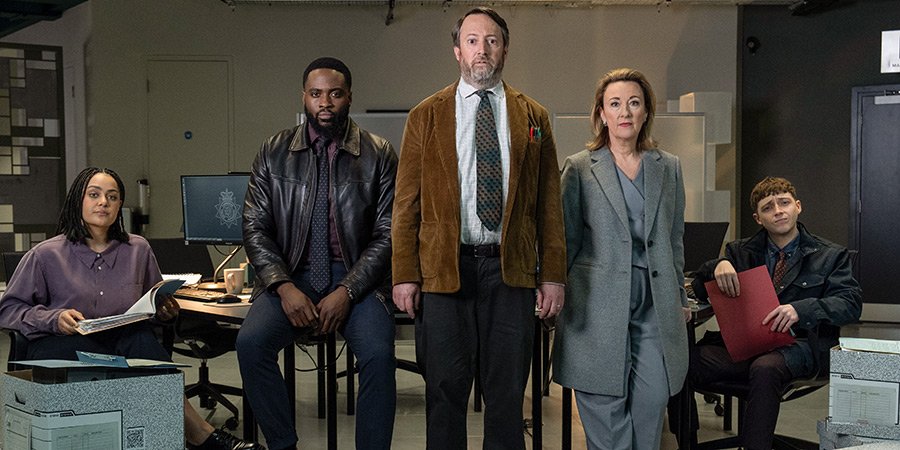
Ludwig
 United Kingdom
About This Show
When reclusive puzzle-setter John “Ludwig” Taylor’s identical twin brother, DCI James Taylor, mysteriously disappears, John reluctantly agrees to impersonate him and infiltrate Cambridge’s major crimes squad to search for clues about his whereabouts. Despite being a complete luddite with no police experience, technology, or social skills, John discovers that solving murders is remarkably similar to designing cryptic crosswords, using his puzzle-making genius to crack impossible cases whilst desperately trying to maintain his brother’s identity and find out what happened to him. Also check out – Cambridge: Colleges, Criminologists, and Cozy Crime
Ludwig is a brilliantly inventive British comedy-drama that premiered on BBC One in September 2024, becoming the broadcaster’s biggest new scripted series since 2022 with 9.5 million viewers across its first 28 days. Created by Mark Brotherhood specifically for comedian David Mitchell, the series combines classic detective fiction with clever comedy and genuine heart, creating something that feels both comfortingly familiar and refreshingly original.
John “Ludwig” Taylor is a renowned puzzle-setter who designs cryptic crosswords under the pseudonym Ludwig. He’s also profoundly reclusive, living a meticulously ordered life without modern technology, social media, or even a television. He’s never married, never had a family, and rarely ventures beyond his front door. John is content in his solitude, surrounded by books, puzzles, and the routines that keep his anxiety manageable. He represents a particular type of British eccentricity – brilliant but awkward, principled but pedantic, capable of extraordinary intellectual feats but utterly flummoxed by ordinary human interaction.
John’s carefully controlled world shatters when his identical twin brother James mysteriously disappears. Detective Chief Inspector James Taylor is everything John isn’t – outgoing, charismatic, successful in his career, happily married with a teenage son. The brothers have been estranged for years, their relationship distant despite their identical appearance. When James vanishes without explanation, his wife Lucy turns to the only person who could possibly help in the most audacious way imaginable – by asking John to impersonate James and infiltrate the police force to investigate from the inside.
Lucy Taylor, brilliantly played by Anna Maxwell Martin, is far more than the typical worried wife. She’s John’s oldest friend, having known him since childhood, understanding both his genius and his limitations. Lucy is practical, determined, and willing to engage in significant deception to find her husband. Her relationship with John provides the emotional core of the series – they share genuine affection, history, and trust, making their conspiracy believable despite its outrageous premise. Lucy acts as John’s handler, helping him navigate the social and procedural aspects of police work that would otherwise immediately expose him.
The central conceit requires considerable suspension of disbelief. Could an antisocial puzzle-maker with no police training successfully impersonate an experienced DCI leading a major crimes team? Absolutely not. But the series commits so fully to the premise, and Mitchell plays it with such conviction, that viewers willingly accept the impossibility because the results are so entertaining. The show cleverly addresses the absurdity through John’s constant near-misses, his reliance on puzzle-solving logic rather than police procedure, and his team’s occasional bemusement at their suddenly peculiar boss’s new methods.
Each episode follows a dual structure. John must solve a seemingly impossible murder presented to the major crimes team whilst simultaneously investigating clues about James’s disappearance. The murders are ingeniously constructed around different types of puzzles – spot-the-difference, reverse chess problems, architectural enigmas, musical codes – allowing John to apply his puzzle-setting expertise to detective work. When traditional police methods reach dead ends, John’s unique perspective reveals patterns and solutions invisible to conventional thinking.
The Cambridge setting provides beautiful locations and appropriately academic atmosphere. The historic university city, with its ancient colleges, mathematical traditions, and intellectual heritage, suits both the cerebral nature of the mysteries and John’s bookish personality. The production showcases Cambridge’s architectural splendour whilst grounding the action in realistic police environments – the contrast between dusty libraries and clinical crime scenes mirrors John’s dual existence.
John’s police team unknowingly enables his deception through their interpretations of his odd behaviour. DCI Russell Carter, played by Dipo Ola, becomes John’s closest colleague and inadvertent protector. Russell is sensible, competent, and loyal to the man he believes is his boss and friend. The growing friendship between John and Russell adds poignancy – John genuinely likes Russell but must constantly deceive him. Russell occasionally questions John’s strange new methods or personality quirks but attributes them to stress or eccentricity rather than suspecting imposture.
DS Alice Finch, ambitious and sharp, represents a potential threat to John’s deception. She’s capable enough to notice inconsistencies but also ambitious enough to focus on career advancement rather than investigating her superior. DC Simon Evans, young and eager, provides comic relief through his hero worship of “James” and complete obliviousness to anything being amiss. DCS Carol Shaw, icy and formidable, oversees the team with efficiency and occasional suspicion, keeping John on constant alert.
David Mitchell delivers an exceptional performance that ranks among his finest work. Best known for comedy partnerships and panel show appearances, Mitchell demonstrates impressive dramatic range whilst maintaining the dry humour that’s his trademark. He makes John’s social awkwardness authentic rather than merely comic, showing the genuine anxiety beneath the pedantic exterior. Mitchell excels at physical comedy – John’s uncomfortable body language, his stiff interactions with colleagues, his visible panic when situations require spontaneous social skills he doesn’t possess.
The comedy emerges naturally from character and situation rather than forced jokes. John’s literal interpretation of idioms, his inability to engage in casual conversation, his horror at office birthday celebrations, his complete bafflement by modern police technology – all feel true to character whilst being genuinely funny. Mitchell’s timing is impeccable, whether delivering deadpan observations or reacting with barely concealed panic to social demands.
Anna Maxwell Martin matches him perfectly, creating a Lucy who’s simultaneously exasperated and affectionate toward John. Their lifelong friendship feels authentic, built on shared history and genuine understanding. Maxwell Martin shows Lucy’s own stress – she’s missing her husband, lying to her son, and managing an increasingly complicated conspiracy – whilst maintaining the warmth and humour that make her relationship with John so appealing. The chemistry between Mitchell and Maxwell Martin carries the series, their ease together making even the most improbable scenarios believable.
The overarching mystery of James’s disappearance provides ongoing tension and narrative drive. Clues emerge gradually, suggesting conspiracy, corruption, or danger. John’s investigation reveals that James may have uncovered something significant shortly before vanishing. The resolution of this mystery arc extends beyond the first series, ensuring ongoing storylines whilst allowing each episode’s murder to resolve satisfyingly.
The writing by Mark Brotherhood is exceptionally clever, balancing comedy and drama whilst creating genuinely engaging mysteries. The dialogue crackles with wit, the plots are intricately constructed, and the character work is surprisingly deep for what could have been merely a high-concept comedy. Brotherhood clearly understands both detective fiction conventions and how to subvert them intelligently. The puzzles themselves are beautifully integrated, allowing viewers to potentially solve them alongside John whilst not requiring puzzle expertise to enjoy the series.
The series also explores themes of isolation, anxiety, and personal growth. John’s reclusiveness stems from genuine social anxiety and difficulty navigating a world that seems chaotic and incomprehensible. His ordered existence, whilst limiting, protects him from overwhelming stimuli and unpredictable human behaviour. Being forced into impersonating James – into constant social interaction, unpredictable situations, and genuine connections with colleagues – challenges John profoundly but also reveals capabilities he didn’t know he possessed.
The show treats John’s anxiety respectfully, never mocking his limitations whilst showing how stepping outside his comfort zone, though terrifying, proves ultimately rewarding. He forms genuine friendships with Russell and his team, discovers he can solve problems beyond puzzles, and reconnects with Lucy and his nephew Henry in meaningful ways. The series suggests that growth requires discomfort but that the connections formed through vulnerability are worth the anxiety they provoke.
The production values are excellent, with stylish direction that uses visual techniques to illustrate John’s thought processes. When solving puzzles, the screen might display crossword grids, chess problems, or architectural drawings overlaying crime scenes, showing viewers how John’s mind translates detective work into familiar puzzle-solving frameworks. These sequences are both explanatory and visually engaging, making John’s genius accessible rather than mystifying.
The series received overwhelmingly positive critical reception, with a 97% rating on Rotten Tomatoes. Critics praised Mitchell’s performance, the clever writing, the warm humour, and the show’s success in balancing comedy with genuine mystery. The series won the Best Comedy Programme category at the 2025 Broadcast Awards and received multiple other nominations including at the BAFTAs, confirming its status as both critical and commercial success.
Guest stars including Dame Felicity Kendal and Sir Derek Jacobi add prestige and allow for delightful cameos that enhance individual episodes without overwhelming the core cast. The episodic structure means each week brings new suspects, victims, and settings whilst the ongoing arc provides continuity and investment in long-term storytelling.
A second series was quickly commissioned following the first series’ success, with filming commencing in September 2025. The renewal confirms that the mystery of James’s disappearance will continue, allowing for extended exploration of the premise and further development of John’s character and relationships. Additional cast members including Mark Bonnar and Sian Clifford join the ensemble, suggesting expanded storylines and new complications for John’s deception.
Ludwig represents the best of British television’s ability to take a high-concept premise and execute it with intelligence, wit, and heart. It succeeds as detective fiction, offering genuinely engaging mysteries with fair clues and satisfying solutions. It works as comedy, providing consistent laughs through character rather than gags. It functions as character study, showing a deeply anxious man forced into situations that terrify him discovering unexpected strengths and forming meaningful connections. And it delivers as entertainment, creating compelling television that works on multiple levels.
The series demonstrates that traditional detective formats can still feel fresh when approached with invention and commitment. It proves that comedy and drama needn’t be separate genres but can enhance each other when properly balanced. And it confirms that David Mitchell, often typecast as a particular kind of comedian, possesses dramatic range and leading man qualities that deserve showcasing.
Ultimately, Ludwig succeeds because it understands that the best detective fiction is about much more than solving crimes. It’s about character, about how investigations challenge and change the detectives, about the relationships formed through shared purpose. John Taylor’s journey from isolated puzzle-maker to reluctant detective to someone discovering the value of human connection provides the emotional foundation that elevates Ludwig beyond clever premise into genuinely affecting television. The mysteries entertain, the comedy delights, but it’s watching a brilliant but isolated man learn to connect with others whilst searching for his missing brother that makes Ludwig not just good television but something special.

Locations
Setting
- Cambridge, United Kingdom — Fictional Cambridge Police Authority / major crimes squad See Cambridge, United Kingdom then and now on GhostViewer →
Filmed in
- Cambridge, Cambridgeshire, United Kingdom — January 2024 location filming: St John’s College, Queens’ College, Mathematical Bridge, Bridge of Sighs, River Cam, Silver Street, Queens’ Lane See Cambridge, Cambridgeshire, United Kingdom then and now on GhostViewer →
- Hertfordshire and Surrey, United Kingdom (Moor Park Mansion (Rickmansworth) = “Bryce Manor” (ep. 2); 2 The Square, Stockley Park = police station; St James Senior Boys’ School, Ashford = school (ep. 5)) See Hertfordshire and Surrey, United Kingdom then and now on GhostViewer →
Books, DVD & streaming
Main cast
Highlighted actors have their own page listing every show they appear in.







Character Tracker
Only shows characters you’ve met so far!
🔒 More characters will unlock as you update your progress
Credits and More
Credits
Ludwig is created and written by Mark Brotherhood
Mark Brotherhood
🔗 External Links
Similar Shows
Shows with similar vibes and style